Friday, November 30, 2007
Fourth of July Parade - 1897
The Jamaica Plain Carnival Association was responsibe for the yearly Fourth of July celebration. In the years before Jamaica Pond was used for the day's events, that meant a parade. And these people were'nt shy about laying out a parade, as you'll see in the route below. We might wonder at what happened to the enthusiasm these people displayed. The only parade I remember in Jamaica Plain was the Memorial Day parade from the Monument to Forest Hills cemetery if I get it right. I know it went down South street. In any case it was a solemn affair, far from the celebration described below.
Boston Daily Globe July 6, 1897
Fun At Jamaica Plain.
Parade Was a Pageant Worthy of the Carnival Association, and Delighted Many Thousands.
The citizens of Jamaica Plain did themselves proud yesterday in their celebration of the Fourth, and the carnival association scored a grand triumph.
The monster parade in the morning was a big success and was one of the best of the kind ever given in Boston. The procession was about three miles long but it took more than an hour for it to pass a given point. Starting at the Soldier's monument, on Centre st, the parade passed through the principal streets of Jamaica Plain, Boylston and Egleston Square.
It was a gain day for the residents of the section and many of the residences along the route were profusely and handsomely decorated for the occasion.
Police station 13, on Seaverns av, was hid behind a mass of bunting and flags, and the engine house on Centre st was also prettily decorated.
At the Jamaica club it was a day memorable in the organization's history. The spacious clubhouse at the corner of Green and Rockview sts was the finest decorated of any section. The exterior was covered with the national colors, while from the tip of the 70-foot flagpole just erected floated Old Glory. Inside the decorations were unusally pretty, there being a profusion of palms and potted plants and bunting.
The club kept open house all day, with its noted hospitality, nearly 400 being entertained. Among the guests were the Kearsarge veterans, the Cambridge military band and the newspaper men. The parade was viewed by the guests from the beautiful lawn. A pleasing feature was an address by Lieut Abbott of the Kearsarge veterans, who thanked the club for its sociability. Mr A.H. Stephenson responded in behalf of the club.
Features Were Good.
At 9 chief marshal S.D. Balkam gave the word, and the bicycle brigade under C.A. Underwood, swung into Centre st, between a solid mass of spectators, which lined the sidewalks.
Passing down Green st the procession was viewed at the Bowditch school by the judges, Senator W.W. Davis of Roxbury, Representative A.A. Maxwell and Rev L.W. Lott and Dr Joseph Stedman of Jamaica Plain, and W.S. Hurlburt of Cambridge.
The route traversed was as follows: Centre, Green, Washington, Atherton, Amory, Boylston, Lamartine, Mozart and Chestnut sts, Wyman av, Wyman Centre and Pond sts, Jamaica way, countermarching, Burroughs and Centre sts, Seaverns av, Alveston, Revere and Elm sts, Greenough av and Eliot st to the parkway.
The features were all good, and the judge had difficulty in picking the winners.
The bicycle division was composed wholly of clubs and individuals on wheels.
The Jogalong club had a pretty and artistic feature, a liberty bell made in red and white, suspended from a framework erected on four wheels. The memebers wore continental costumes.
The Suffolk cycle club turned out the largest number and made a fire appearance. "Darktown's military cycle corps," by the Jamaica cycle club, was a very warlike body, and elicited much applause.
The Ladies' Eliot club attracted attention by its neat showing.
The remainder of the division was made up of groups and individuals.
Children Applauded.
The first division was composed of the veterans, Sons of Veterans and barges with school children. The latter had decorated the barges in a very pretty manner.
All along the route the children received the applause of the spectators.
Composed of floats, the second division was the most attractive of the procession. It was led by a barouche, prettily decorated and entitled "Patriotic Belles." The occupants were Misses Helen Atwood, Cecelia Barrows, L. Bliss, Elizabeth W. O'Connell and Lucy Taylor.
The exhibit of the Jamaica Plain News, "Franklin's old printing office," in which there was an old press once used by that statesman, attracted considerable attention.
The Roxbury Catholic association had two floats, one representing the signing of the declaration of independence and the other a minstrel troupe. The latter had a piano, banjo and all the equiptment of a troupe. The latter delighted all by their excellent singing of minstrel songs.
A clever feature was that of Fred Bieller[sp] and Robert Weiz, a hit on the Hawaiian question. It was "United States and Japan fishing for Hawaii." Representatives of each nation were on horseback, riding back on a representation of Hawaii, with fishing poles trying to catch her.
Louise Lonsler[sp] as a Fiji dancing girl was good.
The battle between Monitor and Merrimac was also a fine feathre.
The personage to attract the most attention was his majesty The Globe, who took a drive to Jamaica Plain to celebrate the day. The spectators greeted their well-known and popular friend with hearty applause.
The third, or trades division was very interesting, and was the longest of any.
It was the last division - the horribles - that caught the eyes of the young people, and it was a unique affair.
[next came a Prizes Awarded section]
Boston Daily Globe July 6, 1897
Fun At Jamaica Plain.
Parade Was a Pageant Worthy of the Carnival Association, and Delighted Many Thousands.
The citizens of Jamaica Plain did themselves proud yesterday in their celebration of the Fourth, and the carnival association scored a grand triumph.
The monster parade in the morning was a big success and was one of the best of the kind ever given in Boston. The procession was about three miles long but it took more than an hour for it to pass a given point. Starting at the Soldier's monument, on Centre st, the parade passed through the principal streets of Jamaica Plain, Boylston and Egleston Square.
It was a gain day for the residents of the section and many of the residences along the route were profusely and handsomely decorated for the occasion.
Police station 13, on Seaverns av, was hid behind a mass of bunting and flags, and the engine house on Centre st was also prettily decorated.
At the Jamaica club it was a day memorable in the organization's history. The spacious clubhouse at the corner of Green and Rockview sts was the finest decorated of any section. The exterior was covered with the national colors, while from the tip of the 70-foot flagpole just erected floated Old Glory. Inside the decorations were unusally pretty, there being a profusion of palms and potted plants and bunting.
The club kept open house all day, with its noted hospitality, nearly 400 being entertained. Among the guests were the Kearsarge veterans, the Cambridge military band and the newspaper men. The parade was viewed by the guests from the beautiful lawn. A pleasing feature was an address by Lieut Abbott of the Kearsarge veterans, who thanked the club for its sociability. Mr A.H. Stephenson responded in behalf of the club.
Features Were Good.
At 9 chief marshal S.D. Balkam gave the word, and the bicycle brigade under C.A. Underwood, swung into Centre st, between a solid mass of spectators, which lined the sidewalks.
Passing down Green st the procession was viewed at the Bowditch school by the judges, Senator W.W. Davis of Roxbury, Representative A.A. Maxwell and Rev L.W. Lott and Dr Joseph Stedman of Jamaica Plain, and W.S. Hurlburt of Cambridge.
The route traversed was as follows: Centre, Green, Washington, Atherton, Amory, Boylston, Lamartine, Mozart and Chestnut sts, Wyman av, Wyman Centre and Pond sts, Jamaica way, countermarching, Burroughs and Centre sts, Seaverns av, Alveston, Revere and Elm sts, Greenough av and Eliot st to the parkway.
The features were all good, and the judge had difficulty in picking the winners.
The bicycle division was composed wholly of clubs and individuals on wheels.
The Jogalong club had a pretty and artistic feature, a liberty bell made in red and white, suspended from a framework erected on four wheels. The memebers wore continental costumes.
The Suffolk cycle club turned out the largest number and made a fire appearance. "Darktown's military cycle corps," by the Jamaica cycle club, was a very warlike body, and elicited much applause.
The Ladies' Eliot club attracted attention by its neat showing.
The remainder of the division was made up of groups and individuals.
Children Applauded.
The first division was composed of the veterans, Sons of Veterans and barges with school children. The latter had decorated the barges in a very pretty manner.
All along the route the children received the applause of the spectators.
Composed of floats, the second division was the most attractive of the procession. It was led by a barouche, prettily decorated and entitled "Patriotic Belles." The occupants were Misses Helen Atwood, Cecelia Barrows, L. Bliss, Elizabeth W. O'Connell and Lucy Taylor.
The exhibit of the Jamaica Plain News, "Franklin's old printing office," in which there was an old press once used by that statesman, attracted considerable attention.
The Roxbury Catholic association had two floats, one representing the signing of the declaration of independence and the other a minstrel troupe. The latter had a piano, banjo and all the equiptment of a troupe. The latter delighted all by their excellent singing of minstrel songs.
A clever feature was that of Fred Bieller[sp] and Robert Weiz, a hit on the Hawaiian question. It was "United States and Japan fishing for Hawaii." Representatives of each nation were on horseback, riding back on a representation of Hawaii, with fishing poles trying to catch her.
Louise Lonsler[sp] as a Fiji dancing girl was good.
The battle between Monitor and Merrimac was also a fine feathre.
The personage to attract the most attention was his majesty The Globe, who took a drive to Jamaica Plain to celebrate the day. The spectators greeted their well-known and popular friend with hearty applause.
The third, or trades division was very interesting, and was the longest of any.
It was the last division - the horribles - that caught the eyes of the young people, and it was a unique affair.
[next came a Prizes Awarded section]
Curtis Hall: Nuisance.
Evidently, the old Curtis Hall was Party Central at the turn of the 20th Century. Just a few years later, the building would burn and be replaced by the current Curtis Hall. Read about the fire here.
Boston Daily Globe May 3, 1901
Protest To The Mayor.
Residents in the Vicinity of Curtis Hall, Jamaica Plain, Object to its Promiscuous Use and the Noise.
A movement has been started in protest against the promiscuous letting by the city of Boston of Curtis hall, South st, Jamaica Plain.
The letting of this hall is now done through the building department. Being situated on the main street on the line of the Jamaica Plain electric cars, it is easy of access to parties from all sections as far north as Roxbury, and about as convenient to parties from the South End.
It is only recently that the use of this hall has become general among organizations outside of West Roxbury. The low rate at which it can be engaged has been one cause of its recent popularity. During the past winter it has been in almost constant nightly use by dancing parties and for other forms of entertainment. Many of these parties have been continued until the morning hours, and the noise and shouting incident upon the breaking up of the dances has been a source of much annoyance to those living in the neighborhood.
The character of these gatherings has not always been of the highest, it is alleged, and the recent holdup of conductor Myers of the Boston elevated railway, when he was brutally assaulted and robbed by a crowd going home from one of the dances, is pointed to in proof of this assertion.
The police of division 13, which has charge of this district, come in for no share of criticism. A patrolman is in attendance at the hall each night a dance is scheduled to take place, but unless something criminal is done he cannot act and has no authority to arest anyone.
Mayor Hart has been written to about the matter, and the claim is made that the residents in the neighborhood of the hall are going to engage counsel to look after their interests, as their property is being depreciated in value because of this nuisance.
Boston Daily Globe May 3, 1901
Protest To The Mayor.
Residents in the Vicinity of Curtis Hall, Jamaica Plain, Object to its Promiscuous Use and the Noise.
A movement has been started in protest against the promiscuous letting by the city of Boston of Curtis hall, South st, Jamaica Plain.
The letting of this hall is now done through the building department. Being situated on the main street on the line of the Jamaica Plain electric cars, it is easy of access to parties from all sections as far north as Roxbury, and about as convenient to parties from the South End.
It is only recently that the use of this hall has become general among organizations outside of West Roxbury. The low rate at which it can be engaged has been one cause of its recent popularity. During the past winter it has been in almost constant nightly use by dancing parties and for other forms of entertainment. Many of these parties have been continued until the morning hours, and the noise and shouting incident upon the breaking up of the dances has been a source of much annoyance to those living in the neighborhood.
The character of these gatherings has not always been of the highest, it is alleged, and the recent holdup of conductor Myers of the Boston elevated railway, when he was brutally assaulted and robbed by a crowd going home from one of the dances, is pointed to in proof of this assertion.
The police of division 13, which has charge of this district, come in for no share of criticism. A patrolman is in attendance at the hall each night a dance is scheduled to take place, but unless something criminal is done he cannot act and has no authority to arest anyone.
Mayor Hart has been written to about the matter, and the claim is made that the residents in the neighborhood of the hall are going to engage counsel to look after their interests, as their property is being depreciated in value because of this nuisance.
Agassiz School Class Pictures
Agassiz school, Class of 1966, 5th grade.
Miss Moretti, teacher.
Front row from left: Tom McGrath, John Wittikin (sp), X, X, X.
Second row: X, X, X, X, X, X, Jean Wong.
Third row: X, Ellen (?), X, X, X, X, X, X, Gail (or Dale), X.
Back row: X, Byron Sharbetian, X, X, Jim Breare, X, X, X, Mark Bulger.
Class of 1966, 4th grade (I think)
Miss O'Hara, teacher
Front row: X, John Wittikin, Tommy Grasso, X, X, X, Karl Kooper.
Second row: Gail (or Dale), Kris, X, X, X, X, Kathy Brewer.
Third row: X, Tom McGrath, Mark Bulger, X, X, X, Ellen (?), X, X, X, X, X.
Fourth row: X, X, Linda Kitners, X, X, .
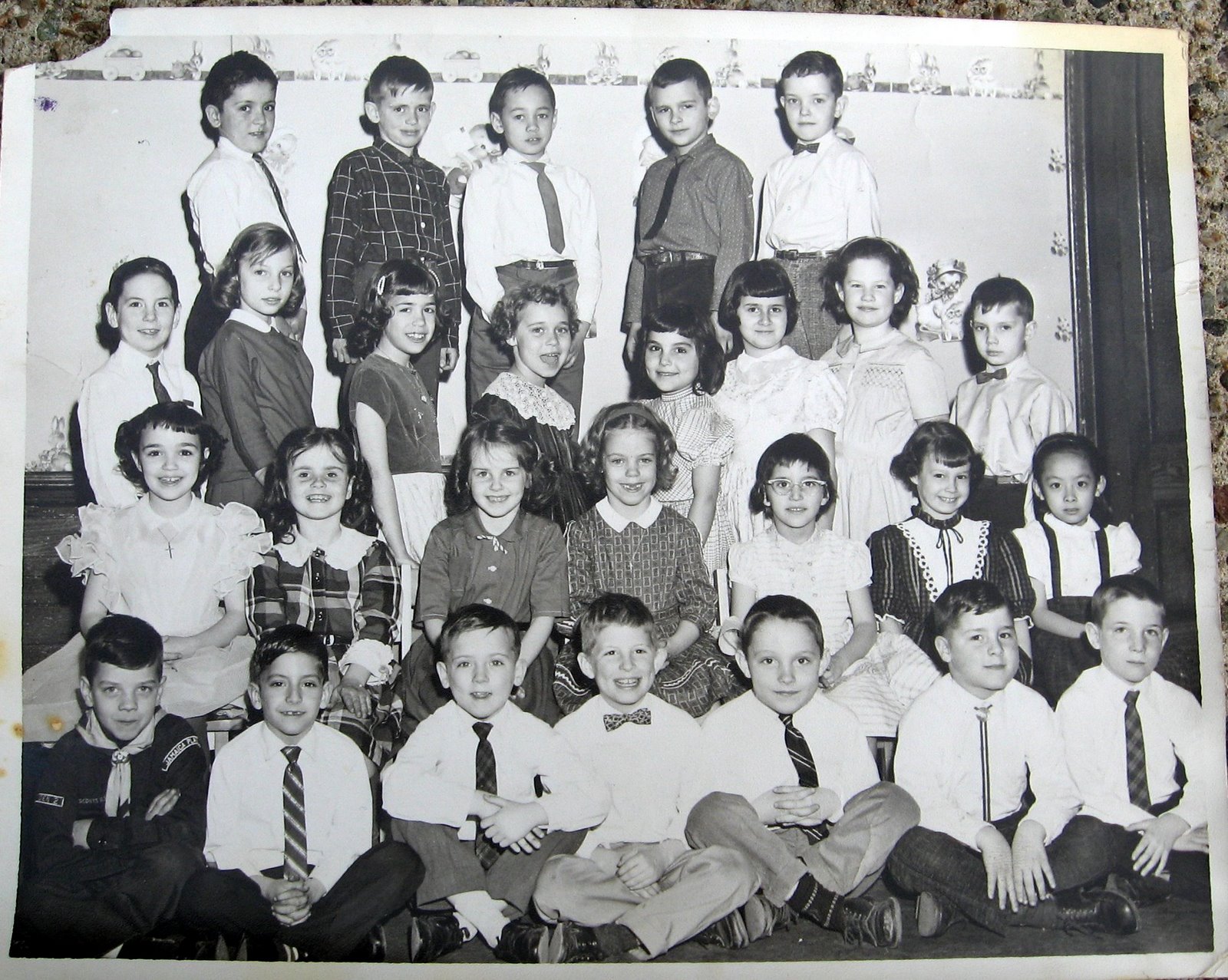
3rd Grade
Front row: X, James Skelley, X, X, Joey Lane. X, John Wittikin, X, Fred Carey.
Second row: Susan Kenney X, X, X, Kris (?), Deborah Noseworthy, Jean Wong.
Third row: Kevin Mallard, Audrey Grynkiewicz, Gail/Dale (?), Anita (?), X, X, X, Charles (?).
Back row: Billy Devine, Mark Bulger, Edmund (?), Byron Sharbetian, Will (?).
These are the three class pics I managed to hold on to over the years. All read left to right. X marks an unknown name. (?) represents a forgotten last name. I'm shakey about some of the names, but I wrote them as I remember them. Gail and Dale were twins, so I don't know which was in my class in any particular year. Jane Gomperts provided some help, but all mistakes are mine. Click on them for a better look if you can contribute names. Kris bothers me particularly. I met her years later and was an usher in her wedding. Sorry Kris, my bad for not remembering your last name.
Baseball - Did A Fossil Survive?
File this entry under Pure Speculation. I was reading an article on the history of baseball earlier this year, and learned about the "Massachusetts rules" form of the game that existed in the mid-1800s. It seems that the local brand of the game was superceded by the New York game - drats! - and the Massachusetts game faded from memory even here in its home. One particular rule peaked my interest. From "The Rules of the Massachusetts Game," by the Massachusetts Association of Base Ball Players. May 13, 1858.
"If a player, while running the Bases, be hit with the Ball thrown by one of the opposite side, before he has touched the home bound, while off a Base, he shall be considered out."
Hmmm... that's interesting. We played under that rule at the Agassiz schoolyard in the early-mid 1960s. We frequently played with different types of rubber balls, so there was no harm to throwing a player out by hitting him as he ran. This raises to obvious possibilies. First, maybe the idea of throwing runners out by hitting them is in some way natural, and came about as a logical result of boys making up rules while playing unsupervised games. That would have been my guess until recently.
The other possibility is more interesting. Could this rule, formerly an official part of the Massachusetts game, have been passed down by generation after generation of boys on fields and lots long after the "New York" rules had been adopted in official games? The idea that the boys of Jamaica Plain, playing without supervision, passed on this rule summer by summer, older brother to younger, over one hundred years certainly can't be proven any way I know of, but it certainly intrigues me. I've never seen it suggested in print, so I thought I'd put it out there in the Intergoogle on the chance that someone might have considered the possibilty before now.
"If a player, while running the Bases, be hit with the Ball thrown by one of the opposite side, before he has touched the home bound, while off a Base, he shall be considered out."
Hmmm... that's interesting. We played under that rule at the Agassiz schoolyard in the early-mid 1960s. We frequently played with different types of rubber balls, so there was no harm to throwing a player out by hitting him as he ran. This raises to obvious possibilies. First, maybe the idea of throwing runners out by hitting them is in some way natural, and came about as a logical result of boys making up rules while playing unsupervised games. That would have been my guess until recently.
The other possibility is more interesting. Could this rule, formerly an official part of the Massachusetts game, have been passed down by generation after generation of boys on fields and lots long after the "New York" rules had been adopted in official games? The idea that the boys of Jamaica Plain, playing without supervision, passed on this rule summer by summer, older brother to younger, over one hundred years certainly can't be proven any way I know of, but it certainly intrigues me. I've never seen it suggested in print, so I thought I'd put it out there in the Intergoogle on the chance that someone might have considered the possibilty before now.
Thursday, November 29, 2007
Margaret Fuller School
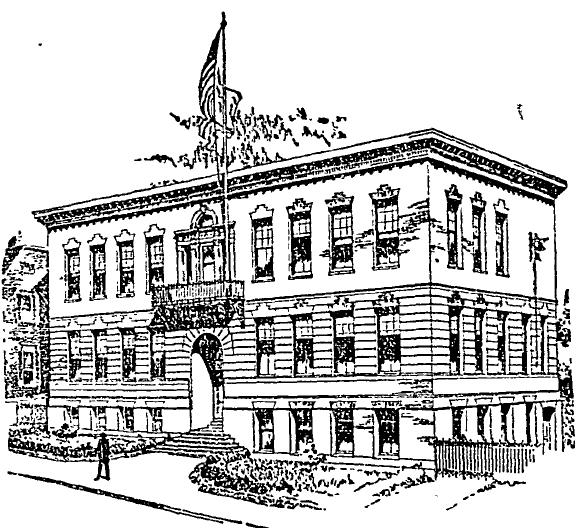
My mother started school at the Margaret Fuller. The drawing above is an "artist's rendition," and leaves out the considerable slope of Glen road at the actual site. The article says that there was to be six rooms, but if each room has seven windows as described, I can only see four rooms.

This view looks up Glen road towards the front and side of the school. There's a block added to the back of the drawing above that would have doubled the size of the school. Was it built as in the drawing, or as it is today?
Boston Daily Globe April 14, 1892
New Primary School, Jamaica Plain
The school is a six-room building, located on Glen road, Jamaica Plain, within 600 feet of Franklin Park.
The building is a brick one, the outside steps and window sills only are stone. The steps are Italian renaissance, common Eastern brick, laid in Flemish bond, is used for the mass of the building, while the trimmings, such as the flat arches of the windows and the corners, are made of yellow moulded brick.
The whole effect is really pleasing and dignified.
In plan it is very compact and nicely arranged, each room being lighted by seven large windows. The wardrobes also receive light from the outside.
There are three rooms on each floor, with toilet and play rooms in the basement.
The building sits 22 feet back from the street, and the approach to the front door is made by a flight of 11 blue-stone steps.
The entrance is recessed 4 1/2 feet in the reveal of the arch, which is one of the architectural features of the design.
Inside the front door is a marble vestibule, with five marble steps bringing up to the first floor level, which is about eight feet above grade at this point.
From the front door is a central corridor with a schoolroom on each side, and another staircase corridor runs at right angles to two side entrances from the girls' and boys' playgrounds respectively.
Overthe front entrance in the second story is the teachers' room, from which a door leads out upon the wrought iron balcony, from which the school flag is to fly.
The "flushing out system" is used in the toilet rooms in the basement.
The ventilation and heating apparatus is of the indirect radiation type with the act of a fan.
It is nearing completion and will be ready for occupancy this term.
The total cost of the structure will be $39,000 or $110 for each pupil accomodated.
A Tragic Accident - Fire Truck Kills Girl
We tend to think of traffic accidents as an affliction of the automotive age, but many people were killed by runaway horses, kicked or dragged by horses, or crushed by wagons. Imagine driving a truck that had a mind of its own.
As a side note, they were not shy about describing accidents back in the day.
Boston Daily Globe March 7, 1880
Fatal Accident.
A Little Girl Run Over at Jamaica Plain by a Hook and Ladder Truck.
A lamentable accident occurred at Jamaica Plain last evening, which resulted in the loss of one life and injuries to two others by a city employee. At 6 o'clock an alarm of fire was sounded for Canterbury to a house owned by Patrick Meehan, and the firemen promptly responded. Hook and latter truck No. 10, horses in charge of Michael Cook, was passing at a furious rate along the highway, and when at the corner of Keyes [McBride] and South streets, the driver was turning the team to enter Keyes street when the horse shied, drawing the wagon on the sidewalk, the wheel of the wagon being only eighteen inches from the fence-bounded private land. There were a number of persons on the sidewalk, among others being a ten-year-old girl named Helen Lally, who was in the act of carrying milk for delivery when the wagon struck her, throwing her down, the wheels passing over her body, mangling it and causing death in a few minutes. John Eagan, residing on Call street, and an unknown man, were seriously injured upon the legs. The driver of the truck sped on his way to the call of duty without stopping. Of course there was much excitement at the scene of the accident, and several persons relate instances of hair-breadth escape. The body of the unfortunate victim was taken to her parents' home by undertaker J.D. Fallon and others, and the grief-stricken mother fainted several times at the sight of her little girl's body. Medical examiner Draper viewed the remains and certified the cause of death was a broken spine by reason of passage of wheels over it. Those who witnessed the disaster aver that there was great carelessness on the part of the driver, that he drove wildly, having no proper restraint upon his horses, and that it is a miracle that more people were not injured. On behalf of the driver, it is said that one of the horses is balky, and that he had notified the authorities that the animal was unsafe to use, but the commissioners had taken no notice of the complaint. The fire was of no importance.
As a side note, they were not shy about describing accidents back in the day.
Boston Daily Globe March 7, 1880
Fatal Accident.
A Little Girl Run Over at Jamaica Plain by a Hook and Ladder Truck.
A lamentable accident occurred at Jamaica Plain last evening, which resulted in the loss of one life and injuries to two others by a city employee. At 6 o'clock an alarm of fire was sounded for Canterbury to a house owned by Patrick Meehan, and the firemen promptly responded. Hook and latter truck No. 10, horses in charge of Michael Cook, was passing at a furious rate along the highway, and when at the corner of Keyes [McBride] and South streets, the driver was turning the team to enter Keyes street when the horse shied, drawing the wagon on the sidewalk, the wheel of the wagon being only eighteen inches from the fence-bounded private land. There were a number of persons on the sidewalk, among others being a ten-year-old girl named Helen Lally, who was in the act of carrying milk for delivery when the wagon struck her, throwing her down, the wheels passing over her body, mangling it and causing death in a few minutes. John Eagan, residing on Call street, and an unknown man, were seriously injured upon the legs. The driver of the truck sped on his way to the call of duty without stopping. Of course there was much excitement at the scene of the accident, and several persons relate instances of hair-breadth escape. The body of the unfortunate victim was taken to her parents' home by undertaker J.D. Fallon and others, and the grief-stricken mother fainted several times at the sight of her little girl's body. Medical examiner Draper viewed the remains and certified the cause of death was a broken spine by reason of passage of wheels over it. Those who witnessed the disaster aver that there was great carelessness on the part of the driver, that he drove wildly, having no proper restraint upon his horses, and that it is a miracle that more people were not injured. On behalf of the driver, it is said that one of the horses is balky, and that he had notified the authorities that the animal was unsafe to use, but the commissioners had taken no notice of the complaint. The fire was of no importance.
Striking Italians
It's just the way of the world; immigrants do the dirty work, and they frequently get abused while doing it.
Boston Daily Globe July 15, 1903
300 Quit Work.
Italians Employed by Elevated Road.
Engaged in Relaying Tracks in Jamaica Plain.
Claim They Didn't Get the Money Due Them.
Four who Refused to Join Strikers Attacked With Stones.
Streets and Sidewalks Now in Dangerous condition.
A small-sized riot was started last evening on Washington st, Jamaica Plain, that for a few minutes caused lots of excitement. The trouble started about 7:15, when the night gang of laborers employed by the Boston elevated railway company, who are at present engaged in relaying the tracks on Washington st, between Green and Forest Hills sq, decided that they had not been paid enough by the company and went on a strike.
The night gang is made up of about 300 Italians and other foreigners, who work from 7 p.m. until 7 a.m. Pay night coming on Tuesday evening, the men say that the sum of money they expected to receive was not what they had contracted for, and as a result they refused to go to work. Four Italians did not hold the same views as their companions, and when the others threw down their picks and shovels these men would not come out of the ditch.
Their continued refusal incensed the strikers, and the gang hurled bricks and cobble stones at the men in the ditch. After a few moments of this fusilade the men decided that they would strike also in a hurry.
The work was then at a standstill, with the rubbish and dirt piled hight in the streets. The men made no more trouble, however, and most of them quietly dispersed to their homes.
The company officials refused to talk about the affair, but it was said that other men will be engaged as soon as possible to take the strikers' place.
The work of relaying the tracks has been going of for about two weeks, and since the start much trouble has been encountered. Two cars have been thrown from the rails at this point, and six people have been injured in the accidents.
Up to a late hour last night no new men were put to work on the job, and the street was quiet. The police of division 13 took no hand in the affair last evening, but a squad of officers will probably be on hand tomorrow morning when the day men go to work.
As a result of the sudden terminating of the night work, the streets and sidewalks in the vicintity of Keyes st and other side streets are in a dangerous condition. Piles of dirt, old railroad ties and rails are thrown all over the streets off Washington st is entirely cut off for vehicles, and in case of a fire during the night the engines would have to go around by Forest Hills av, before they could get to the houses on the side streets.
Boston Daily Globe July 15, 1903
300 Quit Work.
Italians Employed by Elevated Road.
Engaged in Relaying Tracks in Jamaica Plain.
Claim They Didn't Get the Money Due Them.
Four who Refused to Join Strikers Attacked With Stones.
Streets and Sidewalks Now in Dangerous condition.
A small-sized riot was started last evening on Washington st, Jamaica Plain, that for a few minutes caused lots of excitement. The trouble started about 7:15, when the night gang of laborers employed by the Boston elevated railway company, who are at present engaged in relaying the tracks on Washington st, between Green and Forest Hills sq, decided that they had not been paid enough by the company and went on a strike.
The night gang is made up of about 300 Italians and other foreigners, who work from 7 p.m. until 7 a.m. Pay night coming on Tuesday evening, the men say that the sum of money they expected to receive was not what they had contracted for, and as a result they refused to go to work. Four Italians did not hold the same views as their companions, and when the others threw down their picks and shovels these men would not come out of the ditch.
Their continued refusal incensed the strikers, and the gang hurled bricks and cobble stones at the men in the ditch. After a few moments of this fusilade the men decided that they would strike also in a hurry.
The work was then at a standstill, with the rubbish and dirt piled hight in the streets. The men made no more trouble, however, and most of them quietly dispersed to their homes.
The company officials refused to talk about the affair, but it was said that other men will be engaged as soon as possible to take the strikers' place.
The work of relaying the tracks has been going of for about two weeks, and since the start much trouble has been encountered. Two cars have been thrown from the rails at this point, and six people have been injured in the accidents.
Up to a late hour last night no new men were put to work on the job, and the street was quiet. The police of division 13 took no hand in the affair last evening, but a squad of officers will probably be on hand tomorrow morning when the day men go to work.
As a result of the sudden terminating of the night work, the streets and sidewalks in the vicintity of Keyes st and other side streets are in a dangerous condition. Piles of dirt, old railroad ties and rails are thrown all over the streets off Washington st is entirely cut off for vehicles, and in case of a fire during the night the engines would have to go around by Forest Hills av, before they could get to the houses on the side streets.
Wednesday, November 28, 2007
Police Commissioner - Hanged In Effigy

History is a story of context. Each particular subject invites the elaboration of many related topics, and each in turn raise new topics to be explored. The articles below are no exception. In July 1904, the boys of Jamaica Plain saw fit to hang the Boston police commissioner in effigy - twice. To know why, we need at least a passing knowledge of the man, and the traditions of Fourth of July celebrations in Boston.
Taking the last first, Boston had a long history of bonfires and related mischief on the Fourth of July. Each year, police and fire departments would rush from place to place, putting out fires and dealing with excited mobs of revelers. Fireworks were manufactured in many places in the city - including Jamaica Plain - and firecrackers and rockets were a major hazard to body and property. By the early 20th Century, these lawbreaking revels seem to have lessened, but the tradition remained.
The police commissioner was a Judge Emmons. At the time, the Boston police commissioner was named by the Governor of Massachusetts. This is often described as an effort by the Yankee power structure to control the newly empowered immigrant population of their capital city. Judge Emmons was named commissioner by Governor Bates in 1903. Emmons was seen as a likely pick for a superior court appointment, but Bates chose him for the job as a political stroke, replacing the disliked incumbant, while not giving in to pressure to name a political favorite.
As it happens, Emmons was a temperance man, and saw no reason why a man would ever take a drink. As such, he was a stickler for the law when it came to drink. Illegal drinking establishments were shut down, and public drunkenness was rewarded with time in a cell.
Emmons the Killjoy also cracked down on the long-favored unofficial Fourth of July celebrations, which finally brings us to Jamaica Plain and our articles.
Boston Daily Globe July 1, 1904
In Effigy. Emmons "Hanged" at West Roxbury. Excitement in Neighborhood of Boylston Station. Figure Kicked and Stoned and Finally Burned.
To express their opinion of the edict issued by Judge Emmons with regard to the celebration of the Fourth, a crowd of boys and young men of West Roxbury hanged the chairman of the police commissioners in effigy at Boylston station last evening.
That part of the city is usually deserted after 9 p.m., but last night the square was alive with excitement, and the crowd paraded up and down the streets for some time making merry at the judge's expense.
How and where the movement originated nobody seems to know, and the greatest secrecy was observed by all those who participated.
Shortly after 9 o'clock, the crowd began to gather, and before long it had assumed large proportions. From some hidden corner a sorry figure of a man was dragged out amid cheers. A rope was fastened about the neck, and struggling to get a hold of the effigy, the crowd ran up and down the street shouting their disapproval of the chairman of the police board. Not content with dragging it through the mud, the crowd kicked and stoned it to their heart's content.
The episode created the greatest excitement in the neighborhood of the station and the word the "the gang was having some fun with Judge Emmons" spread rapidly. Finally the figure was strung from a pole and a card announced that it was "Judge Emmons."
Later in the evening somebody set it afire, but an officer of division 13 came along and extinguished the fire and took down the effigy. Altogether it was a great night at Boylston station.
Boston Daily Globe July 5, 1904
Emmons In Effigy. Hanged in Jamaica Plain About 2 O'Clock, and Again Four Hours Later in the Same District.
About 2 o'clock yesterday morning Judge Emmons was hanged in effigy in Jamaica Plain at the corner of Chestnut ave and Green st. The figure was strung on a wire across the street and bore a sign marked "A Poor Dub - Judge Emmons."
The cries of derision of those gathered around attracted the attention of patrolman Franks, who removed it and conveyed it to the station house.
About 6 o'clock a second effigy was but up on Eliot st and remained until 8 o'clock, when an officer removed it.
Jamaica Plain Pedalers - 1886
I pulled this out of a larger cycling article. The fact that the Globe published the inner workings of this local club is interesting. In 1886 they would have been riding on dirt roads, and I believe Weld street was still farmland at the time.
So when was the last time there was a bicycle race in the streets of Jamaica Plain?
Boston Daily Globe November 7, 1886
Jamaica Plain Pedalers.
A Club Road Race in Which all Members Must Run or Pay.
The members of the Jamaica Plain Bicycle Club have watched with no little envy the road races given by the different clubs about Boston during the past month. At one of the recent meetings a member of this club was heard to remark that if his club could not give a better conducted series of road races than those in progress they would sell out. Accordingly, at the next meeting of the club road racing formed the chief subject of debate, and it was finally decided to hold a series of club races on Tuesday afternoon, November 9. A number of schemes for the improvement of the present methods of conducting road races were decided upon, chief among which was that of fining of all members of the club who failed to start in the race. They fully appreciated the fact that there were some among their members who were by no means "flyers" on the road, but a large field of starters they must have, and this seemed the most practical method of attaining the end desired. Among the more worldly-minded members there was considerable objection to this race or "ante up" scheme, for, as they expressed it, it would be "deuced hard to collect the fifty cents." However, it was decided to give the scheme a trial, and as the club is young and very enterprising it may prove a success.
There are to be two races. The first is to be for ten miles, and the three first men in are to receive for prizes a bicycle lantern, a pair of ball pedals, and a bicycle saddle. The start will be made at 3 p.m. and the course will be as follows: Start at club house, Centre street, left to Pond street, left to May street, right on Centre street, right to Weld, left to Corey, left to Centre, left to May, right to Pond, right to Orchard, right to Centre, to May, right to Pond, right to Centre, to finish at club house.
The second race will be five miles over the following course: Start at 3:05 p.m., from clubhouse, Centre street, right to Burroughs street, seven times around Burroughs, Pond, Eliot and Brewer streets, to Burroughs, to Centre and finish at clubhouse.
The member who is looked upon as the most likely winner is McCausland, president of the club, and a sergeant of the local police force. McCausland is a fine rider, and would have made a good showing in the recent races of the Massachusetts club had it not been that he broke his Star bicycle.
So when was the last time there was a bicycle race in the streets of Jamaica Plain?
Boston Daily Globe November 7, 1886
Jamaica Plain Pedalers.
A Club Road Race in Which all Members Must Run or Pay.
The members of the Jamaica Plain Bicycle Club have watched with no little envy the road races given by the different clubs about Boston during the past month. At one of the recent meetings a member of this club was heard to remark that if his club could not give a better conducted series of road races than those in progress they would sell out. Accordingly, at the next meeting of the club road racing formed the chief subject of debate, and it was finally decided to hold a series of club races on Tuesday afternoon, November 9. A number of schemes for the improvement of the present methods of conducting road races were decided upon, chief among which was that of fining of all members of the club who failed to start in the race. They fully appreciated the fact that there were some among their members who were by no means "flyers" on the road, but a large field of starters they must have, and this seemed the most practical method of attaining the end desired. Among the more worldly-minded members there was considerable objection to this race or "ante up" scheme, for, as they expressed it, it would be "deuced hard to collect the fifty cents." However, it was decided to give the scheme a trial, and as the club is young and very enterprising it may prove a success.
There are to be two races. The first is to be for ten miles, and the three first men in are to receive for prizes a bicycle lantern, a pair of ball pedals, and a bicycle saddle. The start will be made at 3 p.m. and the course will be as follows: Start at club house, Centre street, left to Pond street, left to May street, right on Centre street, right to Weld, left to Corey, left to Centre, left to May, right to Pond, right to Orchard, right to Centre, to May, right to Pond, right to Centre, to finish at club house.
The second race will be five miles over the following course: Start at 3:05 p.m., from clubhouse, Centre street, right to Burroughs street, seven times around Burroughs, Pond, Eliot and Brewer streets, to Burroughs, to Centre and finish at clubhouse.
The member who is looked upon as the most likely winner is McCausland, president of the club, and a sergeant of the local police force. McCausland is a fine rider, and would have made a good showing in the recent races of the Massachusetts club had it not been that he broke his Star bicycle.
More Police Please
Once again, it seems as if the Good Old Days weren't necessarily so good. It was 1900, and people were hiring watchmen to protect their homes. At this time, station 13 was still responsible for all of the West Roxbury district.
Boston Daily Globe September 25, 1900
Want Better Protection.
Wishes of West Roxbury and Jamaica Plain Residents Will be Granted.
West Roxbury and Jamaica Plain residents have been complaining for six months or more about poor police protection. Burglars have worked openly all summer so extensively that it became necessary for many residents to employ private watchmen. Letters have been written the commissioners and complaints have been made in person by residents.
The morning chairman Clark of the police board announced that the residents would have no cause to complain in the future. He admitted that the department had been short of men, and everything that was wanted in those districts could not be given them, but recently two batches of men passed the civil service examination, and have been added to the force. Now that the department has 30 or more men, the districts mentioned will be better protected.
The chairman said that he thought Boston makes a pretty good showing with cities of her size, when crime is concerned. He says there is no epidemic of burglaries in the city, and stories of that nature are much exaggerated.
When new men are sent to station 13 it is rumored that there will be changes. It is known that 50 or more men will be shifted on the police checker board soon, but they are all patrolmen. Just now there is talk of changing some of the superior officers. It is, in fact probable that when these changes are made, the station mentioned will see new faces.
Boston Daily Globe September 25, 1900
Want Better Protection.
Wishes of West Roxbury and Jamaica Plain Residents Will be Granted.
West Roxbury and Jamaica Plain residents have been complaining for six months or more about poor police protection. Burglars have worked openly all summer so extensively that it became necessary for many residents to employ private watchmen. Letters have been written the commissioners and complaints have been made in person by residents.
The morning chairman Clark of the police board announced that the residents would have no cause to complain in the future. He admitted that the department had been short of men, and everything that was wanted in those districts could not be given them, but recently two batches of men passed the civil service examination, and have been added to the force. Now that the department has 30 or more men, the districts mentioned will be better protected.
The chairman said that he thought Boston makes a pretty good showing with cities of her size, when crime is concerned. He says there is no epidemic of burglaries in the city, and stories of that nature are much exaggerated.
When new men are sent to station 13 it is rumored that there will be changes. It is known that 50 or more men will be shifted on the police checker board soon, but they are all patrolmen. Just now there is talk of changing some of the superior officers. It is, in fact probable that when these changes are made, the station mentioned will see new faces.
Fire At The Arboretum

Richards, L.J. 1899 (copyright © 2000 by Cartography Associates)David Rumsey Collection.

This is a bit of a puzzler. The old coachman's house of the old Bussey estate was part of the Arnold Arboretum at the time of this article. The article puts the house "under Hemlock hill." The map segment above shows a house and a shed at the edge of Hemlock hill along South street in the Arboretum. The map also locates the tunnel under the railroad tracks, so we know that the house was directly opposite the tunnel. The photo shows the site now. It's difficult to see, but there appears to be a cut in the hill right where the house and shed were, but unfortunately there is no evidence of any foundation. The site also seems smaller than the map would suggest, so it's hard for me to imagine the two buildings fitting into the cut in the hill. The site is also a good deal higher than South street, so it would have required a steep incline to get up to the shed/carriage house. Why would the put the building up that high above the road, when the ground closer to the South street gate was near street level?
The map brings up another question: why was the tunnel under the railroad tracks put in precisely that place? South street already passes under the tracks on the way to Roslindale, and the tunnel is quite small. The article has the firemen passing across a Muskrat village - did they go under the tracks at this tunnel? Where exactly was Muskrat village? A trip to the Arboretum headquarters may be in order.
Boston Daily Globe October 19, 1908
West Roxbury Firemen Put In Hard Day's Work Old Bussey House in Arnold Arboretum Destroyed - Jamaica Plain Barn Twice Afire - Two Brush Fires.
Fire, supposed to have been of incendiary origin, early yesterday morning destroyed the old Bussey house in the Arnold Arboretum, on South st, Forest Hills. The house is said to have been more than 150 years old.
It was situated under the famous "Hemlock hill," and in the lifetime of Benjamin Bussey, who deeded his large estate to Harvard university, was used as a coachman house. It was a 2 1/2 story pitch roof, wooden building and had not been used for a long time. There was an L and back of it a large shed, 60 by 18 feet, used as a storage place by the park department. It is said that the shed has been used as a lodging place by tramps.
The fire was discovered by patrolman Lorden at 1:55 and he sounded an alarm from box 528. Engine company 45 and ladder company 16 of Roslindale were first to reach the scene, by cutting across the meadow land on Washington st near "Muskrat village."
The fire had started in the large shed at the rear of the old house, but when the firemen reached the place it had communicated to the dwelling and was eating its way into the ancient building. Difficulty was found in getting water on the fire, for there was no water service in the street at that point and more than 1000 feet of hose had to be laid. It was a short fight when water was obtained.
The fire has left the shell of the house, which was constructed of hewed oak timbers. The shed contained an old steam boiler, many park seats and tools. All were destroyed. The loss is estimated at $1500.
[I snipped out the remaining West Roxbury fire stories]
Tuesday, November 27, 2007
New Fire House - 1910


Boston Daily Globe July 29, 1910
Forest Hills Gets First Auto Chemical Machine. New Fire Station at Walk Hill and Wenham Sts Will Be Placed in Commission Today.
Automobile chemical engine 13 will be placed in commission this morning by Acting Commissioner Carroll in the new fire station erected at Walk Hill and Wenham sts, Forest Hills. The machine was built last year at Springfield and is the first piece of motor apparatus to be permenently installed in the departmental service.
The new commissioner is a great admirer of motor fire apparatus and intends to establish a flying squadron at Grove Hall. For 20 years residents of Forest Hills have sought additional fire protection, but it was not until Benjamin W. Wells took charge that definite arrangements were made to respond.
Mr Wells selected a site for a fire station at Forest Hills shortly before he was removed. After Samuel D. Parker became commissioner the city council appropriated money for a fire station and last winter the auto-chemical was built at Springfield at a cost of $5450.
The new fire station is of brick, 2 1/2 stories high and is regarded as one of the model fire stations of the country. The floors and ceilings are supported by massive steel girders. A feature of the house will be that the patrol desk and stairways will be in an L.
The main floor is of vitrified brick and in the rear is a provision for stalls should the fire leaders decide to place horse-drawn apparatus at the house. Even with the auto-chemical in service, there will be ample room for horse apparatus.
The house is finished with Carolina pine and well sheathed, ensuring a comfortable house in winter. On the second floor are quarters for three officers, while back of those are the dormitories and lounging rooms as well as shower baths and drying rooms. Moller and Smith designed the house and it cost the city $25,000.
The new chemical is equipped with two 35-gallon chemical tanks, several hundred feet of chemical hose, 1000 feet of hydrant hose, a small extention latter, two hand extinguishers, a life line, axes, door opener, hose jackets and other equipment that will make it an up-to-date a piece of fire apparatus. The machine will carry a large searchlight and two large fixed lights on front.
Our Lady of Lourdes

Our Lady of Lourdes Community Hall (copyright 2007)

Boston Daily Globe September 13, 1909
Dedicates Church Of Our Lady Of Lourdes Archbishop O'Connell Attends Services at Reconstructed Jamaica Plain Ediface.
The dedication of the reconstructed and enlarged church of Our Lady of Lourdes, on Brookside av, Jamaica Plain, took place yesterday morning.
The ceremonies were participated in by Archbishop O'Connell and by Mgr Thomas Magennis, PR, of St Thomas' church, Jamaica Plain, of whose parish the chapel of Our Lady of Lourdes was a part until a year ago.
During the 40 years Mgr Magennis has been in charge of St Thomas' parish, Jamaia Plain, the large increase in population has made necessary the divisions of it, including St Theresa's church of West Roxbury, Sacred Heart church of Roslindale, Our Lady of Lourdes, Jamaica Plain, and a part of St Mary of the Angels parish, Egleston Square.
The chapel of Our Lady of Lourdes was a mission of St Thomas' church for 14 years, until a year ago last July, when it was made a separate parish and was given in charge of Rev George A Lyons. The building was wholly insufficient for a parish church, and Fr Lyons set to work to enlarge it.
A 25 foot addition to the rear of the church as allowed of many needed improvements. Two altars have been erected at either side of the large altar, and are the altar of the Sacred Heart and the altar of St Joseph. A beautiful feature of the new church is seen above the main altar.It is a handsome grotto of Lourdes, illuminated by electric lights. The new addition has also allowed of the construction of an assembly hall in the basement and a vestry at the right of the sanctuary.
The ceremony of dedication was performed by Archbishop O'Connell. The solemn high mass was sung by Mgr Magennis, PR, assisted by Rev M.J. Flaherty of Concord, deacon, Rev D.J. Sullivan of the church of St Mary of the Angels, Egleston Square, subdeacon, Rev F.J. Golding, master of ceremonies. The mass was sung by a choir of 40 mixed voices under the direction of Miss Mary Dolan, organist. The dedication sermon was delivered by Rev Joseph V. Tracey, PR, of St Columbkille's church, Brighton.
In the evening at 7:45 solemn benediction was celebrated by Rev Mark E. Madden of St Thomas church, Jamaica Plain. The sermon was delivered by Rev Francis W. Maley of St Augustine's church, South Boston.
Goldsmith vs. Boston
There is a mistake that many of us fall into. We assume that things as they are represent the natural way of things, and we resist any change. All of the current houses and businesses in Jamaica Plain were once new, and no doubt someone saw each one as an intrusion of the former open countryside they remembered from the past. In the same way, we see the Arnold Arboretum and assume that it was always there in some form. If we learn a little history, we may imagine the Bussey farm enclosed in the Arboretum fences. Actually, the Bussey property was just a part of what became today's Arboretum. The rest was taken by the city from surrounding landowners.
One such landowner was Benjamin Goldsmith (think Goldsmith street). He owned a parcel of land that ran from South street near Jamaica street to the Monument, along Centre street to a point across from Orchard street, and from there, parallel to Centre street and back to near the upper edge of Jamaica street again. In other words, all of the current Arboretum near the Headquarters building, and the yet-to-come Arborway, belonged to him. When the city gave him a less than satisfactory price for his land, he went to court.
The Arboretum, Jamaica Pond, Franklin Park, the Arborway, the railroad tracks; all of it included land taken by the government. Could the city do that now?
Boston Daily Globe May 29, 1885
For Land Taken.
Award of $35,000 Damages in Extending West Roxbury Park.
In the case of Goldsmith, petitioner, vs. the city of Boston for damages to an estate on Centre street, West Roxbury, which was taken by the park commissioners, December 30, 1882, for the purpose of extending the Arnold arboretum, the jury found for the petitioner yesterday morning in the sum of $35,000. The award of the park commissioners was between $12,000 and $13,000. Included in the verdict is interest since December 30, 1882. It is reported that before the trial the city solicitor recommended a compromise on the bases of $30,000 in full, but the committee on claims decided to send the case to jury. The quantity of land taken was about fifteen acres.
One such landowner was Benjamin Goldsmith (think Goldsmith street). He owned a parcel of land that ran from South street near Jamaica street to the Monument, along Centre street to a point across from Orchard street, and from there, parallel to Centre street and back to near the upper edge of Jamaica street again. In other words, all of the current Arboretum near the Headquarters building, and the yet-to-come Arborway, belonged to him. When the city gave him a less than satisfactory price for his land, he went to court.
The Arboretum, Jamaica Pond, Franklin Park, the Arborway, the railroad tracks; all of it included land taken by the government. Could the city do that now?
Boston Daily Globe May 29, 1885
For Land Taken.
Award of $35,000 Damages in Extending West Roxbury Park.
In the case of Goldsmith, petitioner, vs. the city of Boston for damages to an estate on Centre street, West Roxbury, which was taken by the park commissioners, December 30, 1882, for the purpose of extending the Arnold arboretum, the jury found for the petitioner yesterday morning in the sum of $35,000. The award of the park commissioners was between $12,000 and $13,000. Included in the verdict is interest since December 30, 1882. It is reported that before the trial the city solicitor recommended a compromise on the bases of $30,000 in full, but the committee on claims decided to send the case to jury. The quantity of land taken was about fifteen acres.
Monday, November 26, 2007
Streets R-Z
I've already started going back through the list and comparing it to Google maps to catch the streets I missed the first time. Takes time.
Revere street - 1874
Roanoke avenue - 1849
Robeson street - 1884
Robinwood avenue - 1892
Rockview place
Rockview street - 1880
Rockwood street - 1872 (relocated 1880)
Rodman street - 1896
Rossmore road - 1910 (renamed portion of Keyes street)
Schiller street - 1891
School street - 1662 (named 1825)
Seaverns avenue - 1849 (laid out a public right of way, 1873)
Sheridan avenue - 1868
South street - 1662 (named 1825)
Spalding street - 1894 (laid out 1902)
Spring Park avenue - 1873
St. Joseph street - 1892
St. Mark street - 1897
St. Peter street - 1903
St. Rose street - 1897
Starr lane - 1849
Stedman street - 1890
Story place
Sunset avenue - 1893
Sylvia street - 1891
Thomas street - 1875
Toll Gate way - 1910
Tower street - 1892
Union avenue - 1874
Varney street - 1894
Varona street - 1906
Wachusett street - 1887
Walk Hill street - 1802
Walnut avenue - 1868
Walter street - 1825 (probably a public highway earlier)
Warren square
Washington street - 1788 (Norfolk and Bristol Turnpike laid out as public highway 1857)
Weld avenue - 1871
Weld Hill street - 1891
Wenham street - 1891
Williams street - 1871
Willow Pond road - 1892
Woodland road - 1892
Woodlawn street - 1892
Woodman street - 1868
Wyman street - 1891
Wyvern street - 1896
Zamora street - 1895
Revere street - 1874
Roanoke avenue - 1849
Robeson street - 1884
Robinwood avenue - 1892
Rockview place
Rockview street - 1880
Rockwood street - 1872 (relocated 1880)
Rodman street - 1896
Rossmore road - 1910 (renamed portion of Keyes street)
Schiller street - 1891
School street - 1662 (named 1825)
Seaverns avenue - 1849 (laid out a public right of way, 1873)
Sheridan avenue - 1868
South street - 1662 (named 1825)
Spalding street - 1894 (laid out 1902)
Spring Park avenue - 1873
St. Joseph street - 1892
St. Mark street - 1897
St. Peter street - 1903
St. Rose street - 1897
Starr lane - 1849
Stedman street - 1890
Story place
Sunset avenue - 1893
Sylvia street - 1891
Thomas street - 1875
Toll Gate way - 1910
Tower street - 1892
Union avenue - 1874
Varney street - 1894
Varona street - 1906
Wachusett street - 1887
Walk Hill street - 1802
Walnut avenue - 1868
Walter street - 1825 (probably a public highway earlier)
Warren square
Washington street - 1788 (Norfolk and Bristol Turnpike laid out as public highway 1857)
Weld avenue - 1871
Weld Hill street - 1891
Wenham street - 1891
Williams street - 1871
Willow Pond road - 1892
Woodland road - 1892
Woodlawn street - 1892
Woodman street - 1868
Wyman street - 1891
Wyvern street - 1896
Zamora street - 1895
Jamaica Plane


This is the second reference I've found to planes being built in Jamaica Plain. This needs more digging to find out exactly where it was built. As a postscript to the story, Mr Hodgdon came in second to a British pilot flying a Sopwith Camel. Damn those Brits!
Boston Daily Globe May 19, 1919
Hodgdon's Flight A Boston Triumph Local Plane Shows Speed With Small Engine
Atlantic City Meet Offers Chance for Private-Built Machines
The flight made by Melvin W. Hodgdon from Boston to Atlantic City, N.J. last Wednesday afternoon for the Boston Globe's trophy and cash prizes is in some respects one of the most extraordinary distance flights that have been made in this country, for Hodgdon averaged 90 miles an hour in this flight with an engine of less than 100 horsepower. That is a very remarkable time.
Of course, the answer in this case is that the Whittemore-Hamm biplane, which Hodgdon piloted, is an exceptionally fine airplane - well-built, on fast lines, and remarkably well balanced. And the satisfactory thing about it, in one way, is that both the pilot and the machine are of Boston. In fact, this airplane is, with one exception, the only successful flying machine ever designed and built in Boston. It was built out at Jamaica Plain.
During the war the government ignored this machine and pinned its faith on some machines that only a rash pilot would attempt to fly from Boston to Atlantic City. But that was the fate of other machines which the government specialists ignored. Almost as soon as Hodgdon had reached Atlantic City the machine he flew was purchased for an aviation station at Falmouth, in this state, where ti will be flown this Summer. That also shows that somebody else has confidence in the L-2.
In point of fact, the L-2 is the fruit of careful cooperative study by Dr W.C. Whittemore of Cambridge and Walter E. Homan of Jamaica Plain, both of whome have devoted six years to the perfecting of the machine, and in that time Melvin W. Hodgdon has been the pilot for the inventors. He has grown up with it, and if it were large enough to carry the necessary fuel he would not hesitate to cross the Atlantic Ocean in it. That is the kind of confidence he has in the machine.
Hodgdon's flight has made some of the other entrants for the Globe trophy pause and it is doubtful now if some of them will fly in the kind of machines they were calculating to use. But there are some machines, like the Christmas Bullet, a speedy little biplane designed by Dr Christmas, but not yet completed, which may break the record Hodgdon made.
In point of fact the only opportunity a new inventor gets with his flying machine is in such contests as the Globe's and the contests for the other newspaper trophies which are free to all at Atlantic City. Besides the Globe trophy and prizes offered by the New York World, one by the New York Herald, one by the Atlanta Journal, and on by the Cleveland Plaindealer and one by the Detroit News.
And it should be clearly understood that there are inventors and flyers in these different cities all anxious to try for these prizes, so that there is no telling what the Atlantic City aviation meet will reveal before May 30, when it closes.
Jamaica Pond Bath House
Once upon a time, there was swimming in Jamaica Pond. Gambols of nude boys and men! And a bathhouse that disappeared.
Boston Daily Globe July 30, 1873
The Courts.
Supreme Judicial Court.
The Jamaica Pond Bathing House - Petition For An Injunction Refused.
Before Judge Morton of the Supreme Court, sitting in chambers, yesterday a hearing was had on the petition of Eben D. Hall and others against Charles G. Mackintosh and others, selectmen of the town of West Roxbury. The petitioners, who are citizens of the town and dwellers near Jamaica Pond, ask for an injunction preventing the defendants from opening to the public a bath-house recently erected by the town on the shore of Jamaica pond, on the ground that the bathers violate modesty and decorum bu an exposure of their persons while in the act of bathing. Defendants reply that the bath-house has been erected for the express purpose of doing away with the cause of numerous complaints to the authorities of the gambols of nude boys and men upon the shores of the pond, and that every possible arrangement is made to prevent the exposure of the persons on the bathers.
A large number of witnesses were examined, most of them testifying that the value of the neighboring estates was in a measure diminished by the gathering of the crowds about the bath-house, but that in reference to the exposure of the persons of the bathers the fears of the petitioners were groundless on account of the precautions used by the authorities to prevent it.
Horace Gray, Jr., on behalf of the complainants, cited the ice-house case of West Roxbury vs Stoddard (7 Alien), the regatta case of Bosty*ick vs. the North Stafford railroad, the bowling-alley case of the Somerset Club, the urinalcase of Rudolph vs. St. George's vestry, and especially the pigeon-shooting case of Rex vs. Moore, where the nuisance consisted chiefly in the fact that an outside crowd of idlers would congregate in spite of the best efforts of the police. Mr Gray also dwelt upon the fact that a place of amusement where there was music by 18 performers, rockets, etc., had been declared a nuisance, although there was the most perfect order among the persons admitted; a crowd would inevitably gather outside and be unquiet.
Waldo Colburn, Esq., on behalf of the respondents, contended that the testimony disclosed the fact that somebody or another must be annoyed and that this concentration was the only way to control the evil. Judge Morton waived any formal argument for the respondents, remarking that it was not necessary to go into the merits of the case now. The only question was whether in case no injunction was granted, there would be irreparable injury. The injunction was accordingly refused.
Boston Daily Globe July 30, 1873
The Courts.
Supreme Judicial Court.
The Jamaica Pond Bathing House - Petition For An Injunction Refused.
Before Judge Morton of the Supreme Court, sitting in chambers, yesterday a hearing was had on the petition of Eben D. Hall and others against Charles G. Mackintosh and others, selectmen of the town of West Roxbury. The petitioners, who are citizens of the town and dwellers near Jamaica Pond, ask for an injunction preventing the defendants from opening to the public a bath-house recently erected by the town on the shore of Jamaica pond, on the ground that the bathers violate modesty and decorum bu an exposure of their persons while in the act of bathing. Defendants reply that the bath-house has been erected for the express purpose of doing away with the cause of numerous complaints to the authorities of the gambols of nude boys and men upon the shores of the pond, and that every possible arrangement is made to prevent the exposure of the persons on the bathers.
A large number of witnesses were examined, most of them testifying that the value of the neighboring estates was in a measure diminished by the gathering of the crowds about the bath-house, but that in reference to the exposure of the persons of the bathers the fears of the petitioners were groundless on account of the precautions used by the authorities to prevent it.
Horace Gray, Jr., on behalf of the complainants, cited the ice-house case of West Roxbury vs Stoddard (7 Alien), the regatta case of Bosty*ick vs. the North Stafford railroad, the bowling-alley case of the Somerset Club, the urinalcase of Rudolph vs. St. George's vestry, and especially the pigeon-shooting case of Rex vs. Moore, where the nuisance consisted chiefly in the fact that an outside crowd of idlers would congregate in spite of the best efforts of the police. Mr Gray also dwelt upon the fact that a place of amusement where there was music by 18 performers, rockets, etc., had been declared a nuisance, although there was the most perfect order among the persons admitted; a crowd would inevitably gather outside and be unquiet.
Waldo Colburn, Esq., on behalf of the respondents, contended that the testimony disclosed the fact that somebody or another must be annoyed and that this concentration was the only way to control the evil. Judge Morton waived any formal argument for the respondents, remarking that it was not necessary to go into the merits of the case now. The only question was whether in case no injunction was granted, there would be irreparable injury. The injunction was accordingly refused.
Sunday, November 25, 2007
J.P. Puzzler
>

Mystery site. (Copyright 2007, all rights reserved)
So where were these pics taken? Hint: it's at the edge of Jamaica Plain, and it's public property.


We have a winner! Pagel park is between the railroad tracks and Hyde Park avenue opposite Wyvern street. That puts it right at the edge of Roslindale. The tunnel came out at the south edge of the Archdale housing projects where Brookway terrace ends.
Stony brook once crossed Hyde Park avenue right at the north edge of Pagel park and went under the railroad tracks. A City of Boston street directory of 1955 lists a Brookway Footpath between Brookway Terrace on the west side of the tracks and Hyde Park avenue on the east. This must have been it. The Archdale side is totally blocked off, but the stone wall on the Pagel side is still in view if you walk up close.
Congrats to Massmarrier - I buy you a virtual beer!

Mystery site. (Copyright 2007, all rights reserved)So where were these pics taken? Hint: it's at the edge of Jamaica Plain, and it's public property.


We have a winner! Pagel park is between the railroad tracks and Hyde Park avenue opposite Wyvern street. That puts it right at the edge of Roslindale. The tunnel came out at the south edge of the Archdale housing projects where Brookway terrace ends.
Stony brook once crossed Hyde Park avenue right at the north edge of Pagel park and went under the railroad tracks. A City of Boston street directory of 1955 lists a Brookway Footpath between Brookway Terrace on the west side of the tracks and Hyde Park avenue on the east. This must have been it. The Archdale side is totally blocked off, but the stone wall on the Pagel side is still in view if you walk up close.
Congrats to Massmarrier - I buy you a virtual beer!
Saturday, November 24, 2007
Jeff, The Brewer Street Methuselah

Carriage house, Brewer street 2008.I believe that the stable shown above is the same as stands now. The house is directly opposite the one I grew up in during the 1960s. Mr and Mrs Hayes lived there at the time. Three houses in a row on Brewer street retain their old carriage houses to this day. Brewer street isn't one of the oldest in Jamaica Plain, but it is older than most residential side streets of its kind. I would have added a matching picture from the present, but it looks like they're doing a major rehab on it right now.
Boston Daily Globe April 21, 1907
An Equine Methuselah
According to all obtainable statistics, Jeff Brigham is one of the oldest horses in the world. He lives in the Jamaica Plain district, at No. 5 Brewer st, as a member of the family of Mrs W.E. Brigham. Thirty-seven or 38 years is no great age in a man, but it is twice the average of a horse. The animal that lives to the end of 18 years is considered to have reached a ripe old age and is usually turned out to pasture, sold at auction, or chloroformed, according to the compassion of his owner.
Jeff's owners would as soon think of administering chloroform to one of themselves as putting an end to the good old horse's life.
Jeff has grown old with the family that owns him. He has outlived his master, and now faithfully serves his mistress, whom he conveys wherever she goes, always moving at a comfortable trot with very little indication of age in his movements. He has never been sick a day in his life, but of late years he has required to services of a dentist, not for any lack of teeth, but owing to an over supply. He has had to have his teeth filed down two or three times to prevent their interfering with the mastication of his food.
Eating has always been a very important consideration with Jeff. Three meals a day, as regularly as the clock strikes, have been his never-failing portion. He is comfortably housed in a warm, new stable, built especially for him. He is accustomed to gentle treatment and a certain degree of deference to the dignity of his age.
The boys George and Will, who used to romp on his back when he was a sprightly horse of 10 or 12, have grown to stalwart manhood under his supervision, and they treat him with the respect which is his due.
An automobile is Jeff's particular horror. Born before the time of bicycles, he managed to become reconciled to them in his youth, but these new devices, with their honking and puffing and locomotive speed, are too much for him at his time of life. He is exceedingly fond of music, especially of the martial type, and will march to time and cavort in dance fashion if he happens not to be harnessed.
Richards, L.J. 1899 (copyright © 2000 by Cartography Associates.)David Rumsey Collection.
Burroughs street runs across the top of the map, and Brewer bisects it from top to bottom. Five Brewer street is the upper Brigham property on this map fragment.
Raise The Flag
Richards, L.J. 1899 (copyright © 2000 by Cartography Associates.)David Rumsey Collection
This is an insignificant story in itself, but it tells us something about the history of a particular plot of land. The housing block that is now across from St Thomas Church on South street was a parking lot in the 1960s and '70s. In 1873, the town directory lists a school on Child street, and an 1874 map shows the building on this site. Maps from the late 1800s show the plot as some kind of city yard with multiple building, but the actual use is not specified. Here, we learn that it was a sewer department yard. Which makes sense. During the 1880s and '90s many residential streets were being laid out, and each would have required a sewer line, so that department would have been very busy. Once the streets were supplied with sewer mains, the local yard could have been closed, and the work crews centralized a main yard. Around the same time, parishioners were probably buying cars, and a parking lot would have been needed. No doubt an important neighborhood institution would have been favored when the city no longer needed the land for its old purpose.
The story also reminds us that the sewer department was once far more active than it is now. All over the city's outer districts, the laying out of streets and utilities would have been a major undertaking of the day. Once the work was done, those departments involved became maintenance departments, an annoyance that blocks traffic on otherwise good roads when they need to go back underground and do repairs. We take a lot for granted these days, no?
Boston Daily Globe May 22, 1898
Little Ones Hail The Flag.
Sewer Department Employees Unfurl "Old Glory" at Jamaica Plain.
"Old Glory" was flung to the breeze yesterday by the Jamaica Plain division of the sewer departemtn at their yard on South st.The flag was purchased by a popular subscription among the men, and measures 12x21 feet.
When the flag was thrown to the breeze a band played "The Star Spangled Banner." This patriotic air and also "America" were sung by about 300 children, pupils at St Thomas parochial school, in charge of Rev Fr Donahue, grouped around the flag pole.
Friday, November 23, 2007
But Did He Play Pinball?
I bet you didn't know that Jamaica Plain had its own Tommy, the "deaf, dumb and blind" boy! The Jamaica Plain institution referred to was the Perkins Institution & Mass. School for the Blind, at the corner of Perkins and Day street. The kindergarten building was at the beginning of Day street.
Boston Daily Globe January 1, 1896
Tommy's Christmas.
How a Little Deaf, Dumb and Blind Boy Found Enjoyment in the Jamaica Plain Institution.
All who have heard of wonderful little Tommy Stringer one of the deaf, dumb and blind pupils of the kindergarten for the blind at Jamaica Plain, are probably interested to hear more, and one of the most recent happenings of interest in regard to Tommy, was Tommy's Christmas.
[snip remainder of article]
The rest of the article goes on in heartwarming detail to tell of the exploits of little Tommy at school. A little too much detail for our purposes, but I did find another reference to Tommy.
"The Kindergarten for the Blind at Jamaica Plain, founded by Mr. Anagnos with the assitance of his wife, serves as a preparatory school for the Perkins Institution. The schools at Jamaica Plain and South Boston quietly and persistantly realize the best educational theories for the blind and the deaf blind. Here Thomas Stringer, Edith Thomas, Elizabeth Robin, and other blind deaf mutes have received and are receiving their education. In each case so far, Mr Anagnos has found means to supply the special teacher on whom the education of the blind deaf-mute must depend. Thomas Stringer, who was received at the kindergarten literally a little animal, has spent most of his life there. During the last years he has been a regular member of one of the public schools in Roxbury, the Lowell Grammar School, from which he was graduated in June, 1903, having received his diploma with an assurance from the head master, that it had been as honestly earned as any ever given by the school."
Source: Laura Bridgman, Dr. Howe's Famous Pupil and what He Taught Her
Maud Howe Elliot, Florence Howe Hall
1904
Boston Daily Globe January 1, 1896
Tommy's Christmas.
How a Little Deaf, Dumb and Blind Boy Found Enjoyment in the Jamaica Plain Institution.
All who have heard of wonderful little Tommy Stringer one of the deaf, dumb and blind pupils of the kindergarten for the blind at Jamaica Plain, are probably interested to hear more, and one of the most recent happenings of interest in regard to Tommy, was Tommy's Christmas.
[snip remainder of article]
The rest of the article goes on in heartwarming detail to tell of the exploits of little Tommy at school. A little too much detail for our purposes, but I did find another reference to Tommy.
"The Kindergarten for the Blind at Jamaica Plain, founded by Mr. Anagnos with the assitance of his wife, serves as a preparatory school for the Perkins Institution. The schools at Jamaica Plain and South Boston quietly and persistantly realize the best educational theories for the blind and the deaf blind. Here Thomas Stringer, Edith Thomas, Elizabeth Robin, and other blind deaf mutes have received and are receiving their education. In each case so far, Mr Anagnos has found means to supply the special teacher on whom the education of the blind deaf-mute must depend. Thomas Stringer, who was received at the kindergarten literally a little animal, has spent most of his life there. During the last years he has been a regular member of one of the public schools in Roxbury, the Lowell Grammar School, from which he was graduated in June, 1903, having received his diploma with an assurance from the head master, that it had been as honestly earned as any ever given by the school."
Source: Laura Bridgman, Dr. Howe's Famous Pupil and what He Taught Her
Maud Howe Elliot, Florence Howe Hall
1904
Airplanes in Jamaica Plain?
Here's an interesting historical nugget: a pilot having an airplane built in Jamaica Plain in 1911 for a flight across the Atlantic. Needless to say, he never made it, and Jamaica Plain didn't enter the aeronautical history books.
Boston Daily Globe February 11, 1911
To Fly Across The Atlantic Carter Starts March 19 in Aeroplane. Aims to Do It in 49 Hours After Leaving Sandy Hook. His Machine Will Be Built at Jamaica Plain.
Harry Graham Carter, the English aviator, yesterday afternoon leased a building in Jamaica Plain in which he will have constructed an all-metal aeroplane in which he will attempt to fly from this country to England in 49 hours, starting March 19.
With several men well-known in the automobile business he closed negotiations in which he takes over the lease of a three-story garage at 10 Green st which runs through to 13 Centre pl. Here in a few days, work of constructing the aeroplane in which he will attempt the record flight will be started by a force of mechanics. Mr Carter will remain in Boston to supervise the work.
"I shall start from Sandy Hook March 19, and I expect to make the flight across the ocean in 49 hours," said the aviator to a Globe reporter last night.
Mr Carter estimates the distance he will fly as 2400 miles. His aeroplane is to be equipped with two 30-horse-power motors, which will drive twin-screw aluminum propellers. The machine, it is expected, will have a maximum speed of 90 miles an hour, but the average will be between 65 and 70 miles.
"I am serious in my purpose to fly to England," said the rosy-cheeked English aviator. "That's what I am in America for. I am convinced that I can do it. I hope to strike the coast about at Queenstown. I shall go as straight as the compass will let me steer.
"I have tried out my motors. They will run for 27 hours, but I expect to perfect them so that they will run for 54 hours. The aeroplane will carry 36 gallons of gasoline.
The aeroplane in which Mr Carter expects to make the remarkable flight will be tandem. All the frame work is to be made of steel, and the wings are to be covered with a special material which he calls parchment. The planes are to be 50 feet wide. The framework is to be of hollow tubing, in order that it may be filled with gasoline. In this way the aviator hopes to carry the necessary fuel without adding undue weight and head resistance. He will carry sufficient food in a compartment to last several days.
Mr Carter said last night that probably a week will be spent in making the building in Jamaica Plain ready for the purpose to which it is to be put, and as soon as this is done the work of constructing the aeroplane will begin.
He added that he is strongly tempted to try his skill at making a flight from New York to San Francisco, as a prize of $20,000 has been offered for such a flight.
********************************************************************************

This map shows us the top of Green street in 1899. The pink colored block owned by T.E. Turnbull is at 10 Green st. By 1905, there was another brick building standing behind this one on Centre place (now Greenview street). I assume that the Turnbull building is the one referred to in the article.
Another company built airplanes in Jamaica Plain, but that's another story.
Boston Daily Globe February 11, 1911
To Fly Across The Atlantic Carter Starts March 19 in Aeroplane. Aims to Do It in 49 Hours After Leaving Sandy Hook. His Machine Will Be Built at Jamaica Plain.
Harry Graham Carter, the English aviator, yesterday afternoon leased a building in Jamaica Plain in which he will have constructed an all-metal aeroplane in which he will attempt to fly from this country to England in 49 hours, starting March 19.
With several men well-known in the automobile business he closed negotiations in which he takes over the lease of a three-story garage at 10 Green st which runs through to 13 Centre pl. Here in a few days, work of constructing the aeroplane in which he will attempt the record flight will be started by a force of mechanics. Mr Carter will remain in Boston to supervise the work.
"I shall start from Sandy Hook March 19, and I expect to make the flight across the ocean in 49 hours," said the aviator to a Globe reporter last night.
Mr Carter estimates the distance he will fly as 2400 miles. His aeroplane is to be equipped with two 30-horse-power motors, which will drive twin-screw aluminum propellers. The machine, it is expected, will have a maximum speed of 90 miles an hour, but the average will be between 65 and 70 miles.
"I am serious in my purpose to fly to England," said the rosy-cheeked English aviator. "That's what I am in America for. I am convinced that I can do it. I hope to strike the coast about at Queenstown. I shall go as straight as the compass will let me steer.
"I have tried out my motors. They will run for 27 hours, but I expect to perfect them so that they will run for 54 hours. The aeroplane will carry 36 gallons of gasoline.
The aeroplane in which Mr Carter expects to make the remarkable flight will be tandem. All the frame work is to be made of steel, and the wings are to be covered with a special material which he calls parchment. The planes are to be 50 feet wide. The framework is to be of hollow tubing, in order that it may be filled with gasoline. In this way the aviator hopes to carry the necessary fuel without adding undue weight and head resistance. He will carry sufficient food in a compartment to last several days.
Mr Carter said last night that probably a week will be spent in making the building in Jamaica Plain ready for the purpose to which it is to be put, and as soon as this is done the work of constructing the aeroplane will begin.
He added that he is strongly tempted to try his skill at making a flight from New York to San Francisco, as a prize of $20,000 has been offered for such a flight.
********************************************************************************

This map shows us the top of Green street in 1899. The pink colored block owned by T.E. Turnbull is at 10 Green st. By 1905, there was another brick building standing behind this one on Centre place (now Greenview street). I assume that the Turnbull building is the one referred to in the article.
Another company built airplanes in Jamaica Plain, but that's another story.
Thursday, November 22, 2007
Fire At Goodnows IV - And No Potatoes Accepted!
This is the last of the fires that hit the stables behind the Goodnow building, at least up until 1924. Quite a string of bad luck, no?
Boston Daily Globe January 22, 1917
Three Horses Suffocated
Perished in Fire on the Second Floor of Brick Stable on Centre st, Jamaica Plain
Three horses were suffocated in a fire yesterday afternoon on the second floor of a 2 1/2-story brick stable in the rear of 704 Centre st, Jamaica Plain. The building is the property of the Goodnow estate, of which the Old Colony Trust Company is the trustee.
The origin of the fire is unknown. A few minutes after 1 o'clock passersby saw smoke coming out of the windows, but the alarm was not rung for some minutes, because of the inablilty of the spectators to determine whether there was a fire.
when the apparatus arrived the building was enveloped in clouds of smoke, and it was utterly impossible to rescue the horses. Wagons and other vehicles were taken out from the street floor, but the fire was under control before anything in the lower part of the building was damaged.
One of the horses was the property of John Mahoney and the other two belonged to George Jiaris, who are the lessees of the property. The damage to the building was about $900; the horses were valued at $400.
Boston Daily Globe March 2, 1917
Black Hander Demands $10,000
Letter Tacked on Shop Door in Jamaica Plain
Mahoney, the Receiver, Believes the Missive Only a Joke
A black hand letter, threatening to destroy his stable and blacksmith shop if he did not place $10,000 on the floor, inside of the shop doorway last night, was the startling ultimatum which John P. Mahoney of Jamaica Plain found tacked on door when he went to open his smithy at 716 Centre st Jamaica Plain, yesterday. The notice was scrawled with a lead pencil.
The wording and spelling indicated that it may have been the work of a practical joker, although there is a reference made to a mysterious fire which only six weeks ago destroyed three valuable horses at Mr Mahoney's stable.
The notice read a follows.
"Dere Mr John Mahoney. Youd better leave $10,000 on the flor inside the door of this shak tonite or well burn the shak down again."
The words were followed by a crude skull and cross bones and a sprawled signature, "Gyp the Blood."
At the bottom of the paper, which was about six inches square, was a postscript: "No Potatoes Accepted."
Last night at his home, 84 Seaverns av, Mr Mahoney said he believed the letter was the prank of some child. "I have no enemies that I know of," he said, "and where in the world would I get $10,000." It must be a joke."
The notice was left on the door of the shop until late afternoon, when it was torn down by Mr Mahoney's daughter, Anna.
The police are interested in the letter because of the reference to the fire, no satisfactory cause for it having been found.
Boston Daily Globe January 22, 1917
Three Horses Suffocated
Perished in Fire on the Second Floor of Brick Stable on Centre st, Jamaica Plain
Three horses were suffocated in a fire yesterday afternoon on the second floor of a 2 1/2-story brick stable in the rear of 704 Centre st, Jamaica Plain. The building is the property of the Goodnow estate, of which the Old Colony Trust Company is the trustee.
The origin of the fire is unknown. A few minutes after 1 o'clock passersby saw smoke coming out of the windows, but the alarm was not rung for some minutes, because of the inablilty of the spectators to determine whether there was a fire.
when the apparatus arrived the building was enveloped in clouds of smoke, and it was utterly impossible to rescue the horses. Wagons and other vehicles were taken out from the street floor, but the fire was under control before anything in the lower part of the building was damaged.
One of the horses was the property of John Mahoney and the other two belonged to George Jiaris, who are the lessees of the property. The damage to the building was about $900; the horses were valued at $400.
Boston Daily Globe March 2, 1917
Black Hander Demands $10,000
Letter Tacked on Shop Door in Jamaica Plain
Mahoney, the Receiver, Believes the Missive Only a Joke
A black hand letter, threatening to destroy his stable and blacksmith shop if he did not place $10,000 on the floor, inside of the shop doorway last night, was the startling ultimatum which John P. Mahoney of Jamaica Plain found tacked on door when he went to open his smithy at 716 Centre st Jamaica Plain, yesterday. The notice was scrawled with a lead pencil.
The wording and spelling indicated that it may have been the work of a practical joker, although there is a reference made to a mysterious fire which only six weeks ago destroyed three valuable horses at Mr Mahoney's stable.
The notice read a follows.
"Dere Mr John Mahoney. Youd better leave $10,000 on the flor inside the door of this shak tonite or well burn the shak down again."
The words were followed by a crude skull and cross bones and a sprawled signature, "Gyp the Blood."
At the bottom of the paper, which was about six inches square, was a postscript: "No Potatoes Accepted."
Last night at his home, 84 Seaverns av, Mr Mahoney said he believed the letter was the prank of some child. "I have no enemies that I know of," he said, "and where in the world would I get $10,000." It must be a joke."
The notice was left on the door of the shop until late afternoon, when it was torn down by Mr Mahoney's daughter, Anna.
The police are interested in the letter because of the reference to the fire, no satisfactory cause for it having been found.
A Minstrel Show In The Woodpile

Post number 100!
From our vantage point in the early years of the 21st Century, it is difficult to know what to make of the phenomenon of minstrel shows. For most of us, blackface may bring to mind Al Jolson in The Jazz Singer, or Amos and Andy. Perhaps we know that minstrel shows were popular entertainment in the 19th century, later replaced in popularity by vaudville. The idea of white people pretending to be African-Americans in order to entertain each other seems slightly ridiculous at best, and more likely obviously racist.
So what does it say about Jamaica Plain at the turn of the 20th century when we learn that minstrel shows were popular fixtures of social organizations at the time? While the travelling minstrel shows of the mid-late 1800s may have past their prime years of success, it seems that the form was still quite popular among amateur groups when it was time to put on the annual show. The Jamaica Club's production in 1898 was "the best ever." Apparently it was a yearly event, playing to a nearly full house at Eliot Hall. From 1900:
"The annual appearance of the minstrel troupe of Jamaica Plain's leading social organization has become one of the social features of the section. Its successes have been so great in the past that the mere announcement of the dates is sufficient to warrant a call for the entire seating capacity of the house, and this year is no exception. As for the show itself, it can be said it has never been exceeded by any of the club's efforts."
In October of 1901, a headline declares
"Fun Behind Black Faces.
Minstrelsy at Columbia Hall by Young Men of Church and Parish of the Blessed Sacrament."
Under the headline we learn:
"There was more than the interest over what might be termed merely a minstrel show, for the participants were giving their time and talent for the benefit of the church of the Blessed Sacrament and parish. Among the many projects under the direction of the progressive clergy there has been the erection of a new school building and steps have been taken toward the construction of a new ediface."
Not to be left out, the next month the young women of Blessed Sacrament followed with their own ladies-only minstrel show, with orchestra selections and songs sung in front of a chorus of "ebonied Roxbury belles."
At the end of the same year, the Jamaica Plain council, Knights of Columbus, put on a minstrel show at Curtis Hall before a large audience. They added a Japanese element, with the host, or interlocutor, playing the part of the Mikado. Still, the stereotypical elements of the standard minstrel show remained, with blackface "end men", "plantation" songs and buck and wing dances.
The next year brought the Jamaica Club back into the news, with the chairman of the board of street commissioners in his initial bow as interlocutor.

Coverage of Jamaica Plain minstrel shows in feature articles is limited to these few years, with allusions to past performances. We don't know from this source when they began, how popular they were across the entire community, or when they went out of fashion. I think we can say that they had a broad popularity, and based on the Globe articles, there was nothing to hide in either putting them on or discussing them. Which, to our modern sensibility, raises the question: what where those people thinking?
No doubt this subject has been examined in detail in historical studies, but in our case we can't go back and ask past Jamaica Plain residents about their attitudes and intentions. Would they argue that it was just good clean fun, with no intention to insult or harm? Would any of those who were not at the shows see them as we do? Without direct evidence from those involved, we just can't say.
What we can say about these shows is that the racism in them was explicit. The best way to show this would be to publish the articles as written, but I've decided to not do so. The language is so obviously offensive that to replicate it now would be to ask for trouble in today's environment. I invite you to go to the Boston Globe archive at the Boston Public Library web site with your library card number, and search for the articles yourself. Seeing the scans of the articles, with the associated drawings, is no less than shocking.
I think I can say that Jamaica Plain was no worse than any other similar community of the time. Minstrel shows were popular across the country, and leading form of entertainment for decades. Presumable, the people who put on these shows, and those who watched and enjoyed them, were not doing so in a conscious effort to harm African-Americans. The nature of the offence seems more subtle, but no less pernicious than that. The lampooning of African -Americans that was the heart of minstrel shows suggest that both performers and audience, if not overtly hostile to black people, certainly didn't take them seriously as human beings. And the latter is no less a crime than the former.
Boston Daily Globe
April 27, 1898
February 23, 1900
October 3, 1901
NOverber 26, 1901
December 31, 1901
February 19, 1902
This article has a postscript. I add it with apprehension, because it is difficult to know what to make of it. The previous articles speak for themselves, but this much later picture, shown below, is more difficult to interpret. It comes from the front page of the Jamaica Plain Citizen, April 16, 1948. The caption reads "These youngsters, all members of Cub 1, participated in the annual Boy Scout Minstrel Show last week presented to a capacity audience in Capen Memorial Hall."

The picture is a poor copy, but it makes the uncomfortable point. Had the minstrel show been defanged by this time, making a simple children's musical show of old South songs (think Way Down Upon the Suwannee River) out of the old racist lampoons? In this case I can add a relevant clue. In previous issues of the Citizen that year, there were respectful articles about a Negro History Week celebration of the time, and the efforts of a "colored" woman to publicize the achievements of black artists. The crude charcterizations of the earlier Boston Globe articles are gone, replaced with what we might describe as the language of "inclusion." If nothing else, this shows that history is messy in its details, and times change in fits and starts.
A final note: in the blackface picture above, I assumed at first glance that there were two women present, playing parts with the boys. The caption revealed that the "girls" were actually boys. In the original minstrel shows, it was common to have women's parts played by men in drag, and the Jamaica Plain men were no different.
Wednesday, November 21, 2007
Community Meeting - 1910
In 1910, the city of Boston was still dealing with the West Roxbury district as a whole, rather than its constituent parts of Jamaica Plain, Roslindale and West Roxbury proper, as it does now. Mt Hope was still recognized as a neighborhood, later to disappear into White City and perhaps Roslindale. Germantown suffered the same fate, losing its distinctive identity to West Roxbury.
I left out the sections referring specifically to districts outside today's Jamaica Plain.
Boston Daily Globe February 16, 1910
West Roxbury's Needs Related
Wants of Sections Presented by Improvement Societies.
New Streets and Sidewalks Most Generally Asked.
Mayor Fitzgerald and the city council, with Guy C. Emerson, superintendent of streets, visited West Roxbury last evening and leared the needs of the district from the citizens, more than 600 of whom had assembled in the splendid hall of the West Roxbury high school.
In area West Roxbury is the largest district in the city, containing more than a half-dozen fairly distinct communities. And the general needs of this vast district are many, although the more urgent matters are not at all extravagant.
Each of the communities has its improvement association and one or more representatives of each of these associations made known the wants of the district.
The first and most general needs of the district as a whole appear to be the acceptance and construction of streets and the improvement of sidewalks next come playgrounds, one or more tunnel under the New York, New Haven & Hartford railroad embankment, a better system of caring for ashes and garbage, cleaner and better watered streets, new primary schoolhouses at Germantown and Roslindale, the opening of the city yard, a more efficient warfare on the gypsy and browntail moths and the elm tree beetle all over West Roxbury, and an elevated station at Green st.
It was the largest meeting held thus far and in some respects it was the most business like, as each of the improvement associations had studied and approved the matters proposed and those matters which related to the district as a whole were approved by all of the associations, and each association had a competent speaker to present its needs. The improvement associations represented at the meeting were Jamaica Plain, Germantown, West Roxbury, Mt Hope, Roslindale and Forest Hills. The Cleveland club was also represented.
Waste Paper Business.
A suggestion from William B. Wheelwright that the city go into business of sorting and selling waste paper brought out a discussion, in which Mayor Fitzgerald and Supt Emerson took part. Mr Wheelwright insisted there was money to be made on waste paper, and Supt Emerson admitted something might be done if the people would separate the paper from the ashes, otherwise it wold not pay.
Frank M. Doyle suggested that an ordinance compelling people to separate the paper as they do garbage from the ashes would settle the matter. It was learned that the Woman's municipal league with the Morgan Memorial had undertaken the kind of work in a small way.
The mayor said that perhaps the meetings of the city government and the people and the discussions resulting might produce a civic spirit that would result in the cooperation of the people more and more in such things. He believed that it was a matter the improvement association should take up.
In opening the meeting Mayor Fitzgerald again explained the things which came under the head of appropriations and those that came under loans and special legislative acts. Most of the matters introduced at the meeting would come under the head of loans.
He later pointed out that Boston was about the only large city in the country that paid the expense of new streets. In other cities the cost was born by the abutters. He said that the city paid half the expense of sidewalks and the property owners the other half, and the present poor condition of the sidewalks in West Roxbury was due largely to the fact that the property owners were unwilling to pay their half of the cost. The city was ready to go ahead with such improvements.
Patrick J. Brady, representing the Cleveland club, was the first speaker. He said the organization represented the largest body of citizens in the West Roxbury district, so he said that he would take up the general needs of the district, but would leave it to the improvement associations to point out the necessity of the various needs.
In Jamaica Plain.
L.J. Brackett, president of the Jamaica Plain citizens' association, said Jamaica Plain had three important needs; playgrounds, the improvement and care of certain streets and sidewalks and the preservation of trees from insects. He called special attention to the sidewalks of Centre st from Green to Boylston st and on Washington st from Green st to Forest Hills sq. He spoke for cleaner and better watered streets and receptacles for waste paper in the business streets; also increased efficiency in the collection of ashes and garbage.
He recommended for the consideration of the city government the construction of a new street over Stony brook, a tunnel under the New Haven tracks at some point between Green and Boylston sts, and the restoration of the noon bell and the no-school bell service. He asked the Mayor to appear at the hearings before the railroad commissioners and endorse a station of the elevated at Green st, and urged the mayor and city council to favor the electrification of steam railroads in greater Boston.
Rev Carroll Perry urged the necessity of three playgrounds in Jamaica Plain, one on the Goodwin estate, which the city already partly owned; one on the Burrage estate on Perkins st and Jamaia Way, which was being used at present by permission of the owner as a playground, and one at Brookside and Cornwall sts, where it would be also possible to have a winter gymnasium.
Dr E. Peabody Gerry advocated more strenuous measures to save the trees from gypsy moths, browtail moths and elm beetles. Much had been done, but much remained to be done, and he suggested that the city appropriate $75,000 to get rid of the pestes. He also pleaded for reforestation and the planting of new trees. He said the Soldier's monument should be better cared for and that the cleaning of the sidewalks of snow should be more strictly attended to.
He said Jamaica pond was sadly in need of cleaning and that the proposed footbridge, 38 feet high, over the New Haven tracks above Forest Hills should not be built. A tunnel should be built at the point.
Supt Emerson said the matter of a tunnel had been considered, and sentiment appeared to be evenly divided between a footbridge and a tunnel.
Mayor Fitzgerald suggested that the snow-plow service in the matter of opening sidewalks should be resumed. He believed that the care of the Soldier's monument would come within the scope of the Parkman fund.
[cut "Germantown's 13 Needs"]
Rev George H. Lyons of Our Lady of Lourdes church urged the necessity of a tunnel under the New Haven tracks to connect Cornwall and Oakdale sts. He said 800 parishioners lived on one side of the track and they had to walk a half mile or moreto get to the church, which was in reality only a short distance away. It is one of the most congested sections and the lack of a tunnel puts thousands of people to great inconvenience, he said.
[cut West Roxbury, Mt Hope and Roslindale sections]
********************************************************************************
A few thoughts: sadly, they lost the battle with the elm beetles. The paper recycling suggestion was interesting, and no doubt before its time. The tunnel under the railroad tracks between Green and Boylston sts was built at the end of Lawndale street, off Lamartine, and coming out to Amory street. The footbridge for Forest Hills must have been the Tollgate bridge, and is listed as being built the same year as this meeting. The steel span remains, but the stairs on each side and the wooden flooring is gone.
I left out the sections referring specifically to districts outside today's Jamaica Plain.
Boston Daily Globe February 16, 1910
West Roxbury's Needs Related
Wants of Sections Presented by Improvement Societies.
New Streets and Sidewalks Most Generally Asked.
Mayor Fitzgerald and the city council, with Guy C. Emerson, superintendent of streets, visited West Roxbury last evening and leared the needs of the district from the citizens, more than 600 of whom had assembled in the splendid hall of the West Roxbury high school.
In area West Roxbury is the largest district in the city, containing more than a half-dozen fairly distinct communities. And the general needs of this vast district are many, although the more urgent matters are not at all extravagant.
Each of the communities has its improvement association and one or more representatives of each of these associations made known the wants of the district.
The first and most general needs of the district as a whole appear to be the acceptance and construction of streets and the improvement of sidewalks next come playgrounds, one or more tunnel under the New York, New Haven & Hartford railroad embankment, a better system of caring for ashes and garbage, cleaner and better watered streets, new primary schoolhouses at Germantown and Roslindale, the opening of the city yard, a more efficient warfare on the gypsy and browntail moths and the elm tree beetle all over West Roxbury, and an elevated station at Green st.
It was the largest meeting held thus far and in some respects it was the most business like, as each of the improvement associations had studied and approved the matters proposed and those matters which related to the district as a whole were approved by all of the associations, and each association had a competent speaker to present its needs. The improvement associations represented at the meeting were Jamaica Plain, Germantown, West Roxbury, Mt Hope, Roslindale and Forest Hills. The Cleveland club was also represented.
Waste Paper Business.
A suggestion from William B. Wheelwright that the city go into business of sorting and selling waste paper brought out a discussion, in which Mayor Fitzgerald and Supt Emerson took part. Mr Wheelwright insisted there was money to be made on waste paper, and Supt Emerson admitted something might be done if the people would separate the paper from the ashes, otherwise it wold not pay.
Frank M. Doyle suggested that an ordinance compelling people to separate the paper as they do garbage from the ashes would settle the matter. It was learned that the Woman's municipal league with the Morgan Memorial had undertaken the kind of work in a small way.
The mayor said that perhaps the meetings of the city government and the people and the discussions resulting might produce a civic spirit that would result in the cooperation of the people more and more in such things. He believed that it was a matter the improvement association should take up.
In opening the meeting Mayor Fitzgerald again explained the things which came under the head of appropriations and those that came under loans and special legislative acts. Most of the matters introduced at the meeting would come under the head of loans.
He later pointed out that Boston was about the only large city in the country that paid the expense of new streets. In other cities the cost was born by the abutters. He said that the city paid half the expense of sidewalks and the property owners the other half, and the present poor condition of the sidewalks in West Roxbury was due largely to the fact that the property owners were unwilling to pay their half of the cost. The city was ready to go ahead with such improvements.
Patrick J. Brady, representing the Cleveland club, was the first speaker. He said the organization represented the largest body of citizens in the West Roxbury district, so he said that he would take up the general needs of the district, but would leave it to the improvement associations to point out the necessity of the various needs.
In Jamaica Plain.
L.J. Brackett, president of the Jamaica Plain citizens' association, said Jamaica Plain had three important needs; playgrounds, the improvement and care of certain streets and sidewalks and the preservation of trees from insects. He called special attention to the sidewalks of Centre st from Green to Boylston st and on Washington st from Green st to Forest Hills sq. He spoke for cleaner and better watered streets and receptacles for waste paper in the business streets; also increased efficiency in the collection of ashes and garbage.
He recommended for the consideration of the city government the construction of a new street over Stony brook, a tunnel under the New Haven tracks at some point between Green and Boylston sts, and the restoration of the noon bell and the no-school bell service. He asked the Mayor to appear at the hearings before the railroad commissioners and endorse a station of the elevated at Green st, and urged the mayor and city council to favor the electrification of steam railroads in greater Boston.
Rev Carroll Perry urged the necessity of three playgrounds in Jamaica Plain, one on the Goodwin estate, which the city already partly owned; one on the Burrage estate on Perkins st and Jamaia Way, which was being used at present by permission of the owner as a playground, and one at Brookside and Cornwall sts, where it would be also possible to have a winter gymnasium.
Dr E. Peabody Gerry advocated more strenuous measures to save the trees from gypsy moths, browtail moths and elm beetles. Much had been done, but much remained to be done, and he suggested that the city appropriate $75,000 to get rid of the pestes. He also pleaded for reforestation and the planting of new trees. He said the Soldier's monument should be better cared for and that the cleaning of the sidewalks of snow should be more strictly attended to.
He said Jamaica pond was sadly in need of cleaning and that the proposed footbridge, 38 feet high, over the New Haven tracks above Forest Hills should not be built. A tunnel should be built at the point.
Supt Emerson said the matter of a tunnel had been considered, and sentiment appeared to be evenly divided between a footbridge and a tunnel.
Mayor Fitzgerald suggested that the snow-plow service in the matter of opening sidewalks should be resumed. He believed that the care of the Soldier's monument would come within the scope of the Parkman fund.
[cut "Germantown's 13 Needs"]
Rev George H. Lyons of Our Lady of Lourdes church urged the necessity of a tunnel under the New Haven tracks to connect Cornwall and Oakdale sts. He said 800 parishioners lived on one side of the track and they had to walk a half mile or moreto get to the church, which was in reality only a short distance away. It is one of the most congested sections and the lack of a tunnel puts thousands of people to great inconvenience, he said.
[cut West Roxbury, Mt Hope and Roslindale sections]
********************************************************************************
A few thoughts: sadly, they lost the battle with the elm beetles. The paper recycling suggestion was interesting, and no doubt before its time. The tunnel under the railroad tracks between Green and Boylston sts was built at the end of Lawndale street, off Lamartine, and coming out to Amory street. The footbridge for Forest Hills must have been the Tollgate bridge, and is listed as being built the same year as this meeting. The steel span remains, but the stairs on each side and the wooden flooring is gone.
A Turkey-less Thanksgiving
In honor of Turkey-Day, I give you a Dickensian story gastronomic tragedy. The two articles don't quite match in the telling, but the event described appears to be the same in both. Happy holidays.
Boston Daily Globe November 24, 1915
Offer Turkeys At Low Prices
Proprietors of Store Put Under Arrest.
Dover st Dealers Accused of Receiving Stolen Goods.
Wagonload Disappears on Way to Jamaica Plain.
Charged with receiving a wagonload of provisions and vegetables alleged to have been stolen Monday night from a market district firm, Morris Rautush, 23 years old, of Malden, and Joseph Tutchinsky, 22 years old, of 43 Willow st, Malden, proprietors of a market at 44 Dover st, were arrested last night by officers of the Court sq and East Dedham st stations after the firm had issued a circular in which they advertised turkeys at shockingly reduced rates.
Monday afternoon B. Kineen & Co, who have a store at 1 1/2 Faneuil Hall sq, sent a wagon load of turkeys, chickens, been, vegetables and miscellaneous articles valued at $386.71 to C.O. Bennett & Sons, Green st, Jamaica Plain. Later Monday evening the rig was put up at a stable on Cross st, stripped of its freight, but the driver disappeared quickly and has not been seen since, and word came from Jamaica Plain that the goods had not been received.
Yesterday the police secured some information regarding the alleged disposition of the property and placed the store on Dover st under surveillance. They had not been watching the store long before circulars advertising turkeys at 22 cents a pound and other things correspondingly cheap were displayed. Sergt McDonald and Special Officer Trayers of the Court sq Station with Sergt Irwin and Special Officer Morrissey of East Dedham st then placed the storekeepers under arrest.
The load that was stolen included 690 pounds of turkey, 126 pounds of been, four hams, many chickens, guinea chicken, celery and other vegetables. The police recovered property valued at $225. It is alleged that the dealers bought the cosignment of goods from the driver for $150. What became of the driver is a mystery.
September 6, 1916
Thanksgiving-less Mystery Cleared
Driver of Vanishing Dinner wagon Arrested
Charged With Stealing Turkeys and Fixin's Worth $365
Why between 150 and 200 residents of Jamaia Plain were left dinnerless last Thanksgiving was explained last evening when James Waters, 41 years old, who says he is "an habitual criminal," and lives "somewhere on Broadway, Cambridge," was arrested by officers of the City Hall av Police Station. Through Waters teh police learned that the dinners were stolen, but what became of them is still a mystery, for the prisoner refuses to tell.
Late last Thanksgiving Eve a wagon left 4 1/2 Faneuil Hall Market, loaded with turkeys, geese, ducks, fowl, potatoes, sweet potatoes, beets, celery and cranberries, in bundles addressed to residents of Jamaica Plain. The wagon represented the Thanksgiving dinners of these families.
Waters was driver of the wagon, which started, presumably, for Jamaica Plain. The conveyance did not arrive at its rightful destination. Not a trace of the horse, wagon, harness or Thanksgiving dinners did the police get for months.
The Jamaica Plain residents waited all Thanksgiving eve for the appearance of their dinners. Thanksgiving dawned, but still no dinners came. As it was then too late to purchase food for home consumption, that section of Jamaica Plain went Thanksgiving-less or to hotels.
Yesterday, Waters appeared at a Canal st store and applied for a job. An officer of the Court sq Police Station recognized him and promptly arrested him. A few days ago the horse, wagon and harness, which vanished last November, were recovered.
Waters was booked at the station charged with the larceny of a horse, wagon and harnes from Bartholomew Dineen of 4 1/2 Faneuil Hall Market. The complaint also states that Waters did steal turkeys, geese, ducks, fowl, beef, potatoes, sweet and white, celery and cranberries to the value of $365. He will be arraigned in court today.
Boston Daily Globe November 24, 1915
Offer Turkeys At Low Prices
Proprietors of Store Put Under Arrest.
Dover st Dealers Accused of Receiving Stolen Goods.
Wagonload Disappears on Way to Jamaica Plain.
Charged with receiving a wagonload of provisions and vegetables alleged to have been stolen Monday night from a market district firm, Morris Rautush, 23 years old, of Malden, and Joseph Tutchinsky, 22 years old, of 43 Willow st, Malden, proprietors of a market at 44 Dover st, were arrested last night by officers of the Court sq and East Dedham st stations after the firm had issued a circular in which they advertised turkeys at shockingly reduced rates.
Monday afternoon B. Kineen & Co, who have a store at 1 1/2 Faneuil Hall sq, sent a wagon load of turkeys, chickens, been, vegetables and miscellaneous articles valued at $386.71 to C.O. Bennett & Sons, Green st, Jamaica Plain. Later Monday evening the rig was put up at a stable on Cross st, stripped of its freight, but the driver disappeared quickly and has not been seen since, and word came from Jamaica Plain that the goods had not been received.
Yesterday the police secured some information regarding the alleged disposition of the property and placed the store on Dover st under surveillance. They had not been watching the store long before circulars advertising turkeys at 22 cents a pound and other things correspondingly cheap were displayed. Sergt McDonald and Special Officer Trayers of the Court sq Station with Sergt Irwin and Special Officer Morrissey of East Dedham st then placed the storekeepers under arrest.
The load that was stolen included 690 pounds of turkey, 126 pounds of been, four hams, many chickens, guinea chicken, celery and other vegetables. The police recovered property valued at $225. It is alleged that the dealers bought the cosignment of goods from the driver for $150. What became of the driver is a mystery.
September 6, 1916
Thanksgiving-less Mystery Cleared
Driver of Vanishing Dinner wagon Arrested
Charged With Stealing Turkeys and Fixin's Worth $365
Why between 150 and 200 residents of Jamaia Plain were left dinnerless last Thanksgiving was explained last evening when James Waters, 41 years old, who says he is "an habitual criminal," and lives "somewhere on Broadway, Cambridge," was arrested by officers of the City Hall av Police Station. Through Waters teh police learned that the dinners were stolen, but what became of them is still a mystery, for the prisoner refuses to tell.
Late last Thanksgiving Eve a wagon left 4 1/2 Faneuil Hall Market, loaded with turkeys, geese, ducks, fowl, potatoes, sweet potatoes, beets, celery and cranberries, in bundles addressed to residents of Jamaica Plain. The wagon represented the Thanksgiving dinners of these families.
Waters was driver of the wagon, which started, presumably, for Jamaica Plain. The conveyance did not arrive at its rightful destination. Not a trace of the horse, wagon, harness or Thanksgiving dinners did the police get for months.
The Jamaica Plain residents waited all Thanksgiving eve for the appearance of their dinners. Thanksgiving dawned, but still no dinners came. As it was then too late to purchase food for home consumption, that section of Jamaica Plain went Thanksgiving-less or to hotels.
Yesterday, Waters appeared at a Canal st store and applied for a job. An officer of the Court sq Police Station recognized him and promptly arrested him. A few days ago the horse, wagon and harness, which vanished last November, were recovered.
Waters was booked at the station charged with the larceny of a horse, wagon and harnes from Bartholomew Dineen of 4 1/2 Faneuil Hall Market. The complaint also states that Waters did steal turkeys, geese, ducks, fowl, beef, potatoes, sweet and white, celery and cranberries to the value of $365. He will be arraigned in court today.
Tuesday, November 20, 2007
Border, What Border?


Both images Sidney & Smith, 1852 (copyright © 2000 by Cartography Associates)
David Rumsey Collection
Both pictures above are from the same map, published one year after West Roxbury seceded from Roxbury. The upper image shows most of both towns, with the bordering towns as well. Dorchester, on the right, consisted of all the land between the coast and the old town of Roxbury. Notice that there is no Hyde Park on this map. The town of Hyde Park was later to be made up from parts of Dorchester, Milton and Dedham. Today's Cleary Square was part of Dorchester at the time. The lower left corner of the map segment shows Dedham in green. Parts of Dedham were later sold off to West Roxbury and Hyde Park to create today's border between Dedham and Boston. The borders of Brookline and Newton are the same as today. A general look at the same image shows that West Roxbury was more south west of the remaining town of Roxbury.
The lower map detail is a closer look at the north section of the east border between West Roxbury and Dorchester. That would be where the green of Dorchester meets the yellow of West Roxbory. If you enlarge the image, you might be able to discern that where the three towns meet is approximately the corner of Seaver street and today's Blue Hill avenue. The Roxbury - West Roxbury border followed Seaver street up from Egleston square along today's Franklin Park to Blue Hill avenue. From there, the West Roxbury - Dorchester border generally follows today's Harvard street in a straight line southwest to a point near today's Morton street, where it angles in a more westerly direction. It crosses Walk Hill street, continuing on across the railroad tracks that now run near Hyde Park avenue.
The verbal description gets a little labored, but if you know the contemporary streets and you look closely at the maps, it should all make sense. The point of this exercise is to ask the question What happened to Franklin Park, the State Hospital property and Mt Hope cemetery? Franklin Park has been considered by most people I know as Dorchester, and the old State Hospital facilities on Morton street were known to all in Jamaica Plain as the Mattapan hospital.
On its north border, Jamaica Plain expanded from its old West Roxbury border to include everything as far as Heath street and the bottom of Parker Hill. In the east, Jamaica Plain contracted from the old West Roxbury borders to the west edge of Franklin Park, the west edge of Forest Hills cemetery, and kinda-sorta Canterbury street. The situation begs for wild speculation. Here goes.
In the north, the straight-line border made no sense geographically or socially. The line actually cut through individual house plots from Egleston square through Hyde square. The breweries that would be built were a logical extention of the Roxbury industrial district, but the residential district was another matter. The railroad tracks and Hogg's bridge separated the area south of Parker Hill from the rest of Roxbury, and it's the residents that define neighborhood identity. It was only natural that people living on Day street would associate more with their neighbors on Paul Gore street than with the rest of Roxbury once the entire district was part of Boston.
The east border of West Roxbury is another matter. Here, there were few residents. Once Franklin Park and the Morton street institutions were built, the non-residential use of the land would make the identiy of the area problematic. Who decides which community "owns" a parkland that sits between the two. My theory is based on the surrounding neighborhoods. Jamaica Plain borders Franklin Park on residential streets. In Seaver street and Blue Hill avenue, Roxbury and Dorchester had major roadways and dense populatios bordering the park. Jamaica Plain residents could go about their business in their communtiy without ever passing by Franklin Park. I suspect that Jamaica Plain residents never felt posessive of Franklin Park because it was "out of sight, out of mind." The "Mattapan" state hospital would have a similar explanation. With the property on the far side of Forest Hills cemetery, there was no residential district in Jamaica Plain to consider it part of the neighborhood, ceding it to the bordering Mattapan.
Streets M - P
Maple place
Marbury terrace - 1895
Marlou terrace
Marmion street - 1885
May street - 1825 (probably a public highway earlier)
McBride street - (see Keyes street below)
Meehan place - 1900
Meehan street - 1898 (shown on plan 1883)
Merriam street
Minton street
Montebello road - 1895
Morton street - previous to 1832 in part
Moss Hill road - 1892
Mozart street - 1887
Myrtle street - 1876
Neponset avenue - 1871
Newbern street - 1850
New Heath street - 1859
Newsome park - 1897
Oakdale street - 1884 (Oak place, 1876)
Oakdale terrace
Oakview terrace - 1899
Olmstead street - 1893
Ophir street - 1892
Orchard street - 1866
Parker street - 1871 (laid out from Heath to Centre sts)
Park lane - 1895
Parley avenue - 1880
Parley vale - 1884
Patten street - 1896
Paul Gore street - 1882
Peabody place
Perkins street - 1825
Peter Parley road - 1891
Plainfield street - 1890
Pond street - 1825 (probably a public highway earlier)
Porter street - 1876
Prince street - 1828
* A street like Parker street was laid out in sections at different dates, and often under different names. I gave the date for the short section within the current boundaries of Jamaica Plain as I define then.
Marbury terrace - 1895
Marlou terrace
Marmion street - 1885
May street - 1825 (probably a public highway earlier)
McBride street - (see Keyes street below)
Meehan place - 1900
Meehan street - 1898 (shown on plan 1883)
Merriam street
Minton street
Montebello road - 1895
Morton street - previous to 1832 in part
Moss Hill road - 1892
Mozart street - 1887
Myrtle street - 1876
Neponset avenue - 1871
Newbern street - 1850
New Heath street - 1859
Newsome park - 1897
Oakdale street - 1884 (Oak place, 1876)
Oakdale terrace
Oakview terrace - 1899
Olmstead street - 1893
Ophir street - 1892
Orchard street - 1866
Parker street - 1871 (laid out from Heath to Centre sts)
Park lane - 1895
Parley avenue - 1880
Parley vale - 1884
Patten street - 1896
Paul Gore street - 1882
Peabody place
Perkins street - 1825
Peter Parley road - 1891
Plainfield street - 1890
Pond street - 1825 (probably a public highway earlier)
Porter street - 1876
Prince street - 1828
* A street like Parker street was laid out in sections at different dates, and often under different names. I gave the date for the short section within the current boundaries of Jamaica Plain as I define then.
Jack the Spanker
Two curious crime stories in a row. Nothing intended - it just worked out that way.
Boston Daily Globe June 12, 1899
May Be "The Spanker"
Man Arrested in Jamaica Plain While Chasing a Little Girl
"Jack the Spanker," the man who has been terrorizing the vicinity of Jamaica Plain was caught in that district late last night, the police believe. He was arrested in the act of attempting to chasitse a little girl whom he had chased and grabbed.
The policeman who made the arrest had been watching him for some time because of his suspicious conduct, and, it is said, saw him chase the child. When he was brought to the station it was seen that he was under the influence of liquor, so when locked up the only charge placed against him on the books is that of drunkenness. However, he was partially identified by several Jamaica Plain residents.
This morning several parties from Roxbury and Dorchester, who have seen the man who was responsible for several of the attempted assaults in those districts, will go to Jamaica Plain and view the man in custody.
Upon the views of those who will attempt to identify him today will depend the character of the charge that will be made against him in court this morning.
Boston Daily Globe June 15, 1899
Not "Jack The Spanker"
Gustaf A. Frockberg Held on a Charge of Drunkenness Only.
Gustaf A. Frockberg, the supposed "Jack the Spanker" held by the police of station 13, Jamaica Plain, on the supposition that he might be the terrorizer of the suburban districts of Boston, is not the real "Jack the Spanker" after all. He was arrested Sunday evening off Washington st by patrolman McCarthy, after he had been seen by the officer talking to a couple of little girls.
He was arraigned in the West Roxbury district court Monday morning on the charge of drunkenness. When questioned as to the spanking business he denied all connection with anything of the kind.
To give the police a chance to have him identified by the children, the case was continued until yesterday.
Since then several of the children have seen him, some of them being in court this morning. None could identify him and the charge of drunkenness alone was pressed against him. He was fined $10.
Boston Daily Globe June 12, 1899
May Be "The Spanker"
Man Arrested in Jamaica Plain While Chasing a Little Girl
"Jack the Spanker," the man who has been terrorizing the vicinity of Jamaica Plain was caught in that district late last night, the police believe. He was arrested in the act of attempting to chasitse a little girl whom he had chased and grabbed.
The policeman who made the arrest had been watching him for some time because of his suspicious conduct, and, it is said, saw him chase the child. When he was brought to the station it was seen that he was under the influence of liquor, so when locked up the only charge placed against him on the books is that of drunkenness. However, he was partially identified by several Jamaica Plain residents.
This morning several parties from Roxbury and Dorchester, who have seen the man who was responsible for several of the attempted assaults in those districts, will go to Jamaica Plain and view the man in custody.
Upon the views of those who will attempt to identify him today will depend the character of the charge that will be made against him in court this morning.
Boston Daily Globe June 15, 1899
Not "Jack The Spanker"
Gustaf A. Frockberg Held on a Charge of Drunkenness Only.
Gustaf A. Frockberg, the supposed "Jack the Spanker" held by the police of station 13, Jamaica Plain, on the supposition that he might be the terrorizer of the suburban districts of Boston, is not the real "Jack the Spanker" after all. He was arrested Sunday evening off Washington st by patrolman McCarthy, after he had been seen by the officer talking to a couple of little girls.
He was arraigned in the West Roxbury district court Monday morning on the charge of drunkenness. When questioned as to the spanking business he denied all connection with anything of the kind.
To give the police a chance to have him identified by the children, the case was continued until yesterday.
Since then several of the children have seen him, some of them being in court this morning. None could identify him and the charge of drunkenness alone was pressed against him. He was fined $10.
Curious Goings On
Boston Daily Globe July 28, 1922
Man In Woman's Attire Seizes Girl
Escapes as Her Cries Bring Help
Jamaica Plain Children Were Returning From Movie at Time
Residents of Elliot st, Jamaica Plain, were aroused last night by the cries of several little girls who were running away from a man dressed in women's clothes.
The children had been attending a free moving picture show at the boat house on Jamaica Pond and were returning home when the man, garged in a woman's suit, skirt and a veil over his face, jumped from behind some bushes bordering the road and grabbed one of them. She succeeded in wresting herself from his grasp and all of them ran toward Centre st.
One of the children ran into the arms of John Doyle, a veteran employee of the Boston Elevated, doing watchman duty nearby, and almost fainted. Joseph Cannon, another employee of the Boston Elevated, yelled to two men crossing the street and they gave chase. Neither they nor the police could find any trace of the man, whom witnesses recognized was not a woman when his trousers showed beneath the skirt while he was running away.
**********************************************************************************
A few thoughts. First, I guess this proves that such goings on didn't start with the Internet. Second, I'd love to know what movie was shown. Presumably not Nosferatu; perhaps a short by Buster Keaton or Our Gang. Third, who needed a watchman? Was it a business around the corner on Centre street, and why did they need a watchman? Some people would have you believe there was no crime in the old days.
Man In Woman's Attire Seizes Girl
Escapes as Her Cries Bring Help
Jamaica Plain Children Were Returning From Movie at Time
Residents of Elliot st, Jamaica Plain, were aroused last night by the cries of several little girls who were running away from a man dressed in women's clothes.
The children had been attending a free moving picture show at the boat house on Jamaica Pond and were returning home when the man, garged in a woman's suit, skirt and a veil over his face, jumped from behind some bushes bordering the road and grabbed one of them. She succeeded in wresting herself from his grasp and all of them ran toward Centre st.
One of the children ran into the arms of John Doyle, a veteran employee of the Boston Elevated, doing watchman duty nearby, and almost fainted. Joseph Cannon, another employee of the Boston Elevated, yelled to two men crossing the street and they gave chase. Neither they nor the police could find any trace of the man, whom witnesses recognized was not a woman when his trousers showed beneath the skirt while he was running away.
**********************************************************************************
A few thoughts. First, I guess this proves that such goings on didn't start with the Internet. Second, I'd love to know what movie was shown. Presumably not Nosferatu; perhaps a short by Buster Keaton or Our Gang. Third, who needed a watchman? Was it a business around the corner on Centre street, and why did they need a watchman? Some people would have you believe there was no crime in the old days.
Haffenreffer House Burns

Boston Daily Globe April 29, 1918
Three Firemen Hurt At $50,000 Jamaica Plain Fire
Three firemen were hurt at the fire that destroyed the residence of Rudolph F. Haffenreffer on Mt Walley av, Jamaica Plain, near Pond st, at the Brookline line, at 4 a.m. yesterday. Because the residence, one of the landmarks of the district, stood on the top of a hill slightly higher than the water level in the Brookline Resevoir, from which the water supply had to be taken, the firemen were unable to get any water. But for the chemical streams the fire would have had its own way. When the pressure failed, Engine 45 was called upon by the members of Engine 28 to act as a relay pumping station, but even this extra work was without avail.
Ladderman Gillespie of 10 and Griffon of 30 were overcome, but revived. Ladderman Schiedel of 10 sprained an ankle and was taken away in an automobile.
The fire started in the rear of the second story near the chimney flue and quickly worked into the attic and through the roof. The cause is unknown.
Mr Haffenreffer, who discovered the fire, after summoning the aid of the other six occupants, attempted to extinguish the flames with a hand extinguisher, but seeing the fire spreading, sent a still alarm, which was followed by a box alarm from box 2492. The damage was set by the police at $50,000.
Liberty Bond Escapes In Jamaica Plain
After the fire at the Rudolph F. Haffenreffer home in Jamaica Plain yesterday morning had been extinguished, the only article of value found intact was a Liberty Bond of the third loan, bought by Mr Haffenreffer a few days ago. While the bond was soaked in bicarbonate solution, the markings on it were plainly recognizable.
Firemen said that the bond must have had a charmed existence to withstand the tremendous heat,and are at a loss to explain how it escaped.
*************************************************************************************
The first map below shows Mr Walley avenue at the bottom left, straddling the Boston-Brookline border. At the upper left of this 1914 map, you'll see the Haffenreffer house, sitting just inside the Boston/Brookline border. That area, between Moss Hill and Allandale street is the forgotten Jamaica Plain. Out of sight, out of mind. The lower map shows the original Haffenreffer house on the corner of Brookside avenue and Germania street. I'd say Rudolph moved up in the world.

The original Haffenreffer house on Brookside avenue.
Walker, G.H., 1927 (BPL)
Richards, L.J., 1899 (copyright © 2000 by Cartography Associates)David Rumsey Collection
Monday, November 19, 2007
St Thomas Aquinas Band

Montreal World's Fair, 1967 - I'm pretty sure that's the Iranian exhibition building in the background.

This looks like Dilboy Field in Somerville - 1967 or 1968.

(All pictures Copyright 2007, all rights reserved)
If you lived between the Monument and Forest Hills in the 1960s, you knew about St Thomas Aquinas Band. The band, or bands, were started in 1962, and closed down in the early 1970s. They were part of the Catholic Youth Organization, or CYO, that sponsored athletic teams and other youth groups. Summers were spent as a marching band, playing in parades and entering competitions throughout the metropolitan Boston area, and winters turned the band into a concert ensemble. For the youth of the area, it was a great way to keep busy. As the original group advanced in age and skills, a feeder band was formed, producing "Senior" and "Junior," or "Prep" bands. Music practices were at the St Thomas grammar school, and marching practices were across South street in the church parking lot, or occasionally at the Carolina playground. Today, it's hard to imagine the neighbors going for the drums leading the band across to the parking lot, or the band playing at full blast, for an hour or two at a time. No doubt there would be much talk about property values, and not-so-subtle hints of lawsuits.
The band was full of older and younger siblings, and brought together children from the southern half of Jamaica Plain. It was mostly Catholic, but there were no religious requirements. Trips were made to New York, Washington D.C., and Montreal. For all its success, the organization came up against an insurmountable obstacle. The cultural changes of the late 1960s did not bode well for a youth organization built on a near-paramilitary model. The short haircuts required of the boys, the military marching, and the band music lost its appeal some time after the Summer of Love, and by 1969, the Senior band suffered the loss of many of its older, experienced members. Kids who grew up together in the band decided they had enough of the discipline the band required. Much the same happened all over the Boston area, and soon, as the baby boom peaked and began to ebb, the CYO music circuit faded away. St Thomas Grammar School came down in the mid-late 1970s, taking with it the hall and music room. The parking lot across from the church was replaced with apartments.
So is 40 years ago history? I tend to think of history as the things that can't be remembered by anyone alive today, but it will be history when we're gone, so it's worth archiving.
Randall-Faichney Company

Randall-Faichney manufactured automotive parts on Amory avenue, off Amory street and along the east side of the railroad tracks just north of Boylston station. For some reason, they give Jamaica Plain station (Green street) as an address. Perhaps they were using the post office as their mail drop. They later started producing medical supplies, including syringes. The spark plug listed above seems to have been patented in 1914.
Advertisements like the one shown above are being cut out of old magazines and sold as collectibles, so if your grandparents have piles of magazines, hold on to them.
4th of July - 1899

If you remember fireworks at Jamaica Pond, raise your hand! You didn't have to be around in 1899 - the 1960s will do. There was nothing like the day-long festivities as described in this article, but the fireworks at the pond was the biggest thing that happened in J.P. each year. No need to go into Boston, just walk up the street. My family could actually see some of the fireworks from our front porch on Brewer street. Somehow, we reached the point that celebrations like those just couldn't be allowed any more - too risky. And too sad.
Boston Daily Globe July 5, 1899
Jamaica Plain was treated yesterday to one of the best and most interesting celebrations of the Fourth that have ever been held in the vicinity. The Jamaica Plain carnival association had charge of the entire affair and the success of the day was due to the untiring energy of the committees and members of the organization. From early morn until late in the evening they hustled around in the endeavor to satisfy the spectators. That they succeeded was manifest by the favorable comments of hundreds who went away feeling that at last Jamaica Plain had awakened from her sleep and had provided a grand day's entertainment.
Instead ofthe big parade as held for two years, a complete change was made and the observance of the day was conducted wholly to the vicinity of Jamaica Pond. A more ideal spot could not have been found and thousands thronged the boulevards and paths during the day.
In the morning and afternoon a series of interesting athletic sports was held, with music by a band. There was a fine display of fireworks from a raft on the water and another band concert in the evening.
The association worked in conjunction with teh city in the celebration, the appropriation of the city being augmented by funds procured by the association.
[text skipped]
Between 15,000 and 20,000 people gathered about the pond in the evening to enjoy the display of fireworks.
[text skipped]
Sunday, November 18, 2007
Jamaica Plain Directory, 1873-74

The Brookline, Jamaica Plain and West Roxbury Directory for 1873-74 is available online for download, which is really nice. Until people started combining internet hosting with scanning, publications like this one sat in libraries unread by all but dusty academic types who knew where to look and what to look for. Now, the Jamaica Plain Historical Society makes this particular book available to all here.
The directory has two listings, one for residents and one for businesses. The business listing is by category: carpenter, grocer, etc. That makes sense for customers, but I'm more interested in where businesses were located at the time. Sooo... I translated the listing to my preference.
I tried to put the listings in order as you would find them along the streets. That may not hold entirely, but it's close enough for now. When businesses were listed under multiple categories, I show it. When there was a lot of overlap - Grocer, Provisions - I sometimes left out the second listing just to save myself the typing. You won't see anything from Hyde square east along Centre street, or Heath street. This is a West Roxbury directory, so they considered that area Roxbury. Also note they didn't use street numbers at the time. Apparently there were so few buildings on most streets that they figured that you would just look for signs or ask someone. I'll try to remove mistakes and typos as I find them.
I should add; this is not a comprehensive listing of the businesses of the time, just those that advertised in this particular directory.
Alveston, near Harris - Benjamin Putnam, Drawing Teacher
Beethoven, near Shawmut - William Boardman, Artist
Bismark - Haffenreffer & Co., Brewery
Boylston, near station, John Kaplinger, Variety store
Boylston, near station - Theodore Lenty, Restaurant
Boylston, near station - John King, Provisions
Boylston, near station - Mrs M.J. Woods, Physician
Boylston, near Station - James Blundell, Boots and Shoes
Boylston, near Station - Grover & Tower, Grocer, Wooden ware
Boylston, opposite Boylston Station - Edward Greiser, Baker
Boylston, near Lamartine - John Werdersum, Dry goods
Boylston, near Lamartine - Frederick Rudolph, Boots and Shoes
Boylston, corner of Lamartine - Frank Ganter & Co. - Provisions
Boylston station - T. Keogh, House and Sign painter
Boylston station - Greenlaw & Gillis, Coal & Wood
Boylston station - D.D. Skilling, Express
Boylston avenue, near Boylston station - Charles Dolan, Leather mfg.
Boylston avenue, near Green (home) - Margaret Dolan, Dressmaker
Boylston avenue, near Jamaica Plain station - Alan Burke, House and Sign painter
Brookside avenue - Miss A. Bowker, Boarding House
Brookside avenue - Mrs S. Parker, Boarding House
Brookside avenue - David Handy & Sons, Masons and Plasterers, Stucco
Brookside avenue - Etna Rubber Mills
Brookside avenue and Green - F. Kohlhepp, Jamaica Plain Dye House
Burroughs, near Brewer - James Thompson, Clergy (Unit.)
Burroughs, near Brewer - Cecile Rickly, French Teacher
Burroughs, near Brewer - Marie Rickly, French Teacher
Byron ct., near School - Joseph Byron & Sons, Curriers, Leather mfg.
Byron ct., near School - John Bowdlear, Pumps
Canterbury, near Walk Hill - A.P. Hodgden
Canterbury, near Mt Hope - Martin Morris, Grocer
Centre, near Perkins - Charles Fogg, Carpenter and Builder, Furniture repair
Centre, oppostie Perkins - Miss Frances O'Reilly Dressmaker
Centre, corner of Boylston - Benjamin Wing, Physician
Centre, corner of Pond - Mrs Elizabeth Wentworth, Boarding House
Centre, near Myrtle - Estabrook Bros., Provisions
Centre, near Myrtle - J. Buchanan, Boots and Shoes, Clothing, Tailors
Centre, near Green - George James & Co., Crockery and Glassware, Grocer, Wooden ware
Centre, corner of Green - Kelley & Cormack, Carriage Trimmer
Centre, corner of Green - Norcross & Myrick, Crockery and Glassware, Grocer, Hardware, Wooden ware
Centre, corner of Green - J.P. Fenno & Co., Flour, grain
Centre, near Seaverns - Thomas Robinson, Carriage Trimmer, Harness Maker
Centre, White's block - S.B. Jenness, Crockery and Glassware
Centre, White's block - Miss C.E. Daniell, Dressmaker
Centre, White's block - E.W. Clark, Dry goods
Centre, White's block - Bernard Murray, Hairdresser
Centre, White's block - C.E. Daniel, Millinery goods
Centre, corner of Burroughs - Alexander Clough, RestaurantCentre, White's block - E.H. Fairbanks, Clocks
Centre, near Burroughs - George Barrett, Apothecary
Centre, opposite Burroughs - Charles Rodgers, Apothecary
Centre, opposite Burroughs - Joseph Goodnow, Baker
Centre, near Burroughs - Edward Brophy & Co., Harness Maker
Centre, near Burroughs - Alexander Clough, Billiards
Centre, Reed bldg, near Harris ave - W.F.&J.D. Fallon, Fish dealer
Centre, corner of Harris - Mrs Lizzie Cheney, Dressmaker
Centre, corner of Harris - Judson Carleton, Provisions
Centre, White's block - White, Mayo & Paine, Gas fitters, Hardware, Kitchen furnishing, plumbers, Stoves
Centre, corner of Thomas - C.W. Drew, Graining and Glazing, House and Sign Painter
Centre, opposite White's Block - Benedict & Foster, Carpenters and Builders
Centre, opposite White's Block - John Kendall, Carpenter and Builder
Centre, Post Office building - Miss S.A. Payne, Fancy Goods, Ladies furnishings
Centre, Post Office building - Horse Railroad Station
Centre, Post Office building - Silas Poole, Circulating Library, Periodicals
Centre, near Post Office - John McNally, Fancy Goods, Intelligence office
Centre, opposite Post Office building - Miss S.A. Payne, Dry goods
centre, opposite Harris avenue - Robert Seaver & Sons, Crockery and Glassware, Grocer, Wooden ware
Centre, at Seaver & Sons - Frank White, order box (express)
Centre, at Seaver & Sons - Alvin White, order box (express)
Centre, at Seaver & Sons - Watson, order box (express)
Centre, at Seaver & Sons - Carriage Conveyance (order box)
Centre, James block - George Phillips, Read Estate Agent
Centre, near Eliot - George Slader, Gas fitter
Centre, near South - Abel Locke, Fish Dealer, Provisions
Centre, near South - Russell Little, Physician
Centre, near Monument - George Trott, Carpenter and Builder
Centre, corner of Eliot - Joseph Hankey, Confectioner
Centre, near Allendale - Martin Lewis, Butcher
Centre place - Charles Perkins, Mason
Chauncey place, near Shawmut - Luther Bullock & Sons, Masons
Chestnut place - Morgan Dura, Clergy (Baptist)
Chapel, near Boylston - A.D. Crabtree, Physician (Homeopathic)
Child, near South - George Fuller, Carriage and Ornamental Painter, House and Sign painter
Elm - John Wester, Architect
Elm, near Green - Joseph Clark, Clergy (Cong.)
Elm, near Jamaia Plain station - Alex. Montgomery, Painter (Fresco), House and Sign painter, Paper hanger
Forest Hills, near Williams - Patrick McMorrow, Contractor
Forest Hills avenue - E. Camfill, Marble & Monument works
Forest Hills station - Western Union Telegraph
Glen, near Boylston - Charlotte Hill, Dressmaker
Glen, near Boylston - Frampton Bros., Morocco Dressers
Green, near Centre - Mrs M.A. Draper, Physician (obstetrics)
Green, near Centre - Cornelius Clapp, Kitchen Furnishings, Plumber, Roofing, Stoves
Green, near Centre - Archibald Ramsey, Horse Shoer
Green, near Centre - Mark Davis, Graining and Glazing, House and Sign painter
Green, near Centre - Alexander Dickson, Blacksmith, Carriage Builder,
Green, near Centre - Charles Pratt, Carriage and Sign Painter
Green, near Centre - Paul Lincoln, Carpenter and Builder
Green, near Centre - Alexander McDonald, Carriage Builder, Wheelwright
Green, corner of Chestnut - Mrs Reuben Card, Boarding House
Green, corner of Elm - C.W. Whittemore & Co., Flour and grain
Green, Bartlett's building - Alden Bartlett, Real Estate Agent
Green, Bartlett's building - Bennett & Barnard, Pumps
Green, Bartlett's building - Charles Page, Insurance, Real Estate agent
Green, Bartlett's building - Thomas Durant, Furniture repair, Upholsterers
Green, Bartlett's building - Arthur Hunking, Civil Engineer
Green, Bartlett's building - Herschel Clemens, Civil Engineer
Green, Bartlett's building - Alden Bartlett, Auctioneer
Green, Bartlett's building - George Henderson, Clothing Dealer, Tailor
Green, Bartlett's building - Charles Keyes, Lawyer
Green, Elson building - E.S. Olpin, Fancy Goods
Green, opposite Depot - Gideon Walker, Carpenter and Builder
Green, opposite Depot - Theodore Lenty, Cigars and Tobacco
Green, opposite Depot - Leopold Vogel, Boots and Shoes
Green, opposite Depot - John Blackburn, Crockery and Glassware, Grocer
Green, oppostie Depot - Thomas Ferguson, Boots and Shoes
Green, opposite Depot - D.A. Brown, Crockery and Glassware, Grocer, Wooden ware
Green, opposite Depot - David Keezer, Fish Dealer, Provisions
Green, opposite Depot - Dennis & Widmarth, Grocer
Green, opposite Depot - Nicholas Albrecht, Hairdresser
Green, opposite Depot - John Dickson, Periodicals, Picture Frame maker
Green, near Depot - S. Hawkins, Watch and Clockmaker
Green, near Depot - W.H. Peabody, House and Sign painter
Green, near Depot - Samuel Hazlewood, Furniture repair
Green, near Depot - Joseph Shaw, Carpenter and Builder
Green, near Depot - William Starr, Carriage Builder
Green, near Depot - John Blackburn, Wooden Ware
Green, near Depot - Anton Krasinski, Cabinet Maker
Green, near Depot - Milton Young, Carriage Conveyance
Green, near Depot - Peter Kolb, Boots and Shoes, Gent's Furnishings, Trunks
Green, near Depot - Alfred Bestwick, Carriage Trimmer, Harness Maker
Green, near Depot - William Starr, Blacksmith
Green, near Depot - Mrs H.H. Chase, Fancy Goods, Ladies furnishings
Green, near R.R. - Eagle Rubber Mills
Green, opposite Brookside - Joseph Leonard, Grocer
Green, corner of Union ave - H.R. Jordan & Co., Carpenters and Builders
- Robert Greene, Carriage and Sign Painter
- Edmund Wallace, Carriage Builder, Wheelwright
Green, near Shawmut - Samuel Hazelwood, Cabinetmaker, Upholsterer
Green, near Shawmut - Ayers & Lynch, Carpenter and Builder
Green, corner of Shawmut - George Maher, Lager beer saloon
Harris avenue - Robert Jameson, Physician
Harris avenue - Joseph Winkler, Physician
Jamaica Plain Station - West Roxbury Gazette (Charles Farrar, ed.)
Jamaica Plain Station - Albert Eayrs, Apothecary
Jamaica Plain Station - Western Union Telegraph
Elson building, opposite Jamaica Plain station - E.S. Olpin, Dry goods
Forest Hills street, near Glen road - Forest Hills Institute
Keyes, near South - John Ervine, Junk Dealer
Keyes, near South - John Erickson, Butcher
Keyes, near R.R. - John Ryan, Grocer
(Keyes is now McBride st)
Lamartine, near Boylston - Charles Leroy, Carpenter and Builder
Lamartine, near Boylston (home) - Mrs E. Blye, Dressmaker
Lamartine, near Cedar - James Nugent,, Florist
Lamartine, near Green - J.S. Munson, Music teacher
Lee, near Keyes - William Duffy (house), Bell Hanger, Locksmith
Maple place, corner of Seaverns - H.B. Cross, Physician
Myrtle, near Centre - Obadiah Adams, Stone Layer
Oak place, near Green - H.A. Perry, House and Sign painter
Pond, near Eliot - Eben Vaughn, Boarding House
Porter, near Boylston avenue - Mrs Cornelius Fisher, Nurse
Porter, near Boylston avenue (home) - Mrs Robert Green, Dressmaker
School, near Shawmut - William Whitten, Mason
Seaverns, corner of Maple place - Joseph Stedman, Physician
Seaverns, near Revere - Josepy Page, Real Estate agent
Seaverns corner of Elm - John Wester, Carpenter and Builder
Seaverns avenue - Mrs Sephronia Hills, Music teacher
Shawmut, near School - William Wallace, Fish dealer, Oysters, Grocer
Shawmut, corner of School - William Wallace, Confectioner
Shawmut, near Green - Thomas Barrett, Nurseryman
Shawmut, near Green - Daniel Carroll, Blacksmith
Shawmut, near Green - Mrs Geo. Belford, Grocer
Shawmut, near Forest Hills station - S. Bearse, Fish dealer, Grocer
Shawmut, at Forest Hills station - Henry Murry, Granite curbing, Marble & Monumental works
Shawmut, near R.R. - Mrs. Daniel Fallon, Grocer
Shawmut, near R.R. - Mrs Margaret Logan, Grocer
Shawmut, corner of Morton - Anthony McLaren, Florist
Shawmut, corner of Morton - Charles Weltin, Florist
Shawmut, corner of Morton - Horse Railroad STation
Shawmut, near South - Horace Lindall, Blacksmith, Carriage Builder, Wheelwright
Shawmut, near Walk Hill - Miss Emma Andrews, Physician (Magnetic)
(Shawmut is now Washington st)
South, near White ave - Thomas Magennis, Clergy (Cath.)
(White ave is now Jamaica st)
South, near Keyes - John Denief, Blacksmith
South, near Keyes - Blackburn & Henderson, Carriage Builders
South, opposite Keyes - Horse Railroad Station
South, corner of Walk Hill - Cyrus Marshall, Crockery and Glassware, Flour, grain
South, near railroad station - Seaverns & Co. Crockery and Glassware, Flour, grain
Spring Park, near Centre - Edward Smith, Carpenter and Builder
Star Lane, near Centre - William Sumner, Carpenter and Builder
Thomas, near Burroughs - Dan Smalley, Private School
Thomas, near Centre - Robert Rose, House and Sign painter
Thomas, near Centre - James Hammond, Upholsterer, Window shades
Union, near Shawmut - James O'Brien, Florist
Union, near Green - Miss Margaret Lawler, Dressmaker
Union, near Green - Daniel O'Brien, Graining and Glazing, House and Sign painter, Paper Hanger
Walk Hill, near Canterbury - Orlando Deshon, Carpenter and Builder
A few thoughts. I've read that the Seaver store was the post office. This directory reads as if there was a separate building for the post office, but it may be that they asked the business for their location, and just entered what they were told. There's a similar question about the businesses at the Jamaica Plain station. For some entries, it's not clear exactly where the busines was. The Jamaica Plain Station entries above may have been in the Bartlett building, or across the street on the Oakdale street side.
Returning to Centre street, I'm not sure were the James building was. White's block was at the south corner of Centre street and Seaverns avenue. There were both homeopathic and magnetic (?) physicians in town. The Bartlett building was on the east side of the tracks at the Jamaica Plain station.
St Andrew The Apostle Church


St Andrew the Apostle church building (copyright 2007)
Boston Daily Globe September 13, 1921
New Church Of St Andrew, Forest Hills, Under Construction
Ground has been broken and work is under way for the construction of the church of St Andrew the Apostle, which will be erected at the corner of Walk Hill and Wachusett sts in Forest Hills Section. The proposed ediface will be a most artistic one. The plans are that it will be ready for occupancy by New Year's Day next.
While the start of then new year is designed for the first service, considerable will depend on the weather the next few months and possibilities are favorable that Christmas Day may witness the holding of the first service.
Rev Fr William J. Casey, the pastor, has done considerable work in planning for a permanent church for the parish. Aug 12, 1918, the parish was founded, being set aside St Thomas Aquinas parish in Jamaica Plain principally, though a small section of the Sacred Heart parish in Roslindale also was included in the boundary lines.
For some time services of the parish have been held in Minton Hall, just opposite the terminal of the Elevated in Forest Hills sq. The new ediface will be about five minutes' walk from the temporary location, and will occupy a site on the summit of the district, affording a fine view of the surrounding country.
The location will be central for all sections of the new parish. It is planned to have the parochial residence along side the new church. On the estate secured for the site stands a house which will be renovated and brought up-to-date for the residence.
The zeal of Fr Casey, the pastor, in developing the parish, has found the parishoners taking an active part in furthering every undertaking that has been carried on. Rev Fr Francis P. Doyle, the assistant, also has worked hard in all these details, so that the work of building the new church has started with a comfortable amount of money in the parish treasury.
The new church will stand back from the main highway and will be approached by a circular drive, some 35 feet wide. There will be no basement for the ediface, the main auditorium being planned to accomodate a congregation of about 1000 people, while a chapel will stand at one end and will accomodate about 350.
The chapel will be available for the weekday services of the parish. Sunday mornings it will be possible to open the doors leading from the chapel to the main auditorium, so that a congregation of nearly 1400 will be enabled to attend mass.
The plans for the ediface, which were made by O'Connell & Shaw, combine in bringing about a fine ventilating system so that it will be cool in the Summer and warm in the Winter. The exterior will be of Weymouth seam face granite.
Streets G - L
Germania street - 1871
Glade avenue - 1898
Glen road - 1853
Glenside avenue - 1898
Goldsmith place
Gordon street - 1865
Green street - 1837
Green Hill avenue - 1851
Greenough avenue - 1853
Greenough park - 1872
Grover avenue - 1889
Hagar street - 1887
Hall street - 1870 (laid out 1887)
Halliday street - 1907
Hampstead road - 1895
Harris avenue - 1852 (Harris place, 1843-49)
Hathaway street
Haverford street - 1902
Heath street - 1825
Holbrook street - 1877
Hubbard street - 1898
Hunter street - 1899
Hyde Park avenue - 1843-49 in part, to Walk Hill
street, 1869
Iffley road - 1895
Jamaica place - 1893
Jamaica street - 1851
Jamaicaway - 1892
Jess street - 1876
John A. Andrew street - 1871
Keyes street* - 1850 (laid out 1859)
Lakeville road - 1846
Lamartine place - 1874
Lamartine terrace
Lamartine street - 1848 (laid out 1859)
Larch place
Lawndale terrace - 1884
Lee street - 1850
Leeland street - 1893
Lester place
Locksley street - 1892
Louder's lane - 1849
Glade avenue - 1898
Glen road - 1853
Glenside avenue - 1898
Goldsmith place
Gordon street - 1865
Green street - 1837
Green Hill avenue - 1851
Greenough avenue - 1853
Greenough park - 1872
Grover avenue - 1889
Hagar street - 1887
Hall street - 1870 (laid out 1887)
Halliday street - 1907
Hampstead road - 1895
Harris avenue - 1852 (Harris place, 1843-49)
Hathaway street
Haverford street - 1902
Heath street - 1825
Holbrook street - 1877
Hubbard street - 1898
Hunter street - 1899
Hyde Park avenue - 1843-49 in part, to Walk Hill
street, 1869
Iffley road - 1895
Jamaica place - 1893
Jamaica street - 1851
Jamaicaway - 1892
Jess street - 1876
John A. Andrew street - 1871
Keyes street* - 1850 (laid out 1859)
Lakeville road - 1846
Lamartine place - 1874
Lamartine terrace
Lamartine street - 1848 (laid out 1859)
Larch place
Lawndale terrace - 1884
Lee street - 1850
Leeland street - 1893
Lester place
Locksley street - 1892
Louder's lane - 1849
Saturday, November 17, 2007
Birth of a Nation - Not Banned in Boston
The release of the movie Birth of a Nation set off a firestorm of protests across the country. African-Americans rose up by the thousands to denounce the grotesque racism of the movie at a time when lynchings were still a terrible reality. Here in Boston, as elsewhere, there were demands that showings of the film be outlawed.
On the other hand, there were those who spoke out in support of the movie, seeing the tale of black lust for white women and the defense of white Christian womanhoon by the noble Ku Klux Klan as simply an accurate reflection of reality in the contemporary American South.
Note: the "Gus scene" that was censored from the film in some places involved a white woman who jumps to her death rather than allow herself to be raped by a black man.
Boston Daily Globe April 26, 1915
Defends Photo Play.
Rev Chauncey J. Hawkins of Jamaica Plain Declares Nothing Should Have Been Cut From It.
Rev Chauncey J. Hawkins in a discourse last evening in Central Congregational Church, Jamaica Plain, declared that there was no justification for the criticisms passed on the photo play "The Birth of a Nation."
He said in part: "Boston has been whipped into a state of hysterics that threatens to sweep people off their feed and will cause them to do something they will regret. I am in oppostion to the proposal that the Legislature take action in the matter, for I maintain that it will be in violation of freedom of the press and of public expression.
"In my opinion the play does not revive dead issues, but presents one that is particularly alive in the South today. I saw nothing immoral in the scene that was cut out by order of the court. It was merely distression, because it represents the position of white women in the South today."
Boston Daily Globe April 27, 1915
Clergy Oppose Sullivan Bill
Speak in Defense of "Birth of a Nation."
Huge Throng Attends Hearing Held in the State House.
M. Sumner Coggan Offers Substitute Measure.
Opponents of the bill to stop all public amusements "tending to create religious or racial prejudice or tending to incite riot" were heard yesterday at the State House by the Committee on Judiciary. About 500 people, with negroes greatly in the majority, crowded into a room with capacity for about half that number.
Colored men and women arrived early and the doors were finally locked with the stairs and corridors outside thronged. Several theatrical men were unable to gain admission.
Although Senator Norwood, the chairman, announced that the hearing would be adjourned if there were expressions of approval or disapproval, there were occasional hisses.
John F. Cusick conducted the hearing for the opposition, and the first speaker was M. Sumner Coggan, representing John R. Schoeffel, who offered a substitute bill to provide that the Mayor shall have power to stop a production if any part of it is obscene or immoral, or tends to injure the morals of the community. This bill also provides for an appeal to the Superior or Supreme Court.
In defense of a section making the proposed act operative Aug 1 next, Mr Coggan pointed out that the next theatrical year ends then, and said no radical step should be taken before that date.
"Russian censorship" was the term used by Rev Dr Chauncey J. Hawkins of Jamaica Plain in stating his objections "to placing any race above criticism." He said he saw "The Birth of a Nation" before the "Gus" incident was removed and found nothing objectional.
[the article continues here]
Boston Daily Globe May 3, 1915
Denies Truth Of What Pastor Says
Colored Man Interrupts Jamaica Plain Service.
The congregation in the Central Congregational Church, Jamaica Plain, was surprised last evening when almost at the close of the service a colored man sitting in a front pew arose and denied the truth of some of the statements made by the pastor, Rev Chauncey J. Hawkins in his sermon on "The Negro Problem."
Rev Hawkins a week ago spoke in favor of "The Birth of a Nation." His remarks then had attracted so much attention that last evening he said that, in support of his views, while not touching directly on the photo-play, he would try to give a general presentation of the negro question.
The colored man who objected to his statements last night was J. Thomas Harrison, a graduate of Tuskeegee and editor of "The Advocate."
Learning the subject of the sermon, he went to the church last night and took a front seat.
The sermon was followed by two reels of motion pictures on "Capital and Labor," and after they had been presented, just before the benediction, Mr Harrison rose and said he wished to reply to some points in the sermon. Rev Mr Hawkins invited him to the pulpit, but he preferred to speak from the floor.
"You told us," he said addressing the minister, "that the amount of crime among Southern negroes is shown by the fact that 95 percent of the prisoners in Alabama are colored. You said that skilled negro workmen in the South are fewer than 10 years before the Civil War. You said that the negro race has produced no great men, no leaders, and that the chasm between them and the whites in the South is growing. You even advocated lynching, explaining that Northerners cannot understand the crimes that necessitate it."
Mr Harrison denied the truth of all these statments and said:
That you should justify lynching shocks me, and in your implication as to its cause you are wrong. Of the 54 lynchings last year, only seven were for the 'usual crime.' Was it for that crime, do you think, that six negro women were lynched?"
************************************************************************************
History in the aggregate is not a particularly difficult subject. When brought down to the level of the individual, the difficulty increases exponentially. We have no trouble making judgement on the likes of Rev Hawkins, but what of his congregation, or the community they lived in? Did they hire him because of his beliefs, or in spite of them? And what happened after this matter was made public? Personally, until I know more, I'll suspend judgement on the good people of Central Congregational. I do have to wonder whether any of the current congregation know anything about this matter. Oh my!
On the other hand, there were those who spoke out in support of the movie, seeing the tale of black lust for white women and the defense of white Christian womanhoon by the noble Ku Klux Klan as simply an accurate reflection of reality in the contemporary American South.
Note: the "Gus scene" that was censored from the film in some places involved a white woman who jumps to her death rather than allow herself to be raped by a black man.
Boston Daily Globe April 26, 1915
Defends Photo Play.
Rev Chauncey J. Hawkins of Jamaica Plain Declares Nothing Should Have Been Cut From It.
Rev Chauncey J. Hawkins in a discourse last evening in Central Congregational Church, Jamaica Plain, declared that there was no justification for the criticisms passed on the photo play "The Birth of a Nation."
He said in part: "Boston has been whipped into a state of hysterics that threatens to sweep people off their feed and will cause them to do something they will regret. I am in oppostion to the proposal that the Legislature take action in the matter, for I maintain that it will be in violation of freedom of the press and of public expression.
"In my opinion the play does not revive dead issues, but presents one that is particularly alive in the South today. I saw nothing immoral in the scene that was cut out by order of the court. It was merely distression, because it represents the position of white women in the South today."
Boston Daily Globe April 27, 1915
Clergy Oppose Sullivan Bill
Speak in Defense of "Birth of a Nation."
Huge Throng Attends Hearing Held in the State House.
M. Sumner Coggan Offers Substitute Measure.
Opponents of the bill to stop all public amusements "tending to create religious or racial prejudice or tending to incite riot" were heard yesterday at the State House by the Committee on Judiciary. About 500 people, with negroes greatly in the majority, crowded into a room with capacity for about half that number.
Colored men and women arrived early and the doors were finally locked with the stairs and corridors outside thronged. Several theatrical men were unable to gain admission.
Although Senator Norwood, the chairman, announced that the hearing would be adjourned if there were expressions of approval or disapproval, there were occasional hisses.
John F. Cusick conducted the hearing for the opposition, and the first speaker was M. Sumner Coggan, representing John R. Schoeffel, who offered a substitute bill to provide that the Mayor shall have power to stop a production if any part of it is obscene or immoral, or tends to injure the morals of the community. This bill also provides for an appeal to the Superior or Supreme Court.
In defense of a section making the proposed act operative Aug 1 next, Mr Coggan pointed out that the next theatrical year ends then, and said no radical step should be taken before that date.
"Russian censorship" was the term used by Rev Dr Chauncey J. Hawkins of Jamaica Plain in stating his objections "to placing any race above criticism." He said he saw "The Birth of a Nation" before the "Gus" incident was removed and found nothing objectional.
[the article continues here]
Boston Daily Globe May 3, 1915
Denies Truth Of What Pastor Says
Colored Man Interrupts Jamaica Plain Service.
The congregation in the Central Congregational Church, Jamaica Plain, was surprised last evening when almost at the close of the service a colored man sitting in a front pew arose and denied the truth of some of the statements made by the pastor, Rev Chauncey J. Hawkins in his sermon on "The Negro Problem."
Rev Hawkins a week ago spoke in favor of "The Birth of a Nation." His remarks then had attracted so much attention that last evening he said that, in support of his views, while not touching directly on the photo-play, he would try to give a general presentation of the negro question.
The colored man who objected to his statements last night was J. Thomas Harrison, a graduate of Tuskeegee and editor of "The Advocate."
Learning the subject of the sermon, he went to the church last night and took a front seat.
The sermon was followed by two reels of motion pictures on "Capital and Labor," and after they had been presented, just before the benediction, Mr Harrison rose and said he wished to reply to some points in the sermon. Rev Mr Hawkins invited him to the pulpit, but he preferred to speak from the floor.
"You told us," he said addressing the minister, "that the amount of crime among Southern negroes is shown by the fact that 95 percent of the prisoners in Alabama are colored. You said that skilled negro workmen in the South are fewer than 10 years before the Civil War. You said that the negro race has produced no great men, no leaders, and that the chasm between them and the whites in the South is growing. You even advocated lynching, explaining that Northerners cannot understand the crimes that necessitate it."
Mr Harrison denied the truth of all these statments and said:
That you should justify lynching shocks me, and in your implication as to its cause you are wrong. Of the 54 lynchings last year, only seven were for the 'usual crime.' Was it for that crime, do you think, that six negro women were lynched?"
************************************************************************************
History in the aggregate is not a particularly difficult subject. When brought down to the level of the individual, the difficulty increases exponentially. We have no trouble making judgement on the likes of Rev Hawkins, but what of his congregation, or the community they lived in? Did they hire him because of his beliefs, or in spite of them? And what happened after this matter was made public? Personally, until I know more, I'll suspend judgement on the good people of Central Congregational. I do have to wonder whether any of the current congregation know anything about this matter. Oh my!
The Bridge At Forest Hills

Picture: Boston Daily Globe May 10, 1897
The railroad bridge at Forest Hills must have been handsome when it was first built. The fresh-cut granite would have sparkled in the sun. The contemporary articles in the Boston Globe certainly painted a glowing picture of the project. Of course, anywhere you see those old granite walls now, the dingy black-brown of the surface hardly inspires poetry. For years, the old steam locomotives spit coal dust into the air, and rain washed it down over the edges of the granite walls and producing the permanent dark stain that marked the bridge and the entire embankment as it passed through Jamaica Plain. Soot from the diesel locomotives that followed would have contributed to the grime of the walls as well.
I remember the bridge over the Arborway as anything but beautiful. Utilitarian, massive and dark come to mind. The Casey overpass overhead didn't help; it put the railroad bridge in a permanent shadow. The Forest Hills elevated station, built shortly later, took attention away from the bridge as well. The effect was one of crowding, with multiple generations of transportation roadway tacked one on top of the other.
Today, the Orange Line park that runs from near Forest Hills north to Centre street is lined in many places with granite blocks that were taken from the walls of the embankment and reused. They must have cleaned them before they put them in place - they don't look anything like the walls I remember. They should have left them dirty for that "vintage" look.
Picture: Jamaica Plain Historical Society web site.This picture, taken in the 1960s, looks down from South street towards Washington street and the Arborway car yards. The bridge recedes to the left, where it ended on a sloping dirt and gravel embankment. See the trees on the left? I believe the biggest was a willow. In the early 1960s, there was a rope swing hanging from a branch high above the slope at the end of the bridge. You could stand on the projecting column - just visible here - and swing out over the weedy lot below. Thousands of people rode by on the streetcar every weekday, not knowing that the boys of Anson, Spalding and Rosemary streets had a secret place to stretch their wings and challenge their manhood.
Streets C - F
Call street - 1877 (formerly Union avenue and Starr street)
Calvin road
Candor place
Canterbury street - 1825 (probably a public highway previously)
Carolina avenue - 1849
Carolina place
Castleton street - 1895
Cataumet street
Catherine street - 1893 (formerly Spruce street)
Cedarwood road
Centre street - 1825 (laid out 1662)
Cerina road
Chestnut avenue - 1877 (as Nebraska, 1848)
Chestnut place - 1870
Chestnut square - 1896
Chestnut street - 1860
Chestnut terrace - 1898
Chilcott place - laid out as Chauncy place, 1857
Child street - 1860? complete laid out 1892
Clive street - 1888
Copley street - 1886
Cornwall street - 1843-1849? (Chemical avenue, 1870, Cornwall, 1886)
Craft place - 1896
Cranston street - 1890
Creighton street - 1856
Custer street - 1881
Dalrymple street
Dane street - 1905
Danforth street - 1881
Day street - 1868 (cross street 1825, probably laid out 1662)
Dedham turnpike - 1808 (now Washington street)
Dimock street - 1884
Dixwell street - 1898
Dresden street - 1899
Driftwood road
Dunster road - 1907
Edge Hill street - 1889
Egleston street - 1890
Eldridge road - 1896
Eliot place
Eliot street - 1802 (named 1825)
Elm street - 1847 (finished and called Elm st 1868)
Elwell road
Enfield street - 1880
Erie place
Ernst street - 1898
Estrella street - 1905
Everett street - 1871
Fessenden street - 1890
Florian street - laid out as Florence street, 1869
Forbes street - 1890
Forest Hills street - 1848
Forest Hills avenue
Francis Parkman drive
Calvin road
Candor place
Canterbury street - 1825 (probably a public highway previously)
Carolina avenue - 1849
Carolina place
Castleton street - 1895
Cataumet street
Catherine street - 1893 (formerly Spruce street)
Cedarwood road
Centre street - 1825 (laid out 1662)
Cerina road
Chestnut avenue - 1877 (as Nebraska, 1848)
Chestnut place - 1870
Chestnut square - 1896
Chestnut street - 1860
Chestnut terrace - 1898
Chilcott place - laid out as Chauncy place, 1857
Child street - 1860? complete laid out 1892
Clive street - 1888
Copley street - 1886
Cornwall street - 1843-1849? (Chemical avenue, 1870, Cornwall, 1886)
Craft place - 1896
Cranston street - 1890
Creighton street - 1856
Custer street - 1881
Dalrymple street
Dane street - 1905
Danforth street - 1881
Day street - 1868 (cross street 1825, probably laid out 1662)
Dedham turnpike - 1808 (now Washington street)
Dimock street - 1884
Dixwell street - 1898
Dresden street - 1899
Driftwood road
Dunster road - 1907
Edge Hill street - 1889
Egleston street - 1890
Eldridge road - 1896
Eliot place
Eliot street - 1802 (named 1825)
Elm street - 1847 (finished and called Elm st 1868)
Elwell road
Enfield street - 1880
Erie place
Ernst street - 1898
Estrella street - 1905
Everett street - 1871
Fessenden street - 1890
Florian street - laid out as Florence street, 1869
Forbes street - 1890
Forest Hills street - 1848
Forest Hills avenue
Francis Parkman drive
Tollgate Cemetery
Tollgate Cemetery, Forest Hills 2007. (Copyright, all rights reserved)
Tollgate Cemetery headstone, 2007 (Copyright, all rights reserved)After years (generations?) of neglect, the Tollgate cemetery in Forest Hills has finally had some attention paid to it. An Irish-American war veteran memorial now stands in the grounds, and flags can be seen each Memorial Day. The land was bought to serve as a Catholic cemetery in the mid-19th century, and seems to have been forgotten by the Archdiocese soon after it was filled up. Apparently, many graves are now unmarked, and the headstones that remain are either damaged or worn to the point of near-illegibility.
The marker shown above was chosen to point out that not all Boston Catholics during the 1850s were Irish. There are several headstones carved in German. Both northern Protestant and southern Catholic Germans came to Boston, and some of the latter found their final resting place along the railroad tracks in this small plot of land. When it was opened, the area was quiet, but for the trains passing by. Years later, it sat ignored in the midst of a busy traffic hub. Not all Forest Hills cemeteries are created equal.
Friday, November 16, 2007
Post Office On The Move
The new post office at Woolsey square. 1890
Richards, L.J. 1899 (copyright © 2000 by Cartography Associates)David Rumsey Collection
Green street runs across the top of the map. The Woolsey block is the pink (brick) building at the corner of Green street facing the outbound train station. The post office is is the wood frame (yellow) building labeled at the bottom center. Gordon street comes in from the left.
Early in 1890, the Jamaica Plain post office moved into new quarters. Twelve years earlier it had moved from its long home in Seaver's block on Centre street to Woolsey's block at the Jamaica Plain station at Green street. Increasing business required larger accomodations, and when the current lease approached its end the post office sought a new home. The landlord could not accomodate them in the existing building, but offered them a place in a building he was about to remodel.
The new office featured two rooms, one for public business and one for the carriers.
Source: Boston Daily Globe January 22, 1890
Corner of Green and Cheshire streets, opposite the Bowditch school. The picture comes from the Boston Public Library Print Department.
Boston Daily Globe June 9, 1918
Transfer Jamaica Plain's Post Office To New Location
Jamaica Plain's Post Office, for 10 years at the corner of Green and Cheshire streets, was transferred yesterday afternoon to new quarters at the corner of Centre and Myrtle sts, in the center of the business section of the district. The work of moving was completed after the close of the day's business last night, but had been in progress during the latter part of last week.
It was planned to have the new quarters occupied on June 1, but the building was not ready on time. The new location is in a block which has been thouroughly remodeled. Car lines pass the door.
The 10-year lease of the Greet st building expired in March.
William Curtis - Last Will and Testament
I found a referece to Gamblin End in the previous street listing book, so I took a chance and Google'd it. Sure enough, I found this reference in another online book, Suffolk Deeds By Suffolk County (Mass.) 1896, by John Tyler Hassam. Remarkably, it's a will written for Wiliam Curtis (as in the Curtis Hall family) in 1669. With enough of these, a loose map could be produced of present day Jamaica Plain in colonial times.
The type below is in the form of graphics, so it can be seen in larger versions if necessary. Click on the text to expand the view.


The type below is in the form of graphics, so it can be seen in larger versions if necessary. Click on the text to expand the view.


Street Birthdays A-B
The following list is taken entirely from A Record of the Streets, Alleys, Places, Etc. in the City of Boston, published in 1910 by the City of Boston. Streets within the borders of the old towns of Roxbury and West Roxbury were listed as such. In creating this list, I have gone by Jamaica Plain borders of my own choosing. To the west, the present border with the Town of Brookline is followed. To the north, Heath street, Jackson square, Columbus avenue and Seaver street. To the east, the near edge of Franklin Park and Canterbury street. To the south, Neponset street to the railroad tracks, back to Forest Hills, out South street to Bussey street, Walter street to Centre street and Alladale street.
The dates given are the earliest in the book. Most dates listed predate the year the street was laid out by several years. I did not do a comprehensive history of all Jamaica Plain streets - this list will be primarily existing street names. Some streets do not exist any more, and others were included into present streets under new names. Where streets had a long history under another name, I try to mention it. Streets listed with no date are listed as such in the source book, and are included for completeness. No doubt I will miss some streets in the book - I welcome additions. Please note: this list is worth every cent you pay for it. It is intended to be a good starting point, no more.
Achorn circle - 1900
Adelaide street - 1893
Adeliade terrace - 1874
Agassiz park
Alden place
Aldworth street - 1896
Alfred street - 1881
Allandale street - 1863
Alveston street - 1858
Alveston terrace - 1907
Amory avenue
Amory street - 1868 (known as Road to Gamblin's End in 1796)
Amory terrace
Anson street - 1887
Arborview road
Arborway
Arborway court - 1909
Arborway terrace - 1898
Arcadia street - 1871
Arcola street - 1896
Arklow street
Armstrong street - 1887
Ashley street - 1884
Asticou road - 1901
Atherton place
Atherton street - 1869
Atwood square
Avon street - 1845
Ballard street - 1884
Ballard way - 1896
Bancroft street - 1898
Barbara street - 1896
Barlow street
Beaufort road - 1905
Beecher street - 1903
Beethoven street - 1869
Bickford avenue - 1875
Bickford street - 1872
Biltmore street - 1899 (originally Bell street - 1888)
Bishop street - 1871
Bismark street
Bolster street - 1887
Boston avenue (became Lamartine) - 1837)
Bourne street - 1825 (probably a public highway earlier)
Bowe street - 1871 (became Forbes street 1890)
Boylston avenue - 1858 (became Amory street 1906)
Boylston place - 1884
Boylston street - 1825
Boynton street - 1870 (laid out 1890)
Bragdon street - 1871
Brewer street - 1855 (shown 1849, laid out 1875)
Bromley street - 1872
Brookley road
Brookside avenue - 1868
Brownson terrace
Brown terrace - 1875 (originally Brown place)
Burnett street - 1890
Burr street - 1877
Burroughs street - 1825 (probably a public highway previously)
Bussey street - 1832
Bynner street - 1896
The dates given are the earliest in the book. Most dates listed predate the year the street was laid out by several years. I did not do a comprehensive history of all Jamaica Plain streets - this list will be primarily existing street names. Some streets do not exist any more, and others were included into present streets under new names. Where streets had a long history under another name, I try to mention it. Streets listed with no date are listed as such in the source book, and are included for completeness. No doubt I will miss some streets in the book - I welcome additions. Please note: this list is worth every cent you pay for it. It is intended to be a good starting point, no more.
Achorn circle - 1900
Adelaide street - 1893
Adeliade terrace - 1874
Agassiz park
Alden place
Aldworth street - 1896
Alfred street - 1881
Allandale street - 1863
Alveston street - 1858
Alveston terrace - 1907
Amory avenue
Amory street - 1868 (known as Road to Gamblin's End in 1796)
Amory terrace
Anson street - 1887
Arborview road
Arborway
Arborway court - 1909
Arborway terrace - 1898
Arcadia street - 1871
Arcola street - 1896
Arklow street
Armstrong street - 1887
Ashley street - 1884
Asticou road - 1901
Atherton place
Atherton street - 1869
Atwood square
Avon street - 1845
Ballard street - 1884
Ballard way - 1896
Bancroft street - 1898
Barbara street - 1896
Barlow street
Beaufort road - 1905
Beecher street - 1903
Beethoven street - 1869
Bickford avenue - 1875
Bickford street - 1872
Biltmore street - 1899 (originally Bell street - 1888)
Bishop street - 1871
Bismark street
Bolster street - 1887
Boston avenue (became Lamartine) - 1837)
Bourne street - 1825 (probably a public highway earlier)
Bowe street - 1871 (became Forbes street 1890)
Boylston avenue - 1858 (became Amory street 1906)
Boylston place - 1884
Boylston street - 1825
Boynton street - 1870 (laid out 1890)
Bragdon street - 1871
Brewer street - 1855 (shown 1849, laid out 1875)
Bromley street - 1872
Brookley road
Brookside avenue - 1868
Brownson terrace
Brown terrace - 1875 (originally Brown place)
Burnett street - 1890
Burr street - 1877
Burroughs street - 1825 (probably a public highway previously)
Bussey street - 1832
Bynner street - 1896
No Near-Beer For You!
Boston Daily Globe May 2, 1924
Jamaica Plain Made Real Dry
Near-Beer Saloons Shut for License Hearings
Yesterday was dry day in Jamaica Plain. Not one near-beer saloon was open, pending the issuing of licenses by the Licensing Board. Saloonkeepers, doctors, lawyers and others pleaded with Capt Joseph Harriman to allow the saloons to open, pending the hearings on the applications for renewal of licenses.
But it was Capt Harriman's day. He and Sergt Michael Healy have long wished to see the day when they would not have to be troubled with complaints regarding saloons. So Capt Harriman stood pat and wouldn't budge an inch.
Today only two places were allowed to open, one on Amory st and the other at Boylston station, both being in the good graces of the Licensing Board. All others will have to remain shut until the results of the hearings have been disclosed.
Sergt Michael Healy has worked incessantly to keep down the liquor complaints in the Jamaica Plain section and his efforts, also those of sergt Fitzpatrick and liquor officer Gaw, have brought good results.
Jamaica Plain Made Real Dry
Near-Beer Saloons Shut for License Hearings
Yesterday was dry day in Jamaica Plain. Not one near-beer saloon was open, pending the issuing of licenses by the Licensing Board. Saloonkeepers, doctors, lawyers and others pleaded with Capt Joseph Harriman to allow the saloons to open, pending the hearings on the applications for renewal of licenses.
But it was Capt Harriman's day. He and Sergt Michael Healy have long wished to see the day when they would not have to be troubled with complaints regarding saloons. So Capt Harriman stood pat and wouldn't budge an inch.
Today only two places were allowed to open, one on Amory st and the other at Boylston station, both being in the good graces of the Licensing Board. All others will have to remain shut until the results of the hearings have been disclosed.
Sergt Michael Healy has worked incessantly to keep down the liquor complaints in the Jamaica Plain section and his efforts, also those of sergt Fitzpatrick and liquor officer Gaw, have brought good results.
Jamaica Plain Assists Unemployed
Boston Daily Globe January 9, 1915
Jamaica Plain To Assist Unemployed
Bureau Supplies Men to Clean Up Properties.
Campaign to Begin This Afternoon - Loan Association Also Helps.
Jamaica Plain will witness this afternoon a campaign to arouse the district into a realization of the extent of unemployment problem. Recent investigations showed that one wage earner in five was without work, the result of which was the establishment of the Jamaica Plain Free Employment Bureau.
This office has done considerable in meeting the situation, but the needs are still so pressing that a squad of unemployed will placard store windows today with appeals for relief, and "fliers" will be distributed.
The bureau is asking residents to have the inside or outside of their properties done now, and employ men furnished by the local office. A fund has been started for cleaning up property not under the jurisdiction of the city, such as private ways and vacant lots, and contributions as solicited.
Monday morning 15 picked men registered at the bureau will start from the city barn at Child st at 7:30 o'clock and, accompanied by a two-horse wagon, will visit a number of places in the district and show their efficiency in this work. The cart will bear a placard reading: "Clean Up Jamaica Plain Now. Help the Labor Exchange by Employing Jamaica Plain Men."
The squad of men will work seven hours a day on Monday, Tuesday and Wednesday and will receive 25 cents an hour. It was at first proposed to include city streets in the clean-up work, but it was later deemed inadvisable, due to opposition by city employees and others. The city machinery will, however, be used.
Five out of a total of 10 applications for loans were approved by the Unemployment Loan Association of Jamaica Plain last evening, and heads of these families will receive an amount equivalent to three-fourths of the usual earning capacity, to extend over a period of one month. These families have altogether 11 children, ranging from 3 weeks to 10 years.
This fund has nearly reached $1000,the principal contributors being a Boston woman with $200, and a school teacher of the neighborhood who has loaned the $500 she expected to save during the year, both of them wishing to remain anonymous. The Tuesday Club women have voted to dispense with the guest night this year and give the $200 usually spent to the fund.
The committee for the relief of the unemployed consists of Theodore Barnes, chairman; D.T. Hiltz, vice chairman; Miss Emily Balch, Miss Ella B. Westcott, K.R. Bloomquist, John McClintock, Allen Grieve and Robert Fowler, treasurer. Miss Ellenora Adams, a graduate of the School of Social Science, has ben appointed to investigate the applications for loans.
Jamaica Plain To Assist Unemployed
Bureau Supplies Men to Clean Up Properties.
Campaign to Begin This Afternoon - Loan Association Also Helps.
Jamaica Plain will witness this afternoon a campaign to arouse the district into a realization of the extent of unemployment problem. Recent investigations showed that one wage earner in five was without work, the result of which was the establishment of the Jamaica Plain Free Employment Bureau.
This office has done considerable in meeting the situation, but the needs are still so pressing that a squad of unemployed will placard store windows today with appeals for relief, and "fliers" will be distributed.
The bureau is asking residents to have the inside or outside of their properties done now, and employ men furnished by the local office. A fund has been started for cleaning up property not under the jurisdiction of the city, such as private ways and vacant lots, and contributions as solicited.
Monday morning 15 picked men registered at the bureau will start from the city barn at Child st at 7:30 o'clock and, accompanied by a two-horse wagon, will visit a number of places in the district and show their efficiency in this work. The cart will bear a placard reading: "Clean Up Jamaica Plain Now. Help the Labor Exchange by Employing Jamaica Plain Men."
The squad of men will work seven hours a day on Monday, Tuesday and Wednesday and will receive 25 cents an hour. It was at first proposed to include city streets in the clean-up work, but it was later deemed inadvisable, due to opposition by city employees and others. The city machinery will, however, be used.
Five out of a total of 10 applications for loans were approved by the Unemployment Loan Association of Jamaica Plain last evening, and heads of these families will receive an amount equivalent to three-fourths of the usual earning capacity, to extend over a period of one month. These families have altogether 11 children, ranging from 3 weeks to 10 years.
This fund has nearly reached $1000,the principal contributors being a Boston woman with $200, and a school teacher of the neighborhood who has loaned the $500 she expected to save during the year, both of them wishing to remain anonymous. The Tuesday Club women have voted to dispense with the guest night this year and give the $200 usually spent to the fund.
The committee for the relief of the unemployed consists of Theodore Barnes, chairman; D.T. Hiltz, vice chairman; Miss Emily Balch, Miss Ella B. Westcott, K.R. Bloomquist, John McClintock, Allen Grieve and Robert Fowler, treasurer. Miss Ellenora Adams, a graduate of the School of Social Science, has ben appointed to investigate the applications for loans.
Thursday, November 15, 2007
The Raising of the Railroad Tracks - Part V

Boston Globe. August 20, 1896
On Elevated Tracks Sunday Enormous Engineering Work on Providence Railroad
More Than Half Completed in a Year
Sunday morning the Providence division trains of the New York, New Haven & Hartford railroad will begin to run on the elevated tracks. This means the the costly engineering job of removing the grade crossing between Chickering station and Forest Hills has been more than half completed, inasmuch as two of the proposed four tracks are up in the air. This much has been done in just about a year, the greater part having been accomplished i the fall, spring and summer.
The roadbed for about four miles on the main line and for 2500 feet on the West Roxbury branch has been raised to a height of from 18 to 20 feet above the old location and new bridges have been built over 15 streets, all but one of which throughfares had been grade crossings. New stations, one on either side of the tracks, are either under construction or will be built at Roxbury, Heath, Boylston, Jamaica Plain, and Forest hills, all of handsome desing, of granite and buff brick.
In addition to this, subways have been constructed under the tracks at every station for the use of passengers, and when the trains are in operation on the elevated line, no only will there be no excuse for crossing the rails, bu no one will be allowed to do so.
The grade begins at the repair shops, just south of Chickering station, reaches a height of 18 feet above the old level at Roxbury Crossing, 20 feet at Centre st.the old Hogg's bridge location, 18 feet at Green st. Jamaica Plain, and 19 feet at Morton st. Forest Hills, gradually dropping from washington st, near Forest Hills station to the grade of the old roadbed at Stony brook culvert, half way to Mt Hope station.
Two features of the work are most prominent, the enormous amount of gravel filling required and even yet to be done, and the costly and handsome granite retaining wall, which practically extends along the westerly line of the road from the point where the grade begins to the end of the Washington st bridge abutment. This wall, beside being a necessity becomes an object of no little ornamentatin, especially at the approaches to the station.
The plans do not provide for a similar wall along the easterly line of the road-bed, excepting in the cut from Prentiss st to Centre st. From Centre st the east side will be an embankment, a gravel slope, excepting for a short distance on either side of the stations, where a granite retaining wall will be built similar to that on the west side.
The anxiety of the railroad company to complete the work accounts for the plan to operate trains over the two elevated tracks at once, and passengers will have to put up with a few inconveniences until the stations are completed. Only two tracks can be elevated at one time, and even then the job is a difficult one between Centre and Ruggles sts, as there is only room for four tracks, and no extra space on which to work.
While granite stairways have been built from the street to the elevation at stations, the buildings are nowhere near completed. The road has constructed small wooden shelters, with a ticket office at every station, and these will have to do duty until the more commodious and pretentious structures are finished.
Ruggles is the first way crossed by the elevated tracks, and here the street had to be depressed a little to lessen the grade of the railroad tracks. The construction of the bridge at this point has cost the engineers more work and worry than at any other point, all because of Stony brook.
That apparently inconsequential waterway has in its history cost more money to control and provide for than probably anything of its size in this part of the country. In the first place, before making any move, the railroad company had to build a new culvert for Stony brook some 20 feet east of the old course, from Boylston station to Centre st. in order to get room for the track raising.
Then further along, when the engineers came to place the abutments for the Ruggles st. bridge, they found that troublesome Stony brook placidly flowing along under the railroad at the spot where some of the masonry for the bridge would have to be sunk. So they had to dicker with Stony brook again. A new culvert was built, and the brook was diverged so that it comes through and under Ruggles st instead of the Railroad.
Ruggles st. is crossed by a double span, steel-plate girder bridge, with a granite pier in the center. Like all of the bridges along the line this one is not an open-work structure, for the sleepers are imbedded in gravel, a compact construction of angel plates between the griders making this possible, and preventing any drippings or siftings from the bridge to the street below.
From Ruggles st. to Prentiss st. there was room for making an embankment for the two tracks, but from there to the Centre st. bridge the trains on Sunday will be run upon a stout wooden double-track trestle, filled in at the base of the supports. The steel-plate girder bridges for Prentiss and Station sts. are all in place, and the tracks are laid over them.
At what is known as Roxbury crossing, Tremont st., the work has been delayed. Here there is to be a 40-foot span plate grider bridge for carriages and pedestrians to cross from Columbus ave. and Tremont st. under the tracks, to the station on the west side of the tracks. This passageway takes the place of th esubway which has been used at other stations.
Then there is the 67-foot span of Tremont st. The tracks are to go over Tremont st. on a steel-arch bridge, but neither this structure nor the passage-way just below it, separated by granite masonry, is yet in place. Two wooden bridges will be used until the tow iron ones are done. Some idea of what the Roxbury crossing bridge is to be can be obtained from the cut showing WalkHill st and Forest Hills station. It will be a steel arch of similar design, only of a much broader span than that on Walk Hill st.
At Roxbury a new station will be built on the west side of the tracks, and the present brick and stone structure will be raised and utilized as a waiting room on the east side. From Roxbury crossing through the deep cut made by the buildings on either side, the trains will continue on the trestle, crossing Old Heath and New Heath sts. on steel plate girder bridges. Between the two streets will stand two handsome brick and stone buildings, and Heath st. station will look much more inviting with the old freight yard removed.
Considerable objection was made by the brewers, whose grain was received and output loaded at this convenient point to the abandonment of this yard, but the railroad company has to make some other arrangment. So it satisfied its patrons by laying out a new freight yard along Lamartine st., beyond Hogg's bridge.
This brings out another striking change in street levels as a part of the tracks. Formerly Centre st. crossed over the tracks by a dilapidated bridge, with a slight ascent of either side. Now Centre st. is depressed some 19 feet by a somewhat steep incling from the east and the railroad is carried over on a steel plate grider bridge with granite abutments and steel posts supporting it. Beyond the railroad the level of grade of Amory st. has been lowered to correspond with the new Centre st. lines as this is the junction of these streets.
The electric rails on Centre st. are only partly laid, and it will probably bemore than a week before the West End cars will run to Jamaica Plain without change. During the changes in Centre st. passangers have been transferred over a temporary wooden footbridge, and this will have to be continued until the car tracks are ready on the new Centre st.
Beyond Centre st. the tracks leave the trestle and take the gravel roadbed. Between here and Boylston station the railroad engineers have built a steel plate girder bridge for a new way which will be laid out as an extention of Mozart st. This structure is designed for five tracks, being the only one on the line wide enough for more than four. The extra track is a line to the new freight yard, which occupies the land between the main line and Lamartine st. and extends to Centre st. bridge. A granite retaining wall marks the limit of the freight yeard, and the entrance from the street to the freight tracks is by an easy grade.
At Boylston station the old brick building has been raised to the level of the new tracks, and the lower story has been constructed to correspond to the appearance of the retaining wall. On the other side a new station will be built.
Girder bridges of identical design carry the railroad over Boylston and Green sts. to Jamaica Plain station. Here two new stations will be built, and the subway under the tracks will enter the lower stories of each station. The railroad line of old Depot sq. is now a length of Pittsburg granite with a smooth coping surmounted by a low iron fence, and a long flight of granite steps near the Green st. bridge built against the wall furnishing the means of ascent to the tracks above. A new street will be laid out between Green st. and Keyes st., and the bridge is already built and waiting for the street.
When Morton st at Forest Hills is reached, the most substantial as well as ornamental construction of any along the line is seen. Here the Arborway from Jamaica pond to Franklin park crosses the tracks, and the railroad engineers have added to the picturesqueness of the park drive by the character of the bridges they have chosen.
A seccession of five stone arches breaks the retaining wall for Morton st. and the parkway. Above every arch rises the granite parapet, between them being heavy stone buttresses, which add to the formidable appearances as wll as the carefully balanced consistency of the line of the wall.
This will be repeated in the construction for the two easterly tracks, yet to be elevated.
Forest Hills station will stand just beyond the parkway and Morton st. arches, and the west side of the station is well along in construction. It is practically what all the other will be. From the street level to the height of the tracks, the walls correspond with the granite construction of the roadbed wall, and the story above the tracks will be light brick.
The buildings have long, rambling roofs, which give them a squaty appearance when viewed from the railroad, but from the street level the aspect is much more pleasing. The lower story is intended to be used for baggage rooms and for the heating plant, and the hall and stairway to the upper story take up considerable room.
The second story is a large waiting room with a ticket and telegraph office. These offices will be in the stations on either side of the track. At every station, exterior stairways will be built.
After leaving Forest Hills station, the tracks cross Walk Hill st. by the steel arch bridge as shown in the cut, and just beyond here the West Roxbury branch leaves the main line. A temporary switch tower has been built, supported on a pile of ties on the embankment, and the interlocking system will be in working order by Sunday, so that the switchman will simply walk from the old tower from which he now operates the switches and take up his routine at the new levers, some 18 feet higher.
It was not possible to fill in enough for two tracks on the branch at the junction with the old branch tracks running under an old trestle a few feet beyond so a single track will be used on the branch for some 50 feet until the lower tracks are entirely abandoned.
From the junction to the new Washington st. steel girder bridge, a short distance, the main-line rails have been elevated on a wooden trestle, in order that during construction and filling along the line there would be no interference with the West Roxbury branch line, which crosses beneath.
When the elevated tracks are used then all the trestle work along the line will be filled in with gravel.
According to the plans the two outside tracks will be used entirely for suburban traffic, and the double track in the center for express trains. At all of the stations on the line of the elevated, an iron fence will enclose the express tracks, thus making it impossible for passengers to cross on the tracks. They must take the subways provided for that purpose.
As has already been published, the tracks to be devoted to suburban serivce will be fitted with a third rail, similar to that now used on the South Shore branch, and electricity will be utilized as the motive power.
The Raising of the Railroad Tracks - Park IV
If I am guessing correctly, the building being moved above is one at the Sturtevant factory. The horses appear to be harnessed to capstans to apply the pulling force.Edit: You can see how buildings were moved by horses here.
Boston Daily Globe July 10, 1895
Away With Grade Crossings
Details of the Work Commenced by NY NH & H Railroad Company.
Starting at West Chester pk, the New York, New Haven & Hartford railroad have commenced the abolition of every grade crossing, eight in all, from this point to Forest Hills. The lowering of Center st at Hoggs bridge, below the track of the road and the widening of other thoroughfares, is also planned.
A conservative estimate of the cost of this great undertaking is $3,000,000. Of this amount the railroad pays 65 percent, the state 25 percent and the city 10 percent.
It is going to take about two years to do the work, and during this time the railroad company expects to so arrange matters that their traffic will be uninterrupted.
Since May there has been great activity all along the main line of the road, on the points named, and officials of the road have been busy adjusting claims of abbutters whose property has been taken. The railroad officials say that they have dealt with all property owners liberally, in most cases paying two and one half times the assessed value.
More than 100 houses and business buildings have been taken for the purpose of widening the roadbed, and along Boylston av, in Jamaica Plain, it has been found necessary to acquire the entire westerly side of the street.
The railroad is doing it own filling and grading, as this has got to be done between trains and it is not considered advisable to allow contractors to have a hand is such a delicate matter. The rest of the work will be done by contract, however, and already two contracts aggregating $1,250,000 have been awarded New York firms.
Engineer Ingersoll, who has charge of the job, has established headquarters in Jamaica Plain, where he has located his efficient force of engineers.
Starting at West Chester pk, there will be an easy rise in the grade of the road. As the tracks approach the present roundhouse, it will be about five feet higher than now, but there will be no difficulty running into the roundhouse on this account. Workmen by the score are now getting ready for the elevation at this point.
The roundhouse on the baseball ground side of the road will be discontinued.
Continuing along to Ruggles st, the tracks of the roadway will pass over the street by means of a steel girder-plate bridge, which will have 13 feet head room. At Prentiss st the tracks will pass over a bridge of similar design, (?) feet wide. All along here small strips of property have been taken to widen the roadbed.
At Roxbury there will be a wonderful geographical and architectural change. Here will be an inward and outward station, and Tremont st at this point will be about 100 feet wide. Forty-foot driveways will approach the station on either side independent of Tremont st, and one may cross from one station to the other by an underground passageway. When these improvements are carried out trains will run to the right, instead of to the left, as is now the case.
Between Roxbury crossing and Heath st a lot of property has been taken in order to carry out the improvements.
Old Heath st will be crossed by a 50-foot steel bridge, and the present dingy station will give way to two new brick structures.
Just above Heath st is Hoggs bridge. Center st now runs over the railroad, but under the new plan the railroad will run over the new Center st, which is to be widened to 80 feet. This is considered a great improvement to property in this section.
The old freight yard at Heath station is to be transferred to Lamartine st, just beyond Hoggs bridge, and work of filing in at this point is now going on. Land on both sides of the railroad has been taken at these points.
At Boylston station there will be a great change. Buildings have been removed and another station will be built, and a bridge across boylston st is planned.
Old landmarks like D.A. Brown's store at Green st, Jamaica Plain, have been torn down, and the great wooden building, Bartlett's block, across the street, is to be removed. Two elevated stations are to be built at Jamaica Plain also.
Between Boylston station and Forest Hills there is more building moving going on just now that in any part of Boston. It is a veritable harvest for the building movers, who can command their own price for the work. The biggest job that is going on in this line is the moving of a big brick factoryy at Jamaica Plain. It is 150 feet long and 50 feet wide, and requires 10 horses to furnish the motive power. Generally one or two horses suffice to move ordinary buildings.
Beyond this point Keyes st will be crossed by one of the steel girder bridges, similar in design to the others mentioned. At Morton st there will be a beautiful masonry five-arch bridge under which will pass the parkway, connecting Franklin Park with the Arboretum, and just beyond this will be another steel span bridge over Washington st, Forest Hills.
The branch will be three-tracked to a distance of 2000 feet toward Roslindale with a gradual elevation of the tracks until Forest Hills is reached. Hundreds of workmen are now employed at this point pushing the work along. The old Forest Hills station has been moved back, and two stations, one on either side, will be built.
Carmen's Memorial
The plaque and stone memorial sit beside the old MBTA headquarters at the Arborway bus yards, along the Arborway and the Casey overpass.
Carmen's Memorial (BPL)
A tablet honoring the 98 members of the Jamaica Plain carbarn who served in the World War. In front of hundreds of Jamaica Plain residents, a new flag was raised, while the 161st Regiment Band played "The Star Spangled Banner."
A service was held in St Thomas church. After prayers and speeches by various dignitaries, colorbearers led the gathering to the carbarn, where the bronze tablet, set in a large boulder, was unveiled. Of the 98 men who served in the war, five gave their lives.
So where is this tablet now? I seem to remember a boulder with a tablet in it at South street and the Arborway. Did it go to the American Legion post? I just don't remember a World War I memorial. I'll have to ask around.
Addendum: Great news! The Boston Public Library is making their photo collection available on Flickr. The photo above is one of the first group online, with more on the way.
Addendum 2: I found the memorial at the old MBTA headquarters while driving through towards Forest Hills - pure luck!
Source: Boston Daily Globe January 26, 1920
Van Heusen - The Shirt Guy
Here's a name I never connected with Jamaica Plain. Who knew there was such big money in collars? The address puts him at the Lakeville Terrace apartment building, facing towards the Jamaicaway. I don't know how long he lived there - this will take some digging.
Boston Daily Globe July 4, 1923
Van Heusen Sued For Milliion More
Howe Claims He Perfected Fabric for Collar
Otis W. Howe of New York City has filed a $1,000,000 suit in the Suffolk Superior court against John Mannning Van Heusen, manufacturer of the semi-soft roll collar, who lives at 33 Lakeville place, Jamaica Plain, in which he declares he is entitled to 75 percent of the profits made by Van Heusen because, he claims, he perfected the fabric while Van Heusen and his associates had produced and perfected the methods of manufacture. Howe says that only by his part of the invention was the soft roll collar made a commercial success.
He states Van Heusen had worked on the soft collar idea from 1913 with one John Boston, who has sued Van Heusen previously for $300,000 for his share of the invention, and with John Lawrence Morgan and others, but the collar they produced was not a success and Van Heusen came to him.
Howe says that he pointed out the essential mistake in the manufacture of the fabric, made proper designs and perfected the methods of manufacture.
Boston Daily Globe July 4, 1923
Van Heusen Sued For Milliion More
Howe Claims He Perfected Fabric for Collar
Otis W. Howe of New York City has filed a $1,000,000 suit in the Suffolk Superior court against John Mannning Van Heusen, manufacturer of the semi-soft roll collar, who lives at 33 Lakeville place, Jamaica Plain, in which he declares he is entitled to 75 percent of the profits made by Van Heusen because, he claims, he perfected the fabric while Van Heusen and his associates had produced and perfected the methods of manufacture. Howe says that only by his part of the invention was the soft roll collar made a commercial success.
He states Van Heusen had worked on the soft collar idea from 1913 with one John Boston, who has sued Van Heusen previously for $300,000 for his share of the invention, and with John Lawrence Morgan and others, but the collar they produced was not a success and Van Heusen came to him.
Howe says that he pointed out the essential mistake in the manufacture of the fabric, made proper designs and perfected the methods of manufacture.
Jamaica Plain Anti-Suffrage Association
It is a cliche that history is written by the victors. Bulger's Variant on that theorem would say that history is also written by those who care enough to do the work. Thus, it should be no surprise that Mrs Thomas Allen will not be noted on any Women's Heritage Trail. Still, there she was, with 800 like-minded souls. That's history too.
Boston Daily Globe October 26, 1915
Antis Have Rose Supper.
Mrs Thomas Allen Attacks Votes for Women Before Gathering of 800 Persons in Jamaica Plain.
Nearly 800 members and guests of the Jamaica Plain Anti-Suffrage Association sat down to a "rose supper" in Eliot Hall, Jamaica Plain, last evening. Roses formed the feature of the decorations of the tables and the waitresses, younger members of the organization, wore distinctive caps with red the predominant color.
Mrs Elmer E. Hudson, chairman of the committee in charge, introduced Francis Balch, who acted as toastmaster. Mrs Thomas Allen of the Women's Municipal League and a prominent antisuffragist, delivered the address of the evening, "The Anti's Point of View."
"Voting," said Mrs Alen, in part, "is not a right even for men. That has been decided by our eminent jurists. Ex-Judge Cooley says: 'Suffrage does not exist for the benefit of the individual, but for the State. It is a regulation which the State establishes as a means of perpetuating its own existance.' Ex-Chief Justice Marshall decided that the granting of the franchise in the practice of Nations has always been regarded as an expediency and not an inherent right.
"All of the women that I know who would be of use politically in our State are now working as hard as they can on the boards of institutions, on the boards of charity, in their church work, and last but not least, to my mind, in the much derided home of the modern woman. We feel that our value in public work as nonpartisans is much greater than if we were affiliated with any political party."
Boston Daily Globe October 26, 1915
Antis Have Rose Supper.
Mrs Thomas Allen Attacks Votes for Women Before Gathering of 800 Persons in Jamaica Plain.
Nearly 800 members and guests of the Jamaica Plain Anti-Suffrage Association sat down to a "rose supper" in Eliot Hall, Jamaica Plain, last evening. Roses formed the feature of the decorations of the tables and the waitresses, younger members of the organization, wore distinctive caps with red the predominant color.
Mrs Elmer E. Hudson, chairman of the committee in charge, introduced Francis Balch, who acted as toastmaster. Mrs Thomas Allen of the Women's Municipal League and a prominent antisuffragist, delivered the address of the evening, "The Anti's Point of View."
"Voting," said Mrs Alen, in part, "is not a right even for men. That has been decided by our eminent jurists. Ex-Judge Cooley says: 'Suffrage does not exist for the benefit of the individual, but for the State. It is a regulation which the State establishes as a means of perpetuating its own existance.' Ex-Chief Justice Marshall decided that the granting of the franchise in the practice of Nations has always been regarded as an expediency and not an inherent right.
"All of the women that I know who would be of use politically in our State are now working as hard as they can on the boards of institutions, on the boards of charity, in their church work, and last but not least, to my mind, in the much derided home of the modern woman. We feel that our value in public work as nonpartisans is much greater than if we were affiliated with any political party."
Beet This!

Boston Daily Globe August 31, 1920
Jamaica Plain Lad Raises A Mammoth Beet
So far as reported to date, Joseph Hogan, aged 8, son of John Hogan of 34 Montebello road, Jamaica Plain, can claim first honors for raising the prize beet of the season. The vegetable, which is fresh from the garden which the boy cultivated and cared for in person, is equal to a cantaloupe in bulk, firm as a rock and just ripe for table service.
The seeds from which the beet was grown were procured by the boy from the sisters at the School of Our Lady of Lourdes, which he attends. His garden has also a variety of other vegetables, including sweet corn, which already exceeds eight feet in height.
What's That Smell?

Former West Roxbury Municipal Court (copyright 2007)So who thought it would be a good idea to put the municipal court directly above the stable?
Boston Daily Globe December 11, 1892
The new annex to police station 13 at Jamaica Plain will make that station of of the very best and most convenient in the city. It gives excellent quarters for the Police Court also and for the patrol wagon and ambulance.
The annex will be situated at the corner of Starr lane and Maple place, directly in the rear of the police station on Seaverns avenue,and will be connected with the police station by a corridor about 12 feet wide.
The building will be of red brick, laid in Flemish bond with terra cotta trimmings matching the brick. It will have a projecting roof with rafter ends showing.
The architectural style is Italian renaissance and is a characteristic piece of Architect Wheelright's handsome work.
The purpose of the annex are on the ground floor for the patrol wagon and ambulance house. This room is 30x40 feet, and will have an asphalt quadrilled floor.
There are to be four quick hitch-up stalls in the rear,and two spare ones.
The main entrance to the stable is through a deep revealed arch from Maple place. There is another entrance from Starr lane, which is to be used for the captain's buggy, etc.
There will be three staircases going to the court room on the second floor. Two will be from Maple place, which will be used by the public, and the other from Starr lane, which will be used by the judge. A separate stairway is also provided to the dock in the court room for the prisoners.
The court room is to be 30x40 feet. Along the Maple place front will be the room of the judge and clerk, with toilet rooms. In the rear of the building will be a dormitory and bath rooms for the officers who run on the patrol wagon and ambulance. The dormitory is connected with the lower floor by stairs and a sliding pole. Over the dormitory in an entresol story is to be the hay loft and grain room, which will be connected with the stable on the ground floor by chutes.
Boston Daily Globe March 24, 1915
Mayor Favors Site At Forest Hills Sq
West Roxbury courthouse Petition Received.
Present Building Inadequate and Unsanitary, It Is Claimed.
Mayor Curley yesterday receive a petition signed by a large number of the residents of West Roxbury, Jamaica Plain and Hyde Park asking for a new West Roxbury Courthouse, the one now being in use being inadequate for the business as well as unsanitary by reason of the maintenance of a stable in the basement.
As the city has the right of way and ownership of certain land in Forest Hills sq the Mayor believes that here would be a most desirable location for the Courthouse. It will be central for the sections affected.
The Mayor favors the proposition.
Blessed Sacrament Church


Boston Daily Globe December 19, 1915
New Church Of The Blessed Sacrament In Jamaica Plain Completed By Easter
Parishioners of the Church of the Blessed Sacrament in Jamaia Plain look forward with great interest to the new ediface, which within a few months they will be able to gather in for services. Workmen are engaged with the interior, but it is probable that at least three months more will elapse before the undertaking can be completed, so that the likelihood is that Easter Sunday will see the first services in the new church.
The thousands of people who pass the new church of the Blessed Sacrament daily have admired the basilica appearing like edifice, and the most commendable praises have been spoken of the efforts of the pastor, Rev Fr Arthur T. Connolly, through whose efforts the church is being erected.
For fully a year the work has been in progress and now for a month or more the parishoners have been enabled to realize the extent of the undertaking. The exterior, aside from the main steps, has been finished and the huge dome that surmounts the church can be seen for some distance in all directions. With the addition of the main entrance steps, completing the exterior, the outward appearance of the new ediface will be one of the finest in the diocese.
However, what one gleans from the outside is but an insight of the interior, which is to be finished in a most artistic manner. The work will be carried on with care so that the very best results can be secured and it is hoped that by Easter Sunday all will be in readiness for the first services and the dedication.
The parishioners will be tireless in their efforts to assist Fr Connolly henceforth, realizing that his effort in their behalf has brought about a gem in church architecture that is enjoyed by few parishes in this part of the country.
Wednesday, November 14, 2007
Stony Brook Imprisoned!
Standing at Jackson square or Amory street, it's hard to imagine that sea-run brook trout once returned from Massachusetts Bay to the open waters of Stony brook to breed each year. Of course the greatest difficulty comes from the lack of a brook at the site. Or at least the lack of a proper brook. Stony brook is there, at least as a passageway for stormwater. Stony brook still runs the length of Jamaica Plain, from Hyde Park to Roxbury, in a concrete and brick conduit. Telling the whole story of Stony brook would take a book, but it's nice to get the basic story out and remind people of what was once one of the most important features of Jamaica Plain.
Boston Daily Globe October 23, 1901
Stony Brook Being Imprisoned. Progress of the Work of Building the Conduit - Stream Has Been Costly.
Stony brook, in which our grandfathers waded and caught minnows when it pursued it tortuous way through old Roxbury, and after sluggishly moving through low marsh lands emptied into a tidal estuary of the Back Bay basin at what is now Elmwood st, became about 1880 somewhat of a nuisance.
The growth in population, with increased land value, made its changeable course the cause of numerous disputes and difficulties. Aside from this, however, as Stony brook drained an area of 14 square miles with changed conditions it became unable to perform its duties satisfactorily.
As is well known, when civilization encroaches upon nature and gradually changes her aspect,the natural drainage that sufficed for the forest primeval becomes inadequate.
So it was found necessary to straighten and widen the bed of Stony brook. In 1884 a channel was completed 18 feet wide, with high walled sides. Through this new and shorter route the brook babbled sometimes peacefully at a depth of 18 inches and again tumbled at a depth of five feet.
Apparently the old brook was fixed for live and was contented with its environment, but not so. From a state of purity, when as a rural brook it delighted the eye and quenched the thirst of the wayfarer, it had degenerated, and was now a receptable for rubbish of all kinds.
The fish that sported in its ripples and eddies and the wild flowers that bloomed along its banks were replaced by the flotasm of the neighboring back yards. When high it was unsightly, and when low it was odoriferous.
After a couple of years of brooding over its fallen estate, it could stand it no longer, and so in February 1886, old Stony brook rose in its wrath, burst its bonds and got gay.
It rained from 7:45 a.m., February 10, to 2:45 p.m., February 13. The rainfall with the melted snow and ice aggregated about nine inches; the culverts were too small to carry the water, the brook overflowed its banks and flooded an area of 700 acres.
Above Tremont street the water entered 191 buildings, 63 acres were overflowed in the vicinity of and below Elmwood street, where 1437 buildings occupied by 3090 families were affected.
Once Mayor O'Brien appointed a commission of three eminent hydraulic engineers to make a report of the disaster and form plans to prevent its recurrance. The commission included James B. Francis, Eliot C. Clarke and Clemens Hershel.
These gentlemen made a very accurate and complete report and reccommended a conduit in the shape of a half-horseshoe with a capacity of 2000 cubic feet per second, measuring 17 feet extreme width and 15 feet 6 inches extreme height.
This was to be laid on a bed of concrete, the bottom, or invert and the sides of brick, 8 inches thick, and the arch of brick 16 inches thick. Where necessary the sides were to be strengthened by a wall of rubble.
Foreseeing that the same causes that made this conduit a necessity, might at some future time demand still larger facilities for disposing of the water the commissioners formulated a plan for another outlet from Canterbury st to Neponset bridge. This will not be needed for a great many years if at all, but the contingency is provided for.
Work was commenced very soon and about 4500 feet of the conduit were built in 1887 and 1888, affording immediate relief from Roxbury Crossing to Back Bay park.
On account of a proposed change of grade by the Providence division of the NY, NH & H RR, the city and railroad company jointly built another section from Roxbury Crossing to Boylston station in 1893 and 1894.
Between 1897 and the present time the secion from Boylston station to Green street has been built.
As may well be imagined, the damages paid by the city in the prosecution of this enormous work have been considerable. Up to 1894 the total amount paid for damages and land taking was $400,000. Of this $250,000 was paid to Boston Belting company at Elmwood street alone.
At one time this same water right, now owned by the belting company, was offered to the town of Roxbury for $1500. Paul Curtis, one of the selectmen, recommended that it be bought but no one anticipating the trouble it would afterward cause the city, nothing was done.
At present about 1000 feet of the conduit between Cornwall and Green streets are under construction. The work is being prosecuted in three sections.
The stream is diverted by a flume around the work. Then with a derrick, two cable machines and steam drills, an excavation is made 28 feet wide, 10 feet wider than the walled channel of the brook, and about 12 feet below the present bed. A tiled drain is laid under this to carry off the ground water.
Then on a bed or concrete, where there is not already a good bottom, the brick bottom of the conduit is laid. To get the best flow the brick is laid carefully and smoothly as in a house front, and all joints are scraped and pointed.
Then the brick walls are built, backed by a five foot wall of rubble and cement, which support is necessary. Above this wooden centering, which runs on casters, is erected the 16-inch arch, which at the center has to stand a pressure of 10,5000 pounds to the square foot, and will stand 28 times this strain.
Nearly on a level with the top of the conduit is added the Roxbury low level sewer, which is intended to accommodate the low lying districts which cannot be drained by the regular sewerage system.
This is egg-shaped, with a long diameter of 36 feet 6 inches and two feet wide.
The capacity of the conduit is five times as great as that of the old walled channel. The old double culverts under the streets would only accomodate a flow of 400 cubic feet per second. About 13,000 feet of the conduit are now completed, about one-half of the distance to the Hyde Park line, where the work terminates.
It costs $75 to $100 per running foot to build.
Fire At Goodnow's - Part III

Three alarms were sounded for a fire at the rear of 716 Centre street, Jamaica Plain. Nineteen horses were lost, and damages of $25,000 were suffered by two wooden and one brick stable. Two of the buildings were owned by J.W. Goodnow and the other by Edward and Charles Fox, who ran an express delivery business from the premises.
The fire began in Keddie's stable, and burned for a long time before the first alarm was pulled. Surrounding tenement and house dwellers removed their belongings to the safety of the streets.
The fire spread from the Keddie's stable to a two story brick building owned by Mr Goodnow, destroying it. The blaze went on to damage the adjacent two story building at 708 Centre street as well.
Employees of the Allen & Fox express company ran into the stable and led out 23 horses and removed a number of wagons. Twenty tons of hay, ten tons of straw and seven tons of grain were lost. A loft used for storing furniture was destroyed, causing a loss of $4000.
Several thousand spectators watched on, while firemen fought small fires caused by burning embers falling on nearby roofs. With Centre and adjoining streets roped off by the police, traffic was blocked from passing the burning buildings.
There was suspicion that the fire might be the result of arson. Five years earlier, the stable of Allen & Fox express company on Union avenue was burned in a fire of unknown origin, with a loss of 26 horses.
Patrolman William Frank was one of the first at the scene, and aided in the removal of the horses. Charles Duffey and Harry White of Green street and G.H.W. Pulsifer of 177A Green street also assisted in saving the horses. Pulsifer had already passed the fire department examination and was on the list for appointment to the job.
The 23 rescued horses caused great excitement as they raced through the streets. One by one, they were caught and taken to safety. Employees of the Fox company saved nearly all of the customer's packages at the building. Most laundry packages in the Keddie stable were saved as well. Both the buildings owned by Mr Goodnow and the one owned by the Fox brothers were insured.
*********************************************************************************
This was the third fire reported from the same site in fifteen years. Fires in stables were not unusual at the time, but the Boston Globe reports no other site in Jamaica Plain suffering more than one in the years between 1872 and 1924. Kerosene lamps and coal stoves combined with tons of hay and straw might reasonably explain the occasional blaze, but Mr. Goodnow and the businesses associated with his property seem to have been remarkably unlucky to say the least. Interestingly, the contemporary report cites the possibility of arson, but not because of the past fires at the site.
Source: Boston Daily Globe July 20, 1910
Holtzer-Cabot - Made In Jamaica Plain
Bromley, 1924 (BPL).
I found this picture online - the year is right for manufacture in Jamaica Plain. Isn't that cool? Read more about it here.
The map on top shows the Holtzer Cabot factory in 1924. By this time, they were making electrical equipment, and the automobiles were long gone.
Brick Envy
Richards, L.J. 1899 (copyright © 2000 by Cartography Associates)David Rumsey Collection
Green street runs horizontally through this map segment. Woolsey square and the Jamaica Plain railroad station are at the bottom, and across Greet street near Oakdale street a building is labeled S.P. Blackburn.
Quite a little family dynamic we have here.
Boston Daily Globe December 21, 1895
Wanted A Brick Block. So Isaac Blackburn Set Fire to the Wooden One. His Sisters Were Ambitious and He Desired to Help Them. Confession Throws Light on Mysterious Jamaica Plain Fire.
John Blackburn, a resident of Jamaica Plain, died some months ago and left a will that seems to have caused some little trouble, which resulted in an attempt to burn some of the property bequeathed by him to his two sisters.
The whole affair comes to light by reason of a confession made to State Fire Marshall Whitcomb yesterday by Isaac Blackburn, brother to said John.
When John Blackburn died he left the so-called Blackburn estate on Green near Oakdale st, a large wooden structure, to his sisters, Mrs Caroline Currier and MIss Sarah P. Blackburn.
The building was occupied by several families in the upper stories, and on the first floor there were several stores. One of these was a grocery store run by Henry and Benjamin Blackburn, two of John's brothers. One of the provisions of the will was that these brothers should have the use of the premises occupied by them as long as they lived without payment of rent.
Next to this grocery store in the same building was a restaurant run by Mrs Stevens.
About 4 a.m. Dec 2 fire broke out just under the restaurant, and had burned through to the first floor before it was extinguished Fire Marshall Whitcomb was on the spot early in the morning. Suspicion seemed to point to Isaac Blackburn, who at the time and since lived with his two sisters, the owners of the property, on Oakdale st.
Yesterday he was brought to the state house and examined at length. At first he denied having anything to do with the matter, but finally confessed to he had set the fire. Blackburn said he was influenced in the action by hearing hes sister, Mrs Caroline Currier, say that she wished the building were burnt down so that she could put up a nice brick block. He said he had also heard his sisters complain of the provision in the will by which Henry and Benjamin were to get their stores without rent. If the building were burnt down of course they would have to pay rent if they wanted to be in the new building.
Blackburn was arrested last night and will come before the municipal court today.
Tuesday, November 13, 2007
Real Estate - 1874
The following excerpt is taken from a short Real Estate article. The Globe was a big booster of real estate at the time, and the enthusiasm here is laid on pretty thick. No mention of "affordable housing" yet.
Boston Daily Globe May 12, 1874
There are few places in the near suburbs which possess so many attractions, both in point of location and from accommodations for trade with which it is furnished, as the West Roxbury District. By the annexation of this large tract of land the territory of Boston has been increased by about 6000 acres, and a cursory glance at the district will clearly demonstrate the fact that it embraces within its limits some of the most picturesque and beautiful spots in our suburban or outlying city limits. Taking the three principal stations in the district, Boylston, Jamaica Plain and Forest Hills, it will be found that there are twenty-six trains passing each way which stop at these places for the accommodation of passengers, the first train leaving Boston at 6:55 a.m., and the last at 11:15 p.m., while those returning leave at 6:27 a.m. and 10:17 p.m., with three Sunday trains each way. Besides these, a line of horse-cars runs from the Tremont House to Jamaica Plain every half-hour, so that every facility for reaching Boston or returning is afforded thouse who live in that neighborhood.
There has been little change in the real estate market by the annexation of Jamaica Plain and West Roxbury, as it will only be when water shall have been introduced and sewers built that the effects can be really and sensibly felt. Building is carried on in about the same manner as last year, the only section which shows an noticeable activity being that portion of the new ward called Boylston. Here a number of moderate sized houses have been erected within the last year, and they are speedily occupied as soon as completed. Land in Ward XVII varies in price according to location, and the figures quoted range from twenty cents to $2.50 per foot. In the vicinity of the Green street station lots have been bought a few years ago for twelve and one half to fifteen cents. On Greenough avenue 21,000 feet have been sold for eighty-five cents, and the prices all through that section vary from fifty to eighty-five cents and $1. Land for business purposes around the depot and on Centre street sells for $1.73 and there is not much of it in the market. The Boston and Providence Railroad Company paid over $5 for some few particular lots but this cannot be cited as an index to the value of property, as the parcels in question were particularly valuable and could not be purchased except for a large sum. Residences vary in price from $3000 to $23,000, but there are scarcely any for sale. Around Boylston station land is worth from forty to eighty cents per foot and the houses which have been erected are offered from $5000 to $10,000.
A tract of land containing about twenty-four acres, and called Spring Park, was purchased by Mr. George H. Williams and cut up into building lots, which were put in the market at from twenty-five to fifty cents per foot. Houses have been built which range from $7000 to $10,000, and street built up and graded so that what was a few years ago a waste tract of land will soon be a prosperous and busy settlement. Towards Forest Hills land is quoted at from twenty to forty cents, and Mr. Alden Bartlett, the auctioneer, owns a large estate which he holds at twenty-five cents per foot. there is not much activity in building in this section, and owners of large estates show a disposition to hold over, in anticipation of large advances in prices when the street improvements shall have been completed and Cochichuate water introduced. There is evidence of a feeling that real estated matters in the new district will be marked by a degree of unusual liveliness during the present year. We would expect this from the number of advantages which it possesses, it being unquestionably one of the most desirable of our lately acquired territories.
Boston Daily Globe May 12, 1874
There are few places in the near suburbs which possess so many attractions, both in point of location and from accommodations for trade with which it is furnished, as the West Roxbury District. By the annexation of this large tract of land the territory of Boston has been increased by about 6000 acres, and a cursory glance at the district will clearly demonstrate the fact that it embraces within its limits some of the most picturesque and beautiful spots in our suburban or outlying city limits. Taking the three principal stations in the district, Boylston, Jamaica Plain and Forest Hills, it will be found that there are twenty-six trains passing each way which stop at these places for the accommodation of passengers, the first train leaving Boston at 6:55 a.m., and the last at 11:15 p.m., while those returning leave at 6:27 a.m. and 10:17 p.m., with three Sunday trains each way. Besides these, a line of horse-cars runs from the Tremont House to Jamaica Plain every half-hour, so that every facility for reaching Boston or returning is afforded thouse who live in that neighborhood.
There has been little change in the real estate market by the annexation of Jamaica Plain and West Roxbury, as it will only be when water shall have been introduced and sewers built that the effects can be really and sensibly felt. Building is carried on in about the same manner as last year, the only section which shows an noticeable activity being that portion of the new ward called Boylston. Here a number of moderate sized houses have been erected within the last year, and they are speedily occupied as soon as completed. Land in Ward XVII varies in price according to location, and the figures quoted range from twenty cents to $2.50 per foot. In the vicinity of the Green street station lots have been bought a few years ago for twelve and one half to fifteen cents. On Greenough avenue 21,000 feet have been sold for eighty-five cents, and the prices all through that section vary from fifty to eighty-five cents and $1. Land for business purposes around the depot and on Centre street sells for $1.73 and there is not much of it in the market. The Boston and Providence Railroad Company paid over $5 for some few particular lots but this cannot be cited as an index to the value of property, as the parcels in question were particularly valuable and could not be purchased except for a large sum. Residences vary in price from $3000 to $23,000, but there are scarcely any for sale. Around Boylston station land is worth from forty to eighty cents per foot and the houses which have been erected are offered from $5000 to $10,000.
A tract of land containing about twenty-four acres, and called Spring Park, was purchased by Mr. George H. Williams and cut up into building lots, which were put in the market at from twenty-five to fifty cents per foot. Houses have been built which range from $7000 to $10,000, and street built up and graded so that what was a few years ago a waste tract of land will soon be a prosperous and busy settlement. Towards Forest Hills land is quoted at from twenty to forty cents, and Mr. Alden Bartlett, the auctioneer, owns a large estate which he holds at twenty-five cents per foot. there is not much activity in building in this section, and owners of large estates show a disposition to hold over, in anticipation of large advances in prices when the street improvements shall have been completed and Cochichuate water introduced. There is evidence of a feeling that real estated matters in the new district will be marked by a degree of unusual liveliness during the present year. We would expect this from the number of advantages which it possesses, it being unquestionably one of the most desirable of our lately acquired territories.
The Raising Of The Railroad Tracks - Part III
Boston Daily Globe September 25, 1894
The work of raising the railroad tracks of the New York, New Haven & Hartford railroad tracks began in September of 1894 with the diversion of the Stony brook channel at Forest Hills. As the brook ran too closely to the existing rail bed at Forest Hills and Boylston station to allow the raising of the tracks, a new channel was required 30 feet out from the existing one. The channel in its new location at Forest Hills would be 1400 feet long and 15 feet deeper than before, and between Boylston and Centre streets 2600 feet of new channel would be necessary.
In order to move the brook channel and rearrange the Heath street freight yards as necessary, the commission planning the work announced that land would be taken, including property between Heath street and the end of Lamartine street. Also, Albert street in Roxbury would be moved to the west, and a change would be needed in the location of Bromley Park.
Source: Boston Daily Globe September 25, 1894
The work of raising the railroad tracks of the New York, New Haven & Hartford railroad tracks began in September of 1894 with the diversion of the Stony brook channel at Forest Hills. As the brook ran too closely to the existing rail bed at Forest Hills and Boylston station to allow the raising of the tracks, a new channel was required 30 feet out from the existing one. The channel in its new location at Forest Hills would be 1400 feet long and 15 feet deeper than before, and between Boylston and Centre streets 2600 feet of new channel would be necessary.
In order to move the brook channel and rearrange the Heath street freight yards as necessary, the commission planning the work announced that land would be taken, including property between Heath street and the end of Lamartine street. Also, Albert street in Roxbury would be moved to the west, and a change would be needed in the location of Bromley Park.
Source: Boston Daily Globe September 25, 1894
The Casey Overpass

This is a remarkable photograph of the Forest Hills area in 1952. A pedestrian on the sidewalk, and cars in the street. An elevated train leaves Forest Hills station heading north. And to the left, a railroad train can be seen through the arch of the Elevated structure. Over the top of it all, the new automotive traffic overpass is under contstruction. All that's missing for a perfect transportation picture is a streetcar.
Senator (and future Mayor) John F. Collins filed a bill to name the overpass for Monsignor William J. Casey, telling the Rules Committee:
"Monsignor Wiliam J. Casey was born on February 1, 1872, and ordained to the priesthood on December 18, 1896. In 1917, he was appointed by the late Cardinal O'Connell as the first pastor of the new parish in Forest Hills known as St Andrew's. It was he who built the beautiful structure on Walk Hill street.
"In 1936, he was transferred to St Patrick's parish in Roxbury. Eight years later, in April, 1934, he was appointed Permenent Rector of St Thomas parish in Jamaica Plain, where he labored until his death in December, 1949.
"Hence, over the period from 1917 to 1949, 25 years were spent by Monsignor Casey in guiding the spiritual welfare of the people in the Forest Hills - Jamaica Plain district."
When I was growing up in the 1960s, it was just called the Overpass. I think there may have been a sign at South street with the Msgr. Casey designation, or perhaps I saw one at the approach to the overpass near the Arboretum entrance, but it never occurred to me to inquire who Casey was. As with the "Squares" honoring fallen soldiers at intersections here and there, once the sign goes up and the ceremony ends, most people fall back on the simpler name.
Source: Jamaica Plain Citizen
A Long Wait For A Paycheck
Boston Daily Globe March 8, 1878
Four Years Waiting For Wages.
Two Hundred Laboring Men in West Roxbury to Bring Suits for Money Due at Time of Annexation - The Law's Delays and Circumlocutions.
When West Roxbury was annexed to Boston, among other matters brought to the city for settlement were the claims of 200 laborers of the town who asked that their unpaid wages might be given to them from the city treasury. Upon application to the City Hall the opinion was expressed that the workingmen should present their claims to the City Council directly; and accordingly, a hearing was granted, when the arguments why these laboring men should be paid their wages were presented at length. It was thought that the City Council would pass a special act, granting them the money which they had earned; but, in spite of much expression of sympathy, nothing definite was done. Tired of the long delay, the workingmen met together, and it was finally decided to bring the matter into the Courts. From inquiries made it was understood by them that if certain test cases were brought, the city would abide by the decision in this matter should this be favorable to the claims of the laborers in these instances, and without delay would settle the claims of the others. Readers of the records of Court business will perhaps remember that two cases have been brought, one to the highest tribunal, the Superior Court, and that the decision in these instances has been in favor of the plaintiffs, who have consequently received their wages. But contrary to expectation the city authorities have not considered these decisions to be precedents. No action has been taken towards
Meeting The Clains Of Other Laborers,
who base their demands for wages upon, presumably, the evidence that gained the victory for their co-workers in the so-called "test" cases. Much indignation is expressed by the men, who declare that the city is endeavoring to evade its lawful obligation, and that it intends to compel every laborer to bring his own case in court, hoping that some will be too poor to push the matter and get what they think to be their rights. The counsel of several of these men declares that he means to carry these cases into Court as soon as possible. One of them has been placed upon the docket for the next week, but there is an effort to defer it, which the counsel on behalf of the plaintiff declares he will prevent if possible. Aside from his professional interest in the matter, the counsel says that the policy of delay in the trial in these cases is most unjustifiable. These men have waited for years to receive the money which they earned in doing work in what is now one of the wards of the city. In all justice, he thinks these test cases, so earnestly fought, and so plainly decided in the interest of these laborers, should be accepted by the city, and these long-deferred claims paid in full. As there seems to be no intention of doing this, he thinks that, at the least, no obstruction should be allowed to prevent the speedy adjudication of claims to come.
Four Years Waiting For Wages.
Two Hundred Laboring Men in West Roxbury to Bring Suits for Money Due at Time of Annexation - The Law's Delays and Circumlocutions.
When West Roxbury was annexed to Boston, among other matters brought to the city for settlement were the claims of 200 laborers of the town who asked that their unpaid wages might be given to them from the city treasury. Upon application to the City Hall the opinion was expressed that the workingmen should present their claims to the City Council directly; and accordingly, a hearing was granted, when the arguments why these laboring men should be paid their wages were presented at length. It was thought that the City Council would pass a special act, granting them the money which they had earned; but, in spite of much expression of sympathy, nothing definite was done. Tired of the long delay, the workingmen met together, and it was finally decided to bring the matter into the Courts. From inquiries made it was understood by them that if certain test cases were brought, the city would abide by the decision in this matter should this be favorable to the claims of the laborers in these instances, and without delay would settle the claims of the others. Readers of the records of Court business will perhaps remember that two cases have been brought, one to the highest tribunal, the Superior Court, and that the decision in these instances has been in favor of the plaintiffs, who have consequently received their wages. But contrary to expectation the city authorities have not considered these decisions to be precedents. No action has been taken towards
Meeting The Clains Of Other Laborers,
who base their demands for wages upon, presumably, the evidence that gained the victory for their co-workers in the so-called "test" cases. Much indignation is expressed by the men, who declare that the city is endeavoring to evade its lawful obligation, and that it intends to compel every laborer to bring his own case in court, hoping that some will be too poor to push the matter and get what they think to be their rights. The counsel of several of these men declares that he means to carry these cases into Court as soon as possible. One of them has been placed upon the docket for the next week, but there is an effort to defer it, which the counsel on behalf of the plaintiff declares he will prevent if possible. Aside from his professional interest in the matter, the counsel says that the policy of delay in the trial in these cases is most unjustifiable. These men have waited for years to receive the money which they earned in doing work in what is now one of the wards of the city. In all justice, he thinks these test cases, so earnestly fought, and so plainly decided in the interest of these laborers, should be accepted by the city, and these long-deferred claims paid in full. As there seems to be no intention of doing this, he thinks that, at the least, no obstruction should be allowed to prevent the speedy adjudication of claims to come.
Fire At Goodnow's - Part II
Three alarms were called to a fire at the bake shop, stable and tenement house of J.W. Goodnow on Centre street in Jamaica Plain. The fire began in a stable in the back of the building before 1:00 a.m., and spread rapidly to the front of the building. The three alarms brought nine engines, two ladders and one chemical engine.
The firemen fought back the flames, but not before significant damage was done. Three families were taken out from the apartments above the store front, including a young man with a previously broken leg who was carried to safety by a policeman.
Most damage was due to water and smoke, with Mr Goodnow losing six horses to the smoke, and 14 wagons and carriages destroyed. Carpenter Andrew F. Gori lost one horse, a wagon and his stock. The stable owned by Henry W. Beckwith was seriously damaged as well.
Source: Boston Daily Globe August 11, 1899
A Mid-Century Fixture

This advertisement comes from the Jamaica Plain Citizen, 1942. Carl Peterson was a fixture on Green street for many years. He was also one of a small colony of Swedes in Jamaica Plain. The Irish and the Germans were the major nationalities in Jamaica Plain during the post-Civil War years, but other nationalities should not be forgotten. My mother's parents were Swedish immigrants, and my grandmother had Swedish friends in the Danforth street area.
My mother tells me that Carl Peterson died on pnuemonia at a relatively early age. I suspect that years of laying under cars on a creeper did no good for his health.
Monday, November 12, 2007
Children's Museum: In The Beginning
The original museum, in the old Perkins estate above Jamaica Pond.For over fifty years, the Children's Museum was one of the central institutions of Jamaica Plain. My family was typical: my parents visited the museum in the 1930s, when it was in the building pictured above, my brother attended the summer day camp in the buildings between Burroughs and Eliot streets in the 1950s, and I followed him in the 1960s. Each year, for a small amount of money, I got a season's pass and spent many hours in the various rooms. I do remember the Perkins building, standing above Jamaica pond, but hidden by trees, but I can't say I paid particular attention to it. I had no idea it had housed the museum until many years later.
Boston Daily Globe March 19, 1914
Children's Museum At Jamaica Pond.
From Small Beginnings This Has Rapidly Become An Important Institution For Teaching, Not Only Natural History, But the Study of Races of the Earth and their Growth in Civilization.
From a modest beginning of two cases of minerals and mammals, seven months ago, the Children's Museum at the Park Building, on the shores of Jamaica Pond, has rapidly developed, until at the present time the large main room is filled with natural history exhibits of every description on the first floor, and a multitude of exhibits, a lecture room and a well-stocked natural history library on the second floor.
The Children's Museum is the only one of its kind in New England, and the second in the country, the other, in Brooklyn N.Y. It had its inception in the desire of a group of Boston teachers who felt that they needed help in the nature study which they were supposed to teach the children, in many cases without the means to properly do so.
The first headquarters of the museum were in the library at Franklin Park, but so insistent was the popularity of the museum among teachers and children alike that the quarters became too cramped, and the teachers were forced to seek a more capacious location.
The Park Commissioners offered the use of a room in their building in Jamaica Park, and the museum moved in on the first of August. The exhibits increased so rapidly that room after room was given over to its use, and finally the commission turned over the entire building to the museum.
It is a matter of the greatest pride to Miss Delia I. Griffin, the curator, and the directors of the museum that practically every one of the exhibits has been either given or loaned by museums or private individuals, and that eminent geologists, botanists and natural historians have volunteered their services to give lectures to the children on subjects in which they are recognied authorities.
The main room on the first floor contains exhibits on mammals, birds, minerals, shells, butterflies, moths and insect life in general, arranged in such a manner as to picture to the children the development from the lowest forms of animal life to the most advanced types of mammals, and the geological periods of the earth. The room contains a number of very valuable casts of prehistoric animals, as well as models of corals and fossils.
One of the most interesting exhibits is the continuous, though ever-changing collections of wild flowers, twigs and branches of trees, and fruits in their season. Practically every specimen of the local fauna and flora may be seen by the children in this room, and they are also shown the animals and flowers of the various foreign countries they study about in school.
On the second floor is a large history room, which is in reality an ethnographical exhibit, which contains a remarkably fine exhibit from the Philippnes, showing the costumes, weapons, instruments and objects made by the various tribes, such as the Negritos, Moros, Igorottes, and also show the work of the tribes which have come under the influence of Spanish and American civilization.
The exhibits are arranged in cases, from the most primitive to the most advanced tribes, and the exhibits are used to teach the children the growth of civilization in the Philipines, and of civilization in general. Other cases show the skill of the primitive tribes in basketry, in metal work and in sewing.
A group of mentally defective children who recently visited the museum gazed blankly at the animals, birds and minerals, but became intensely interested in the samples of primitive sewing, and on their return to the instutition at which they are pupils immediately set to work at sewing with admirable results and still speak of the visit to the museum as one of the red-letter days of their lives.
The room also contains the beginnings of a North American Indian exhibit, and an exhibit showing the costumes and weapons of the Eskimos of Greenland has been promised. In complete contrast to these exhibits of primitive life, Miss Griffin intends to have an exhibit of articles from Japan, showing the daily life, costumes, and domestic utensils of that people, expressed in terms of daintiness and excellence. Nearly all the ethnological exhibits have been placed in the building as a farily permenent loan by members of the Woman's Educational Association.
On the second floor is also the lecture room, where the real work of the museum is carried on. Dr. W.W. Atwood, recently of Chicago, who was lately called to chair at Harvard University, said when he saw this room "This is the heart of the museum." On nearly every schoolday classes come to this room from the various schools of the city, to listen to illustrated talks from the curator or from eminent naturalists who give their services.
Mr Horace Taylor of Brookline, game warden of that town, for instance, gave 10 lectures on bird life last week. Despite the inclemency of the weather, since the opening of the museum over 170 talks have been given, to the children, and in every case the lecture room was crowded to its capacity. Dr Franklin P Dyer, superintendent of schools, and the masters are doing all in their power to aid its work.
Except during the dead of winter, outdoor classes are held, during which children can study nature at first hand, the smallest children study, and incidentally feed the ducks and swans, and the larger children study the birds and trees.
The museum is now open on Sunday afternoons from 1 to 5 o'clock and popular lectures are given at 3 o'clock by a scientist, which are proving exceedingly popular, a large proportion of the persons attending are adults. The museum is open to the public daily from 9 to 5.
The library contains three book shelves filled with books sent by the Boston Library, dealing with every variety of nature study, history and geology, and the personal library of the museum is small but rapidly growing. It is planned to have a member of the staff constantly present after school hours and on Saturdays to aid the children in their studies.
Also on the second floor is a room filled with industrial exhibits, for which no place has yet been found on account of the inadequate accommodations. These show the development of such fabrics as cotton from the crude stage to the finished clothing.
Among the most intersting features of the museum is the Industries Club, made up of children who gather voluntarily on Saturday mornings to study "Features in the Development of Mankind." The class is at present taking up the subject of foods, beginning with the foods of primitive man, and next week will take up the foods of our Puritan ancestors.
A series of bird walks are planned for the Spring, and in the Summer the museum will cooperate with the vacation schools and the settlement schools.
Miss Delia I. Griffing is the curator of the museum, and her assistant is Miss Ruth King, an the board of directors is made up of teachers, professional men and scientists. The growth of the museum has been rapid and its popularity has been intensely gratifying to all interested in its welfare, but the institution is still sadly hampered in its work by lack of funds.
***********************************************************************************
Some of the writing in the article may tweak the contemporary sensibility. If so, imagine what people will think of Rush Limbaugh and Michael Moore one hundred years from now.
Fire At Goodnow's - Part I
Goodnow Building, Centre street, between Burroughs street and Harris avenue. Richards, L.J. 1899 (copyright © 2000 by Cartography Associates)David Rumsey Collection.
The Goodnow Building stood at 710-714 Centre street, between Harris Avenue and Seaverns Avenue. It was a three story wood frame building, with a store on the first floor and apartments above. Unlike today's solid row of stores, there was space on either side of the Goodnow building, leading to an attached livery stable in the back. The building directly connecting to the front-facing block was of brick, with a further wood stable building connecting still further back.
In the ground floor of the front building, J.N. Goodnow had his bakery. Above, six families lived in the apartments. In the brick building to the rear, Lewis & Co. had a bakery and ice cream shop in the basement, and a livery stable above. At the very back, the wood frame livery stable was owned by H.W. Beckwith.
At 1:38 a.m. on the morning of February 2, 1895, the first of three fire alarms was pulled in response to a blaze in the three story rear brick block. In the basement bakery, hot oil being used for donought making had exploded across the room, setting the entire room ablaze. The fire spread to the livery stable above, killing seven horses and destroying two carriages. The fire rose up through the elevator shaft to the apartment on the third floor as well. In time, the entire brick extension was destroyed.
The fire spread to the front building, burning the store on the ground floor. Above, the residents of the apartments had to leave their homes with the clothes on their backs, some coming down ladders, and an elderly woman carried out.
The Beckwith livery stable in the back caught fire as well, but was saved. Within 25 minutes of arriving, the firemen had contained the fire.
Source: Boston Daily Globe February 2, 1895
Sunday, November 11, 2007
Walter Street Cemetery


I don't know when I first saw the headstones of the Walter Street Cemetery, but I know I was pretty young. The idea of a graveyard inside the Arboretum was a little disconcerting. The people of Roslindale claim Peter's Hill as their own, but the cemetery contains souls originally buried in Jamaica Plain. It is known as a Revolutionary War cemetery, but the double headstone above memorializes Benjamin and Grace Child. Do you suppose they are the same family that gave Child street its name? I do. There's something appealing about connecting familiar street name with actual people.
The Boston Police Strike
The Boston Police Strike of 1919 made national headlines, and is often said to have led to Massachusetts governor Calvin Coolidge becoming President of the United States. There were riots in Scolley square and in South Boston, and the National Guard was called in to keep the peace. Before the conflict ended, Jamaica Plain had made its was into the headlines.
Boston Daily Globe September 12, 1919
Guardsmen Fire On Crowd, One Killed
Three Others Wounded at Jamaica Plain
Soldier's Order to Halt Ignored - Henry Grote Victim
One man is dead, another is expected to die and two others are seriously wounded as a result of two guardsmen stationed at Porter st, Jamaica Plain, firing two shots into a crowd in the middle of Amory st at 9 last night.
The Dead
Henry Grote, 20, unmarried, of 16 Cable st. Dead on arrival at City Hospital.
The Injured
Arthur English, 16, of 14 Jeff st. Faulkner Hospital. Wound in left thigh.
Carson McWilliams, 18, of 34 Boylston st, City Hospital. Wound to left thigh. Not expected to live.
John Powers, 25, unmarried, of 16 Marmion st, City Hospital. Wound in left thigh.
According to the guardsmen, the men were gathered in a crowd in Amory st.
Order to Halt Ignored
As the guardsmen approached the men began to scatter. The two guardsmen then called "Halt!" they said, and repeated the command several times. When the men refused to obey they levelled their pieces and shot low.
The shot from one of the guardsmen struck Grote, and also hit Arthur English, who fell.
The other shot hit McWilliams, wounding him seriously, and struck Powers.
A passing automobile picked up Grote and rushed him to the City Hospital. He died on the way.
Dr Henry Broughton, in another car, picked up English and hurried him to the Faulkner Hospital, where he was reported only slightly injured.
McWilliams was taken to the City Hospital, where his injury was reported as serious.
The ambulance of Station 13, with Sergt Fetrige and Patrolman Howse took Powers to the City Hospital.
Victim Truck Driver
Grote was the son of Mr and Mrs Carl Grote of 16 Cable st, Jamaica Plain. He was 20 years old and a truck driver for Alfred G. Burkhardt of Jamaica Plain. He graduated from the Sisters' Parochial School of South Boston, where his family lived until five years ago.
He leaves his parents and two younger brothers, Albert and Paul. His mother said that Henry went out after supper last night, for the first time this week. He expressed a desire to see "what was happening."
James Lennon, a neighbor, identified the body.
McWilliams lived with his father, J.C. McWilliams at 84 Boylston st and was employed in the cutting room of the Thomas G. Plant factory. He graduated from the Agassiz school.
Powers boarded at the home of Mrs Winifred Moriarity, 16 Marmion st.
Boston Daily Globe September 12, 1919
Guardsmen Fire On Crowd, One Killed
Three Others Wounded at Jamaica Plain
Soldier's Order to Halt Ignored - Henry Grote Victim
One man is dead, another is expected to die and two others are seriously wounded as a result of two guardsmen stationed at Porter st, Jamaica Plain, firing two shots into a crowd in the middle of Amory st at 9 last night.
The Dead
Henry Grote, 20, unmarried, of 16 Cable st. Dead on arrival at City Hospital.
The Injured
Arthur English, 16, of 14 Jeff st. Faulkner Hospital. Wound in left thigh.
Carson McWilliams, 18, of 34 Boylston st, City Hospital. Wound to left thigh. Not expected to live.
John Powers, 25, unmarried, of 16 Marmion st, City Hospital. Wound in left thigh.
According to the guardsmen, the men were gathered in a crowd in Amory st.
Order to Halt Ignored
As the guardsmen approached the men began to scatter. The two guardsmen then called "Halt!" they said, and repeated the command several times. When the men refused to obey they levelled their pieces and shot low.
The shot from one of the guardsmen struck Grote, and also hit Arthur English, who fell.
The other shot hit McWilliams, wounding him seriously, and struck Powers.
A passing automobile picked up Grote and rushed him to the City Hospital. He died on the way.
Dr Henry Broughton, in another car, picked up English and hurried him to the Faulkner Hospital, where he was reported only slightly injured.
McWilliams was taken to the City Hospital, where his injury was reported as serious.
The ambulance of Station 13, with Sergt Fetrige and Patrolman Howse took Powers to the City Hospital.
Victim Truck Driver
Grote was the son of Mr and Mrs Carl Grote of 16 Cable st, Jamaica Plain. He was 20 years old and a truck driver for Alfred G. Burkhardt of Jamaica Plain. He graduated from the Sisters' Parochial School of South Boston, where his family lived until five years ago.
He leaves his parents and two younger brothers, Albert and Paul. His mother said that Henry went out after supper last night, for the first time this week. He expressed a desire to see "what was happening."
James Lennon, a neighbor, identified the body.
McWilliams lived with his father, J.C. McWilliams at 84 Boylston st and was employed in the cutting room of the Thomas G. Plant factory. He graduated from the Agassiz school.
Powers boarded at the home of Mrs Winifred Moriarity, 16 Marmion st.
Tear Down the El!
Looking north from Forest Hills
Green street stationDuring my years growing up in Jamaica Plain, the streetcars and the Elevated trains were our connections to Boston. My mother brought me with her when she shopped at Filene's and Jordan Marsh, and our dentist was on Bromfield street. When I was a little older, I took the elevated train from Forest Hills to Dudley street on my way to Boston Technical High School. Given the chance, I would always choose the Elevated trains - there was no traffic, so they were quicker. It never occured to me that someone would want to take down the elevated structure. It was old, and the leaning curve at Dudley street could be unnerving, but the streetcars were no day in the park either. The structure did cast a shadow on the street, and Washington street did seem to be the "wrong side of the tracks", so to speak, but that was just the price that someone, somewhere had to pay to get me in town quickly.
In time, of course, the El did come down. The people living along Washington street got rid of the awful noise of the trains going by, but I can't say that the area is particularly rejuvenated when I drive through now. It's still a working class area, with a gentrified bakery looking hopeful but out of place at Green street.
In 1948, barely fifty years after the Forest Hills elevated train line had been built, Representative (and future Mayor) John F. Collins led an attempt to have it removed. Supported by residents of Roxbury and Jamaica Plain, businessmen and civic groups, Representative Collins sponsored a bill in the Legislature that would replace the existing elevated structure with an underground tunnel as far as Marcella street, and from there, by way of Ritchie street to an elevated structure crossing Columbus avenue and Amory street to the New Haven railroad tracks. From there, the tracks would follow the railroad right of way along the railroad embankment to Forest Hills, crossing over to enter the existing station. In Representative Collins's words: "The property owners and residents of Jamaica Plain and Roxbury have suffered the blight of this archaic structure for too many years and prompt action is vital. The removal of this structure will restore property values and improve this district as a residential area. Competent engineers have endorsed this plan as both sound and highly desirable."
Ralph U. Brett, head of Timothy Smith Co., a major retailer at the intersection of washington and Warren streets in Dudley square, represented Modern Passenger Transportation For Boston Inc., a group seeking the removal of the Elevated structure. Mr Brett told the Trustees of the Metropolitan Transit Authority that the substitution of a subway would have many benefits. It would clear up Washington street and relieve automobile congestion. It would rejuvenate the area and increase property values, providing the city with increased income. It would improve the living conditions of those living near the line, and improve as well the riding conditions of thousands of passengers per day. Finally, it would both reduce maintenance costs and remove accident hazards caused by the Elevated supports.
The trustees of the Metropolitan Transit Authority came to a different opinion, reporting: "The removal of the Elevated structure along Washington street is not a top priority." While recognizing the benefits of removing the structure, the Trustees reported to the Legislature that in view of the high estimated cost of the project, the difficulties involved with the project were too great to make the work a priority. The existing structure would have to be supported while the underground work was being done, adding to the cost.
So the effort to replace the elevated line with a subway failed. John Collins became Mayor of Boston in the 1960s, and he seems to have lost his interest in the effort. It was the time of the "New Boston" and massive urban renewal projects, so I imagine he had larger fish to fry.
Source: Jamaica Plain Citizen, March 18, 1948
The pictures above and more can be found here.
Mr Washington Mills
Boston Daily Globe August 9, 1908Up From Slavery.
Washington Mills Now a Boston Janitor.
How He Ran Away as a Boy and Reached Yankee Lines.
Washington Mills, born into slavery in Murfreesboro, N.C. in 1848, was destined to pass through many and varied experiences before he attained his present pleasant position as janitor and engineer at the American Unitarian association building in Boston.
As a boy his life was uneventful until Noverber, 1862, when the rumor spread that the "Yanks" were near by in Winston, N.C. A little company of 12 slaves, two of whom besides young Mills were boys, decided to run away to the Yankee lines.
So one dark Sunday night they met and set out upon this desparate venture. They travelled through a dense wood until 2 o'clock in the morning, when they reached the house of the mother of one of the men. Here they rested a short time, then went on to the banks of the Clowan river.
They waited a week, hoping that a gunboat would pass which would put them across. None came, however, but at sunset, just a week from the time they started, they procured a boat which landed them on the other side.
They travelled on and on through the deserted confederate country, till they were halted by a Yankee picket. Their leader stepped forward and replied "Friends."
The little band was at last within the northern lines, and under the protection of the Federal government, and then, for the first time in his life, Mr Mills says, he "breathed free air."
This camp which the company had reached was at Trenton, N.C., and they were placed upon an old schooner which in a week's time landed them in Newburn, N.C. There they separated and little "Washy" with another boy set out to look for employment, which they soon found with the 43rd Mass regiment; "Washy" working for the cook, and the other boy for an officer.
In the middle of December, the regiment went on a short expedition, and engaged in several skirmishes. The little colored boys tramped in advance of the regiment. One day, as they were on the march, little Washington Mills happened to walk beside Adjt James Whitney, of Boston, who was riding in front.
"Hello! Where are you going?" Mr Whitney asked the boy.
"With a regiment," he replied.
Mr Whitney said he had promised his mother to bring her a little black boy from the south, and suggested to the boy that he enter service and go home with him. It was satisfactorily arranged, and young Washington Mills entered upon the fourth great change in his life.
When the regiment was ordered home at train for Baltimore was boarded. All the cars were flat except one, a box car, into which "Washy" climbed, and fell asleep. When he awoke he was amazed to find that the train was wholly made up of box cars. Upon inquiry he learned that his car had been switched off. Within a few hours he arrived in Washington, friendless and alone.
He tried to board a train, but was knocked off.
At last he climbed onto a train which he was told was bound for Philadelphia. He had no idea of either the route or the destination, but as luck would have it, he rode into Baltimore. At that time the railroad passed through the main streets of the city, so the train was obliged to slow down. The boy, tired of the long ride, got off and ran beside the cars.
He happened to glance across the street, and there stood Adjt Whitney, who had given him up for dead.
The completes the story of the more exciting adventures which Mr Mills has passed through.
He reached Boston on July 21, 1863, and went to live in Adjt Whitney's home. Miss Whitney, his benefactor's sister, undertook to teach him the "three Rs," as he did not know A from B. He learned quickly, and attended the public schools for two years and a half.
He remained with Mr Whitney for four and one-half years.
He had become a young man and began to feel the natural desire to earn a salary. A Mr Weld offered him work, and he worked for him for 10 months.
Mr Weld then offered to find him a chance to learn the carpenter's trade. Through the influence of Adjt Whitney's father, he was apprenticed to Jonas Finch, a carpenter. He learned the busines, married and settled in Jamaica Plain. He worked for Mr Finch for 20 years.
On December, 1887, he obtained the position of Janitor and engineer at the headquarters of the American Unitarian association, where he is at present pleasantly situated.
***********************************************************************************
I took the following entries from the Boston directory of the time.
Sampson, Murdock, & Co.
Date: 1885
Mills, Washington, carpenter, home Boylston av. near Porter, J. P.
Sampson & Murdock Co.
Date: 1905
Mills, Washington janitor 25 Beacon home 18 Boylston av J P
Boylston avenue was the present section of Amory street between Boylston street and Green street. Eighteen Boylston avenue was a split two-family house just south of Porter street. It is no longer there.
Dear Editor
I thought streetcars were bad in my day!
Boston Daily Globe February 10, 1885
Jamaica Plain Horse Cars
To the Editors of the Globe:
On Tuesday morning, having an early call to Boston, I got into a horse car and found that the seats had a wooden back which was covered with frost, and on attempting to take some straw from the floor to protect my back, I found the snow exposed through the holes in the floor. I sat shivering on the edge of the seat until the station at Roxbury was reached where I got out, took the steam cars and found at the Boston Depot a comfortable car of the Highland road to take me to Court street. On inquiring of the conductor of the Metropolitan car how old the car was, he replied, though quite an old man, "You must ask someone older than I am." I understand the frequent answer to an inquiry for some old resident of Jamaica Plain is: "He has passed away; he got his death on the horse cars." If the Board of Health would furnish some second hand carpet to cover the wooden backs of these seats they would do a humane act.
A Physician.
Jamaica Plain, February 9.
Boston Daily Globe February 10, 1885
Jamaica Plain Horse Cars
To the Editors of the Globe:
On Tuesday morning, having an early call to Boston, I got into a horse car and found that the seats had a wooden back which was covered with frost, and on attempting to take some straw from the floor to protect my back, I found the snow exposed through the holes in the floor. I sat shivering on the edge of the seat until the station at Roxbury was reached where I got out, took the steam cars and found at the Boston Depot a comfortable car of the Highland road to take me to Court street. On inquiring of the conductor of the Metropolitan car how old the car was, he replied, though quite an old man, "You must ask someone older than I am." I understand the frequent answer to an inquiry for some old resident of Jamaica Plain is: "He has passed away; he got his death on the horse cars." If the Board of Health would furnish some second hand carpet to cover the wooden backs of these seats they would do a humane act.
A Physician.
Jamaica Plain, February 9.
Saturday, November 10, 2007
They Just Don't Write Like This Any More
Montebello road, 2008
Richards, L.J. 1899 (copyright © 2000 by Cartography Associates)David Rumsey Collection
This article was written in 1878, before Franklin Park was laid out. The late Samuel Goodrich had left an estate between Washington and Walnut streets, and an enterprising gentleman had decided to make a beer garden out of it. There is no further mention of it in the Boston Globe, and I fear he failed to get the liquor license he sought. The reporter must have been disappointed - he certainly did his best to push forward the endeavor. I must say; I respect a man who can juggle commas and semi-colons like this one can. People write today as if words were heavy stones to be carried, rather than doves to be released.
Washington street runs vertically up the left side of the above map. If I've got my bearings correct, the purple building on Montebello road on the map above is the old Goodrich estate. (Note: I got my bearings wrong. To read about the correct location of the Goodrich estate, go here). The writer makes it sound like the estate is in the middle of nowhere, but by that time Egleston square was already built up with worker's housing as far south as Chauncy place, just two blocks away today.
You can read more about Samuel "Peter Parley" Goodrich at the Jamaica Plain Historical Society web site here.
Addendum: I've just (3/5/2008) added the top picture. I just assumed that the old stone house was gone, so I never got to Montebello road until now. The footprint of the building seems to be about the same, although there's an addition to the left and out of sight in this picture. The sign out front says "Montebello Road Cooperative" and "Urban Edge Property Management." I'll have to see what the Landmark Commission report says about the building and report back.
Boston Daily Globe August 4, 1878
Boston's Beer Garden A Picturesque Summer Resort in Forest Hills - A Pen-Picture of the Shady Groves and Spacious Walks of the Old Peter Parley Estate.
"Peter Parley's old residence is about to be opened as a summer garden!" That was the rather startling announcement which caused your representative to board a Forest Hills car and proceed in all haste to the home of the children's storyteller to learn whether in had been really desecrated or not. Riding in an open car with a pretty girl on one side and an envious newspaporial friend on the other is not exactly the best place in the world for thought; but under these disadvantages and several others, such as an umbrella poked nearly two inches into one's back; a baby in front who would persist in slopping on to our new light kerseys, and the aforesaid friend's frantic endeavors to flirt with the gentle maiden on the left - one could not but bring up in memory's vision the old Parley estate as we knew it when the present Police Commissioner's father resided there. It is a grand old place, and one where it would seem one might forget the world and all its cares. The house stands about twenty rods from the street, embowered in trees, and backed by cliffs, hills and natural scenery of the wildest and most picturesque kind; little nooks, shut out from the gaze of the curious by the leafy screens; rocky cells, where lovers' vows may be spoken and heard only by the bird who sits dozing on the trees above; long, winding walks, canopied with green by the hand of the Creator, charming views, granny lawns, and, in fact, every kind of scenery which nature or art can crowd together in eleven and a half acres of land is to be seen there. It is this charming spot which Mr. J.B. Kendall proposes to convert into a summer garden, where, for a small admission fee, the members of the can't-get-away club can fancy that they are hundreds of miles from the hot, dusty city, enjoying themselves as thoroughly as their more fortunate brethren at their mountain or seaside retreats. A ride of thirty minutes sufficed to bring our little party to Forest Hills street, on which is the estate in question. From the street we could hear the music of the band, see the thousand many-colored lights, which twinkled from among the trees, and barely distinguish the silvery ripples of laughter from the more musical love whispers which seemed to fill the air with music all around us. A broad, winding avenue, overhung with Chinese lanterns,lead through the grove to the house, which, from the illumination, appeared like some fairy palace lighted up by the most radiant colors which the gnome kings could produce.
Strolling Through the Garden,
expecting to see simply a beer garden as they are represented in Boston, with a few sickly trees, and the vistas painted on dirty canvas, the effect produced by the brilliant illuminations and the crowd of 2000 ladies and gentlemen promenading to the strains of sweet music, can hardly be described. Although the admission is free to all, the most perfect order reigned on every part of the grounds, and not the slightest thing to offend the eye or ear was apparent. It had been and is the purpose of the present proprietor of this beautiful place to make it a summer garden in every sense of the word; but so far the all-wise magnates of City Hall have refused him a license, even as inn-holder, although he appeared before them, and declared that he would neither sell nor allow on the grounds any spirituous or intoxicating liquors, but only proposed to open a restaurant and sell beer. He was denied the privilege through the remonstrances of the property holders in the vicinity, the majority of whom live at least two miles from the garden, and proposes to show to the same neighbors, who although they declare that the garden is a nuisance, do not hesitate to avail themselves of the privileges which now cost nothing, that an orderly, well-regulated garden is an attraction and not a nuisance. Entering the house, and the long, wide hall, covered with light, cool-colored carpeting, from which the rooms used as ice-cream parlors and sitting rooms, are seen, and the bevy of fresh-looking waiter-girls, with jaunty lace caps, darting here and there with creams or ginger ale - the only beverage now sold - form a sweet rustic picture.
What the Proprietor Proposes to Do.
Should the present plan, viz: Opening the garden free to the public, in order to prove that it cannot, in any sense be objectionable, succeed, Mr. Kendall proposes to erect two large pavilions on the ground - one for ladies and gentlemen, the other for gentlemen only. This would be done in order that those visiting the house for refreshments might not be disturbed by those who simply wanted to drink beer. In that case, the music stand would be further down the lawn, instead of in front of the house, where it is now. Next week the grounds are to be illuminated with calcium lights, and soon as it can be enclosed and an admission charged, gas-lights will thickly dot the grove, which now seems fairly alive with squirrels and birds. On Sundays the grounds are open to all who wish to come, and ice-water is freely furnished, but nothing is for sale. The immense stable stands open for those who wish to use it, and picnic parties encamp on every portion of the grounds without fear of a bill for rent being presented. At present the whole thing is one gigantic charity more than anything else, and it is to be hoped that Mr. Kendall may receive such a license as will enable him to perfect the plan which promises so much pleasure to the public.
Have You Seen Me?
(Copyright, 2007. All rights reserved)Do you recognize this stone marker? It's at the corner of two streets near the Stony Brook T Station. You can read about it here.
The Raising of the Railroad Tracks - Part II

In the summer of 1893, preparations had been made and work was soon to begin. The railroad tracks would be raised, and the old wooden depot building at Heath st, Boylston station, Jamaica Plain and Forest Hills would be replaced by modern stone station houses. Starting at West Chester park, the tracks would rise to 20 feet above grade at Tremont street, continue its elevated path to Forest Hills, and thence return to grade to the south. Along the way, the handsome Bartlett Building in Jamaica Plain would be taken and be demolished to make room for a new station.
The new embankment was to be of dirt and gravel, with stone walls. At each road crossing, a steel bridge would support the railroad tracks overhead. At the crossing of Centre street, where Hogg's bridge had carried road traffic over the rail line, a steel bridge would span the street, which would now be at grade.
At each station, the single depot would be replaced by two, one for each direction of travel. Each new depot would be of brick with brownstone trimmings, with slate roof and copper finials. Depot doors were to be of oak, and windows mostly stained glass.
At the same time as the tracks were being raised, a fourth track would be added. The two outer tracks would be used for local traffic, and the two inner tracks would serve suburban express routes. Fences would seperate the inner and outer lines, preventing passangers from coming to harm from the speeding express trains.
(Source: Boston Daily Globe July 7, 1893)
Metropolitan Furniture

(Copyright, 2007 All rights reserved)What we have here is an account book from Metropolitan Furniture, which was on Centre street at the north corner of Green street, at the present location of the Southern Jamaica Plain Health Center. This purchase dates to 1952, It lists a bed room set, lamp, hassock and bassinet in the original purchase. Inside, you can see where the balance went up when my parents made another purchase. If you click on the image you can get a full size picture for the details. Payments were made when possible; once a week, once a month, or somtimes longer when times were tough. Payments of $2 were common, and $1 shows up more than once - 1953 must have been a hard year. Leo Kaplan was the owner, and bless his soul he was an understanding man. When one of the clerks tried to give my mother a hard time about her payments, Leo told him that whatever Mrs Bulger had to give was enough.
My mother still has this account book, and five more just like it. Being careful with money and saving receipts is a hard habit to break.
Patrolman William F. Bulger
Class of 1941 - Jamaica Plain High School
(Copyright 2007. All rights reserved)Patrolman William F. Bulger, (the father of your writer), some time around 1950. He is standing in front of Central Congregational Church. The photographer was facing towards the corner of Seaverns avenue and Elm street.
(Copyright 2007. All rights reserved)Here is similar view in November, 2007. Notice the dormer windows on the third floor and the chimney. The tree on the left hides the single-floor extention the back that appears in the older picture. The building to the right in the older picture was down on the corner of Green and Elm streets, and is no longer there. The phone pole in both pictures may be the same.
My parents were married in 1947, and lived in on of the little mansard roof houses that are opposite Capen Hall and the church on Seaverns ave. Judging by how skinny my father looks in this picture, it could have been taken any time between when he went on the police force and when we moved away from Seaverns avenue in the mid-1950s.
I've looked through the family snapshots, and unfortunately most of the pictures from Jamaica Plain show very little of the building on the streets. They are mostly close-ups that just show the sides of houses or yards. I like this one because I think it shows the pride that my father had in his uniform.
You'll often see it said that the Irish became policemen because Irish politicians got control of patronage and took care of their people. That's a small part of the story, and paints a misleading picture. The Irish became policemen because no one else wanted the job. My father went on the job when he came back from the war. At that time, the men who swept out streetcars at the end of each run were paid more than a Boston police patrolman. There was no union at the time. My father worked the graveyard shift. If they came up a man short, he would have to stay through the next shift for no extra pay. On election day, he would have to work his shift, then go to a polling place for the day. When voting ended, he would have to bring the box into City Hall on a streetcar. And then it was time for his next shift. It took unionization and many years before a job on the police force became an attractive one.
I found the top picture online this year - I had never seen my father's yearbook before. I was surprised to see "Policeman" listed as his ambition. By the end of the year, Pearl Harbor had happened, and he had enlisted, so the police job had to wait for several years.
Friday, November 9, 2007
The Raising of the Railroad Tracks - Part I
By 1890, people had been complaining about the Roxbury grade crossings of the Boston and Providence railroad for years. Ruggles, Prentis, Station, Tremont, New Heath, and Heath streets were all heavily used by pedestrians and horse teams, and accidents were inevitable. Similar situations existed throughout the state. After years of agitation, the governor appointed a board of engineers to examine the possibility of eliminating add grade crossings in the state. With the engineers report providing the impetus, the Roxbury Local Improvement Society petitioned the Boston Board of Aldermen requesting that the grade crossings be eliminated and the railroad tracks elevated above street level.
There were eleven grade crossings between Ruggles street and Forest Hills. The presence of Stony brook prevented the railroad from being depressed through much of the length. Therefore, it was proposed to elevate the line, starting from West Chester Park and rising to 13 feet above existing grade at Tremont street. South of Forest Hills, the tracks would slope down until returning to grade some 3500 feet to the south. The estimate for the entire project was $1,350,000, and resistance was expected from the railroad company.
(Source: Boston Daily Globe, March 10, 1890)
There were eleven grade crossings between Ruggles street and Forest Hills. The presence of Stony brook prevented the railroad from being depressed through much of the length. Therefore, it was proposed to elevate the line, starting from West Chester Park and rising to 13 feet above existing grade at Tremont street. South of Forest Hills, the tracks would slope down until returning to grade some 3500 feet to the south. The estimate for the entire project was $1,350,000, and resistance was expected from the railroad company.
(Source: Boston Daily Globe, March 10, 1890)
Life's Little Surprises
Jim Bulger (almost six) and little brother Mark (17 months) . Marlou Terrace, 1956 (Copyright 2007)When I found the Jamaica Plain Historical Society web site, I was amazed to find out that I had lived at the site of a former baseball factory (read the article here). Marlou Terrace, which is off Lamartine street just a few houses up from Green street, is one of those little dead-end private ways that you can pass by for years without ever noticing My only dim memory of the location is as a slightly older child, returning with my mother for vistits with our former landlady. We lived in the house on the left foreground on the first floor.
Jamaica Plain Becomes Boston
In October of 1873, the residents of the City of Boston, along with the residents of West Roxbury, Charlestown, Brighton and Brookline voted on the issue of annexation of each of the four latter towns to the city proper. The Boston Globe, in true booster spirit, editorialized strongly in favor of the expansion of the city. Bigger was better, and cities to the west were surpassing Boston in population. The following article, published the day before the referendum, gives a taste of the boosterism in its reporting of the two sides of the issue. Below the article is result of the vote the next day.
Boston Daily Globe October 7, 1873
West Roxbury
Enthusiastic Meetings in Favor of Union with Boston.
A large audience, composed in great part of the working classes of the town, assembled in the Town Hall of West Roxbury, last evening, to ratify the annexation project. Upon the platform were seated about twenty-five of the best known citizens, and the Eliot Brass Band was in attendance to furnish music for the occasion. The meeting was called to order by A.S. Brown, Esq., and Mr. John C. Pratt was chosen for permanent Chairman with a large number of Vice-presidents. John M. Galvin acted as Secretary. On taking the chair, Mr. Pratt made a brief speech in favor of the object for which the meeting was called, and introduced , as the first speaker, Mr. John M. Galvin of West Roxbury, who was received with hearty applause. Mr. Galvin, in a few eloquent words, spoke of annexation as sure to benefit the working class, in spite of all reports to the contrary. He hoped that not only would the estates of the rich be benefited, but that the humbler homes of the poor would be made more valuable, as well as more comfortable, and within reach of all the conveniences which appertain to a city.
The Hon. Patrick A. Collins of Boston was introduced amid great applause, and music by the band. He proceeded to deliver an earnest address in favor of annexation, and said that this was the era of great cities, when men were learning to consolidate interests; yet here was Boston, the second city of importance in the land, and at the head of art and literature, reckoned as below Chicago and St Louis by people in foreign lands, because its area is so circumscribed. St Louis could number 460,000 by taking in a circuit of fifteen miles; but Boston, by taking in the few towns within a circle of ten miles, as she should do, would increase her population to 500,000, and give her a rightful place among the cities of the world. Population, said Mr. Colling, has a great deal to do with inducing people to settle; but besides that, a great city can always incur expenses at less cost to its citizens, in proportion, than any small town. Having answered the general arguments against annexation, Mr. Collins proceeded to refute certain statements made in a circular issued by West Roxbury anti-annexationists, entitled "Independence better than Annexation." Boston proposed, said the speaker, to give West Roxbury pure water, more street lamps and better light, public music and the advantages of the renowned public library; and only those who are never in favor of improvement are opposed to annexation. The Bussey farm, that great extent of land paying nothing into the town treasury, would probably be taken by the City of Boston for a public park,instead of going to that land-grabbing educational institution, Harvard College. And if the town was annexed, not only would the public health be secured by a suitable and complete system of draining and sewerage, but steady and permenent work be found to a much greater extent then under the picayune Town Government which now prevails.
After some more music, Mr. L. Foster Morse of the Highlands was introduced as one of the Commissioners, appointed by the city to investigate the subject of annexing the towns adjacent. He read from statistics to show that Roxbury and Dorchester had been greatly benefited by united with Boston. The number of street lamps had been increased, and more policemen furnished, all from among the residents of the district. West Roxbury, with her seventy miles of streets, has 325 street lamps, mostly kerosene, and only ten policemen to guard that vast district. The Fire Department in Roxbury and Dorchester, so inefficient before annexation, has been excellently managed within the last few years. Why does Boston spend so much money on these newly annexed districts? Because the valuation of the land is greatly increased thereby; and the election of Gaston and Pierce to the Mayoralty is sufficient to show that Boston does not neglect its suburbs. The question of draining Stony Brook would be taken care of by Boston, if West Roxbury shall be a part of her, but cannot be properly cared for by the town as it is.
The Chairman, in referring to the statements in the anti-annexation circular that five-sixths of the land-holders in town were opposed to annexation, said that it was because they did not pay their proper share of taxation. Poor people are paying the taxes of the rich; land, however, does not vote in this country, but men, and these who are asking you to continue to pay their taxes will find out this fact tomorrow.
Mr. Albert Palmer, Representative from West Roxbury in the last Legislature, denounced the spirit of landed aristocracy, which calls the proposition of allowing the people to vote on annexation a "fraud," and would have only landlords vote on the question, as shown in the last opposition circular. After some further remarks by the Chairman and others, and some good music by the band, the meeting adjourned with cheers for annexation.
The friends of Town Government held no rally, but continued their efforts to the distribution of circulars setting forth the annexation project as having been "conceived in iniquity," and from which no good had or could come. The working men were warned that there would be a dearth of work for them in case of annexation, but, judging from the number of "hard-handed artisans" in attendence at the annexation meetin, and the enthusiasm which prevailed amongst them, the arguments of the "antis" produced very little effect. A crowd of unnaturalized persons beseiged the Selectmen's room, last evening, and were made voters in season to participate in the important contest which is to be decided today.
October 8, 1873
West Roxbury Annexation Vote
Yes: 720
No: 613
Boston Daily Globe October 7, 1873
West Roxbury
Enthusiastic Meetings in Favor of Union with Boston.
A large audience, composed in great part of the working classes of the town, assembled in the Town Hall of West Roxbury, last evening, to ratify the annexation project. Upon the platform were seated about twenty-five of the best known citizens, and the Eliot Brass Band was in attendance to furnish music for the occasion. The meeting was called to order by A.S. Brown, Esq., and Mr. John C. Pratt was chosen for permanent Chairman with a large number of Vice-presidents. John M. Galvin acted as Secretary. On taking the chair, Mr. Pratt made a brief speech in favor of the object for which the meeting was called, and introduced , as the first speaker, Mr. John M. Galvin of West Roxbury, who was received with hearty applause. Mr. Galvin, in a few eloquent words, spoke of annexation as sure to benefit the working class, in spite of all reports to the contrary. He hoped that not only would the estates of the rich be benefited, but that the humbler homes of the poor would be made more valuable, as well as more comfortable, and within reach of all the conveniences which appertain to a city.
The Hon. Patrick A. Collins of Boston was introduced amid great applause, and music by the band. He proceeded to deliver an earnest address in favor of annexation, and said that this was the era of great cities, when men were learning to consolidate interests; yet here was Boston, the second city of importance in the land, and at the head of art and literature, reckoned as below Chicago and St Louis by people in foreign lands, because its area is so circumscribed. St Louis could number 460,000 by taking in a circuit of fifteen miles; but Boston, by taking in the few towns within a circle of ten miles, as she should do, would increase her population to 500,000, and give her a rightful place among the cities of the world. Population, said Mr. Colling, has a great deal to do with inducing people to settle; but besides that, a great city can always incur expenses at less cost to its citizens, in proportion, than any small town. Having answered the general arguments against annexation, Mr. Collins proceeded to refute certain statements made in a circular issued by West Roxbury anti-annexationists, entitled "Independence better than Annexation." Boston proposed, said the speaker, to give West Roxbury pure water, more street lamps and better light, public music and the advantages of the renowned public library; and only those who are never in favor of improvement are opposed to annexation. The Bussey farm, that great extent of land paying nothing into the town treasury, would probably be taken by the City of Boston for a public park,instead of going to that land-grabbing educational institution, Harvard College. And if the town was annexed, not only would the public health be secured by a suitable and complete system of draining and sewerage, but steady and permenent work be found to a much greater extent then under the picayune Town Government which now prevails.
After some more music, Mr. L. Foster Morse of the Highlands was introduced as one of the Commissioners, appointed by the city to investigate the subject of annexing the towns adjacent. He read from statistics to show that Roxbury and Dorchester had been greatly benefited by united with Boston. The number of street lamps had been increased, and more policemen furnished, all from among the residents of the district. West Roxbury, with her seventy miles of streets, has 325 street lamps, mostly kerosene, and only ten policemen to guard that vast district. The Fire Department in Roxbury and Dorchester, so inefficient before annexation, has been excellently managed within the last few years. Why does Boston spend so much money on these newly annexed districts? Because the valuation of the land is greatly increased thereby; and the election of Gaston and Pierce to the Mayoralty is sufficient to show that Boston does not neglect its suburbs. The question of draining Stony Brook would be taken care of by Boston, if West Roxbury shall be a part of her, but cannot be properly cared for by the town as it is.
The Chairman, in referring to the statements in the anti-annexation circular that five-sixths of the land-holders in town were opposed to annexation, said that it was because they did not pay their proper share of taxation. Poor people are paying the taxes of the rich; land, however, does not vote in this country, but men, and these who are asking you to continue to pay their taxes will find out this fact tomorrow.
Mr. Albert Palmer, Representative from West Roxbury in the last Legislature, denounced the spirit of landed aristocracy, which calls the proposition of allowing the people to vote on annexation a "fraud," and would have only landlords vote on the question, as shown in the last opposition circular. After some further remarks by the Chairman and others, and some good music by the band, the meeting adjourned with cheers for annexation.
The friends of Town Government held no rally, but continued their efforts to the distribution of circulars setting forth the annexation project as having been "conceived in iniquity," and from which no good had or could come. The working men were warned that there would be a dearth of work for them in case of annexation, but, judging from the number of "hard-handed artisans" in attendence at the annexation meetin, and the enthusiasm which prevailed amongst them, the arguments of the "antis" produced very little effect. A crowd of unnaturalized persons beseiged the Selectmen's room, last evening, and were made voters in season to participate in the important contest which is to be decided today.
October 8, 1873
West Roxbury Annexation Vote
Yes: 720
No: 613
Thursday, November 8, 2007
The Yeggmen of Jamaica Plain
I put together an article on a dramatic Jamaica Plain crime story for the Jamaica Plain Historical Society web site. A robbery and shooting in a saloon, a running gun battle through the streets, and a final blazing shootout at Forest Hills cemetery - how's that for excitement? You can read the story of the crimes, the investigation and the outcome here.
Wednesday, November 7, 2007
An Organist Remembered

I found this picture of Central Congregational Church online. The file name says 1940s, and the car parked beside the church supports the dating. During the war, my mother lived just to the right on Seaverns avenue. When my parents got married, they moved in to an apartment just two doors down. My mother was a member of Central Congregational, a singer in the choir, and a regular at church picnics and functions.
During those years, the late Daniel Pinkham came to spend some time as the organist and music director. For those who don't know, Dan Pinkham went on to teach at the New England Conservatory and become a world-famous organ soloist and composer. If you've listened to classical music on public radio in Boston for any length of time, you've heard Dan Pinkham featured at one time or another.
I did a Google search for Dan and came up with 13,800 hits. When I added "Central Congregational" to the search, it went down to 9 hits, only one of which was relevant. Apparently, the only people who know that Dan worked at Central Congregational are at the church itself - it was their web site that mentioned Dan. The official Daniel Pinkham web site, danielpinkham.net, does not mention Central Congregational in its biography section. I suspect that the hoity-toity of Boston classical music just aren't interested in a little church in Jamaica Plain. At least one person still remembers and appreciates the work Dan did at Central Congregational.
Jamaica Plain High School Track Team - 1941
Fires At Brookside Ave
Richards, L.J. 1899 (copyright © 2000 by Cartography Associates)David Rumsey Collection
I'm not a big fan of fires, but fires are one of the only ways that businesses get into the newspaper. The site of these fires is now a playground that was rehabilitated by neighbors back when it was just an empty lot and a nuisance. When Brookside avenue was laid out, the Aetna Rubber Company built a factory on the site. It shows up on a Sanborn fire insurance map in 1874. Cornwall street was Chemical avenue at the time, and Ophir street did not exist.
By the time of the first article below, there was a bluing factory on the site. Bluing is the process of adding a small amount of blue dye to laundry to keep white fabric from appearing its natural yellow as it ages. Bleach has largely replaced bluing as a stand-alone product, but it is still used today in laundry cleaners.
In the second article, I'm guessing that the Chase carbonating company was carbonating water for beverages. There was a Star refining company with offices at 50 State street in Boston. Could that be the same company? I found this entry in the Sampson & Murdock Boston city directory of 1925.
"Star Refining Co E P Barrett pres and treas brass founders and metal dealers 110 to 122 W First S B"
And sure enough, E.P. Barrett is listed under the 50 State street address in the 1905 directory as well. So the "refinery" was refining metal - it was a foundry.
In 1905, the Sanborn fire insurance map shows only the brick buiding, owned by a William A. Gaston. In 1914, the building is labeled "Laundry" My mother remembers a laundry on Brookside ave in that area in the 1930s - perhaps the same business.
Boston Daily Globe December 21, 1898
Watchman Lost
Caretaker in Faunce's Bluing Factory Not Heard From - Supposed to be in the Heart of a Fire.
An alarm was rung in from box 515 at 3:48 this morning, for a fire in the wooden building corner of Brookside av and Cornwall st, owned by J.T. Shaw and occupied by J.B. Faunce as a bluing factory.
It was rumored that a watchman was lost in the burning building, but at the hour of going to press the rumor had not been substantiated.
Boston Daily Globe September 19, 1901
Started in Unoccupied Shop.
Blaze at Corner of Brookside Av and Cornwall st, Jamaica Plain, Caused a Loss of About $5000.
For the third time within a few years the old plant corner of Brookside av and Cornwall st, Jamaica Plain, formerly occupied by Aetna Rubber company, was on fire last evening. Two alarms were sounded, the first at 9:15 from box 515, on the corner where the fire was located, and in five minutes another alarm was given.
The plant consisted of a brick building about 75 feet long and two stories in height, and in the rear was a wooden building three stories in height and a shed. The fire started in the wooden building, which was unoccupied, and completely destroyed it. The shed, in which was stored a small amount of timber, the property of Hapgood & Long, was also destroyed. The cause of the fire is unknown and the loss will not exceed $5000. The building is owned by E.F. Gifford.
The brick building is occupied by three firms, the Chase carbonating company, J.D. Lawler, manufacturer of metal portions of harnesses, and the Star refining company. The manager of the brass company said the company's loss would be small.
The building burned has not had on occupant for more than six months. The firemen are at a loss to find the source of the blaze.
Winter Wonderland
J.H. Bufford 1859Doesn't that look wonderful? My mother remembers skating on the pond with great pleasure. When people come together today, they pay $200 to sit in uncomfortable seats and watch someone else have fun. I'm talking to you, Red Sox fans. Things were better in the old day, harrumph, harrumph....
Boston Daily Globe December 29, 1919
Thousands of Skaters On Greater Boston Ice Surfaces
Jamaica Pond Attracts The Biggest Crowds
Yesterday was a great day for skating in Greater Boston. The ice, generally, was good and the weather conditions perfect. Thousands upon thousands of boys and girls and men and women took advantage of this combination and turned out to give this enjoyable and health-giving Winter sport a great whirl.
The largest crowd at any one place undoubtedly was Jamaica Pond. The peak of the attendance at this magnificent outdoor rink was reached between 3 and 4 o'clock in the afternoon, when there were upward of 10,000 on the ice or resting ashore.
The skaters came from all parts of the city and thousands of residents of Jamaica Plain gathered around the pond simply to watch them, getting almost as much pleasure as did the actual participants in the carnival.
There were some excellent skaters in the throng - fancy skaters they might be called - and some, of course, who were making their first venture on the steel runners.
Three or four dogs declared themselves in on the sport, and every last one, including the canines, had the time of their lives.
Early in the day the ice was perfect, but before dark it was considerably cut up, especially inshore on the side nearest Pond st. Out in the middle of the pond, however, it remained good throughout the day and evening.
The big gathering of youth and beauty made a grand spectacle, but it is a safe bet that many who helped to make the picture have reminders of some ground and lofty tumblings. so far as could be learned, however, no one was seriously hurt.
Tuesday, November 6, 2007
Local Parents Protest School Conditions
Richards, L.J., 1899 (copyright © 2000 by Cartography Associates)David Rumsey Collection
This map segment shows an area just south of Forest Hills. Stony brook loops across the top marked in blue. Washington street, the New York, New Haven railroad tracks, and Hyde Park avenue run horizontally from right to left. Walk Hill street forks off at the bottom. The Catholic cemetery along Hyde Park avenue is prominent here, just across the tracks from the schoolhouse. In recent years, the former Tollgate Footbridge crossed the tracks between the cemetery and the school. Actually, the footbridge structure is still there, but the stairs have been removed on both sides.
In 1900, the area on Washington street must have been a funnel for all the water draining from Canterbury, Hyde Park and Roslindale. If you stand on the spot now and look around, you see the hills of the Arboretum to the west and the Walk Hill slope to the east. You have to wonder who it was who decided to put a school at the lowest and wettest spot in the area.
Boston Globe March 14, 1900
Will Hold A Mass Meeting Forest Hills Citizens Protest Against Accomodations for Children in the Washington St School
Tomorrow evening the residents of Forest Hills will
hold a mass meeting in Minton hall to protest
against the present school accomodations in that
section. Ex Representative A.B. Root, the prime
mover in the meeting, will preside. Among those
invited to be present are Mayor Hart, Alderman
Gerry, Representatives Minton and Curley,
Councilmen Smith, Whiteley and Henderson and the
members of the subcommittees of the school board on
new buildings, schoolhouses and the 8th district.
There has been nothing for years in Forest Hills of
so much interest to Forest Hills residents as this
school question. The only building used in the
section for school purposes in the memory of any of
the residents is the old wooden building on
Washington st. still doing duty as a primary
school. The grammar school children are obliged to
go to the boy's grammar, the Agassiz, on Burroughs
st, or the girl's grammar, the Bowditch on Green
st. Both are in Jamaica Plain, a mile away from
Forest Hills sq.
But the particular grievance is in relation to the
little children in the old wooden building on
Washington,whom the residents want removed to the
new building on Walk Hill st.
As a result of a mass meeting two years ago work
was started on a new schoolhouse on Walk Hill st.
The plans called for an eight-room building, which
would give ample room for all the primary school
children in the building on Washington st. and
those attending the lower grades in the grammar
schools at Jamaica Plain and Roslindale. They
received their first disappointment when the school
committee decided to finish only four rooms then
and put on the other four when the money was
obtained.
A few years ago, the four rooms were finished, and
it was expected that the primary children would
then be removed to the current building. But a
rumor became current that it was not the intention
of the school committee to remove the primary
children at all, but to bring pupils of the lower
grammar grades in Roslindale at the Charles Sumner
school and keep the little children in the old
building.
Immediately there was a protest. The residents
claim that one of the objects of the new buildings
was for the primary children: that the old building
on Washington st is unfit for the children: that
they should be removed as soon as possible.
It is with the feeling that these children should
be attended to at once and taken away from their
present quarters that the residents are going to
gather and present a united protest.
A visit was made to the Washington st school by The
Globe representative and many interesting facts
learned. On the day of his visit the school yard
was a veritable mud hole, and in one corner was
considerable water.
Bad as the school building is, and as crowded as it
is, there are a large number of children of the
school age who cannot be accommodated. There is no
kindergarten school in the section, although over
100 applications have been received.
Mt Hope Home For Fallen Women
Richards, L.J., 1899 (copyright © 2000 by Cartography Associates)David Rumsey Collection
The section of Jamaica Plain borderd by Hyde Park avenue, Walk Hill street and Canterbury street was known as Mount Hope in the late 19th Century. Mount Hope cemetery was east of Canterbury street, and the nearby Mount Hope train station was the first south of Forest Hills. Once more, it was a fire insurance map that revealed a long-forgotten institution to me. If I read and speculate correctly, the North End Mission was attempting to remove prostitutes from the temptations of Boston proper, with its docks, warehouses and factories full of laboring men, and deliver them to the safety of rural Jamaica Plain.
Boston Daily Globe June 20, 1873
North End Mission Opening of the New Home at Mount Hope.
The opening of the country home recently purchased by the North End Mission, to further its good work, occurred yesterday afternoon. A large number of the friends of the mission assembled at the house, early in the afternoon, and the time until four o'clock was spent in looking over the new purchase and in mutual congratulation over the promise of future good which the acquisition of the premises by the mission gives.
The purchase made by the mission is a portion of the "Brewer estate," about an eighth of a mile from Mount Hope station on the Providence road, which is but six miles from the city proper. The portion of the estate purchased includes the roomy and substantial dwelling-house, barn and outbuildings, together with about five acres of land, the entire cost of which, to the mission, was but $20,000, although $28,000 was the price at which it was held for a long time. A payment of $17,000 has been made on the purchase from the half of the amount raised at the Music Hall fair, which half was reserved for this purpose, and it is expected that the friends of the mission will see that the remaining debt of $3000 is speedily provided for. The dwelling-house will be arranged to contained twenty rooms, to be used as parlor, dining-room, sewing and sleeping rooms. The furnishing of ten of these rooms has already been provided for by the personal efforts of the lady managers fo the mission, the ladies of Park Street Church having taken the task of furnishing the remaining rooms, the making of needed alterations and additions, the stocking of the gardens and farm, purchase of necessary tools and animals, much more money is needed, and toward this object further contributions will be gratefully received, either at Mount Hope or through the treasurer, J.G. Parker, 10 South Market street. All contributions of materials of any sort will be delivered by Wentworth's express, 8 Court square, if directed to Boston North End Mission, Mount Hope.
The purpose of the home at Mount Hope is to provide a place where the mission may take the fallen women, upon whom it is expending its efforts, where they may be entirely removed from all temptation, and may be able to support themselves by their labor at the needle, in the laundry, or in various duties which the management of a country establishment of such size imposes. It is not proposed to take any women who are not willing to stay at the home for a periond of six months, as it is felt that a lasting hold upon them cannot be obtained in any less time. The success of the mission, under all its disadvantages, in saving four-fifths of its proteges is a strong argument in favor of the improved results, with this strong additional helper in the work. The full details of the plan proposed at the home will be stated in the circular soon to be issued by the mission.
The exercises yesterday, to commerate the opening, were of a very informal character. The company were called together in the parlor, by Dr. Eben Tourjec(sp?), who, in a breif manner, welcomed those present, and stated a few facts in regard to the new undertaking. Prayer was then offered by the Rev. Mr. Chapman, followed by Scripture reading, by the Rev J.W. Hamilton of Grace Church, and singing. Brief addresses upon the importance and good promise of the home were then made by the Rev. Dr. Kirke, ex-Governor Claflin, Ezra Farnsworth and the Rev. C.M. Winchester of the mission. A feast of strawberries, cake and cream was then served by the ladies, and the company dispersed.
Massachusetts Infant Asylum
Richards, L.J. 1899 (copyright © 2000 by Cartography Associates.)David Rumsey Collection
Note: I believe that the orange line cutting through the map from left to right is the old Roxbury/West Roxbury border.
Maps like the one shown in part above were made for the fire insurance industry. They show each building in its surroundings with great detail. Yellow building are wood, and pink are brick. The names of the property owners are listed on each property, and if you expand the picture and look closely, you'll see the address of each property written in.
My interest was drawn to this particular segment because of the presence of the Mass. Infant Asylum. It sits at the corner of Chestnut avenue and Wyman street, in what is otherwise a residential neighborhood. So what was this place, and why is it at this particular site in Jamaica Plain? Was it the original home of the institution, or did it have a history elsewhere?
A Google search came up with some hits, but most are passing mentions. Then, I found what I was looking for. On the WGBH web site, a podcast of Martha N. Gardner, professor, history, MA College of Pharmacy, speaking on Lucy Ellen Sewall and the Mass. Infant Asylum.
The following is based on Ms Gardner's lecture. The Infant Asylum had its origin in efforts of Lucy Ellen Sewell and others at the New England Hospital for Women and Children, on Dimock street and Columbus avenue nearby, to improve the conditions of infants left, for various reasons, without a mothers' care. The typical destination for such children was the Alms House, which few survived. In the days before infant formula, a lack of wet-nursing would kill most children. Sanitary conditions and care in such institutions was very poor, and an effort was made to provide a clean, well ventilated facility with clean water and wet nurses. After several years of using houses, a building was erected on Chestnut avenue in 1876.
So there you have it. With the good work of Ms Gardner and the power of high-speed internet access, the mystery was cleared up within an hour. For more information about the New England Hospital for Women and Children, read the linked article at the Jamaica Plain Historical Society web site.
And for Mark Twain's contribution to the institution:
The New York Times, December 9, 1875
MARK TWAIN'S CONTRIBUTION.
A book of autographs offered for sale at the Massachusetts Infant Asylum Fair, in Boston, contains a letter from Mark Twain, which reads:
HARTFORD, Oct. 5, 1875.
DEAR MADAM: I beg to wish the best success and a long career of usefulness to the Infant Asylum Fair. But words are empty, deeds are what show the earnest spirit. Therefore I am willing to be one of a thousand citizens who shall agree to contribute two or more of their children to this enterprise. I do not make this offer in order that I may appear gaudy or lavish in the eyes of the world, but only to help a worthy cause to the best of my ability.
Very truly yours,
SAMUEL L. CLEMENS. (Mark Twain.)
Addendum: for more about the Infant Asylum, read what I learned here.
Monday, November 5, 2007
Apollo Garden
Bromley, G.W., Bromley, W.S., 1895 (copyright © 2000 by Cartography Associates.)David Rumsey Collection
In the previous post, there was mention of an Apollo garden, and a hotel. Never having heard of any of this, I decided to see what I could find. The map segment above shows the beginning of Amory street, starting at Centre street at the top right. This is the only stretch that I could imagine having room for a hotel and garden. The industrial block is there in this 1895 map, with the Rockland Brewery a foundry and the German Arbeiter Club, but there is also some open property. Of the two large wood frame buiding shown, one is an Amory family property, and the other is owned by a T. Jefferson Coolidge. I checked an online Boston directory and found an Apollo listed at 107 Amory street. Feed the address into Google Maps, and Bingo! the Coolidge property is ground zero. Back to the Boston Public Library archive of old Boston Globe articles, and I found the following two, the first from 1879. Horse-thieves! Washing-machine thieves! The second article mentions Father Cummins and Sacred Heart church in Roslindale. Cummins Highway in Roslindale and Mattapan is named for him. It sounds like they had quite a time. I drive through Amory street a few times a year, and it's hard to imagine any kind of "garden" in that spot. It does get referred to as Roxbury and Jamaica Plain alternately. We'll call it Jamaica Plain and claim the Apollo garden as our own.
From the Boston Daily Globe, January 12, 1879
Thomas J. Duffy of Jamaica Plain reported at Station 10 last evening, that his horse and sleigh were stolen about 6 o'clock while he was in the hotel at the Apollo garden, on Amory street, transacting business. The team consisted of a sorrel horse, silver-mounted harness, sleigh, and in the latter was a large pocket-book containing papers and $13, a Eureka washing-machine, two robes, blanket and whip.
Boston Daily Globe June 3, 1896
New And Varied Attractions At First of Father Cummins' Summer Outdoor Festivals for Season of 96.
The first in the series of Fr Cummins' summer out-door festivals for season of 96 takes place at Apollo garden, Amory st, Roxbury, Saturday of next week, June 13.
At this, his fourth annual monster summer outing, many new and varied attractions will be offered for the thousands of patrons who are sure to attend.
The famous St Augustine cadet band of South Boston, the champion juvenile musical organization of New England, will give concerts day and evening.
Gaellic and Olympian games will be competed for valuable prizes by noted athletes; high class vaudeville entertainments will be given by artists from the leading Boston theatres; there will be dancing on the lawn and in the grand pavilion.
In the evening the grounds will be handsomely illuminated with hundreds of electric lights and Chinese and Japanese lanterns and a magnificant display of fireworks will be given.
The grand carnival for the children takes place in the afternoon. Punch and Judy, steam carousel the Mexican burros and games and sports will be given for the amusement of the little ones. Twenty booths for refreshments will be in charge of the young ladies of Sacred Heart parish, Roslindale.
Doppelgangers On Amory Street
Here's a curious case. An assault on a young girl, and two nearly identical suspects.
Boston Daily Globe October 2, 1906
Identifies Two As Assailant
Strange Complication in Assault Case.
Little Girl Accuses One Old Man, Then Another.
Wonderful Similarity in Their Appearance.
A peculiar case confronts the police of Jamaica Plain in the case of little Alice Rebane, the 7-year-old daughter of Rev Hans Rebane, pastor of the Parker Hill av Lutheran church, who was criminally assaulted on Monday evening, Sept 24, near the Apollo garden, Roxbury. Two men of nearly the same advanced age, with general similarities, have been identified by the little girl as the one who committed the assault.
The two men have so many characteristics in common physically that at first glance one would be readily taken for the other.
When little Alice Rebane was found on Amory st, near the Roxbury line, close to Apollo garden a week ago last evening, the police of division 13 made an investigation which resulted in the arrest of Harry Mellen, 65 years of age, living on Brookside av, Jamaica Plain. He was taken to the City hospital, where the little girl lay suffering. She immediately identified him as the man who had done her injury. Mellen was brought into the West Roxbury court, pleaded noot guilty and had his case continued for a hearing to next Saturday morning under bail of $2000. The bail was so large that the police knew he would be unable to obtain sureties.
Police Thought Poole Was Mellen.
Consequently it was with great surprise yesterday when two officers of division 13, while on Washington st, Jamaica Plain, saw what they supposed was the familiar figure of Mellen, commonly known as "Bush," shambling along the street. They called out "Hullo, Bush, when did you get out?" The answer came, "O, a little while ago." He passed on and met patrolman George Riley a little farther along, who at first thought the man was "Bush" Mellen, who was supposed to be in custody. Riley crossed the street, and on getting nearer the man he saw his mistake. The striking resemblance led him to ask the man where he was going. He answered that he was going to Jamaica Plain.
Riley then asked him if he knew the locality and he said he did - that he had been there before.
"When?" asked the officer.
"Monday night," was the answer.
"Whereabouts?"
"At Boylston station."
"What were you doing there?"
"O, I came out to see the political parade and hear the speeches."
The appearance of the man - so much like that of Mellen and the admission that he was in the locality at the time of the assault, set Riley to thinking, with the result that the man was taken to the police station on Seaverns av, where he was questioned by Capt McBryan.
The admissions made by him and statements of others in regard to him brought out one of the most peculiar situations in the history of the department.
The man said his name was George Washington Poole, and that he lived at the Modern, a cheap lodging house on Washington st near Dover, in the South End. His admissions included the route taken by the man who assaulted the little girl, and also included the statement that he had gone to Apollo garden, followed by a little girl, although he strenuously denied that he had assaulted her.
Little Girl with Poole.
He said he had gone out to Boylston station to see the parade. While there he was followed by a number of boys and girls who yelled something at him sounding like "Bush." The boys threw stones at him. They followed him through an alleywas to Amory st to Apollo garden. Here, with the exception of one little girl, who kept close to him, they left, going back toward Boylston station. The little girl walked into the garden with him, but he did not assault her, he said. Afterward he went to his lodging in the city.
Three boys, living in the vicinity of Boylston station, who were in the crowd that followed the man, on being brought to the station house identified him as being the one they had seen.
They said that between 7 and 8 o'clock on the night of the assault they saw a man they thought was "Bush" Mellen. They called him "Bush" and chased him through the alley to Amory st. There were some little girls with them, of whom one was Alice Rebane.
Alice was close to the man. He did not appear to be coaxing her; she was apparently going along with him of her own accord. Finally the boys went back to Boylston station to see the parade. They saw the man with Alice at Apollo garden. They did not know of any assault until the next day.
The man was taken to the City hospital where Alice identified him as her assailant.
At his lodging house the man is known by the name Lane, which he later admitted was the right one, although he is sometimes known as Poole.
The two men have the same shambling gait and are about the same height; each has a beard and long hair. Mellen gives his age as 65 and Poole says he is 64.
When the little girl first regained consciousness she said the man who assaulted her had on a black hat. Poole wore a black derby, but Mellen when arrested had a straw hat.
This morning Poole will be brought into the West Roxbury district court and an effort will be made to unravel the peculiar tangle.
************************************************************************************
And so the story seems to end. I could find no further articles on the crime, nor any news of what happened to Mr Poole. Did I miss something, or did the case fall apart? The story ends with no satisfactory finality, but in the interest of Jamaica Plain history, it did lead me on another path. What is that Apollo garden mentioned in the article? I've never heard of that before, so I did some investigating. The next posting will show what I found.
Boston Daily Globe October 2, 1906
Identifies Two As Assailant
Strange Complication in Assault Case.
Little Girl Accuses One Old Man, Then Another.
Wonderful Similarity in Their Appearance.
A peculiar case confronts the police of Jamaica Plain in the case of little Alice Rebane, the 7-year-old daughter of Rev Hans Rebane, pastor of the Parker Hill av Lutheran church, who was criminally assaulted on Monday evening, Sept 24, near the Apollo garden, Roxbury. Two men of nearly the same advanced age, with general similarities, have been identified by the little girl as the one who committed the assault.
The two men have so many characteristics in common physically that at first glance one would be readily taken for the other.
When little Alice Rebane was found on Amory st, near the Roxbury line, close to Apollo garden a week ago last evening, the police of division 13 made an investigation which resulted in the arrest of Harry Mellen, 65 years of age, living on Brookside av, Jamaica Plain. He was taken to the City hospital, where the little girl lay suffering. She immediately identified him as the man who had done her injury. Mellen was brought into the West Roxbury court, pleaded noot guilty and had his case continued for a hearing to next Saturday morning under bail of $2000. The bail was so large that the police knew he would be unable to obtain sureties.
Police Thought Poole Was Mellen.
Consequently it was with great surprise yesterday when two officers of division 13, while on Washington st, Jamaica Plain, saw what they supposed was the familiar figure of Mellen, commonly known as "Bush," shambling along the street. They called out "Hullo, Bush, when did you get out?" The answer came, "O, a little while ago." He passed on and met patrolman George Riley a little farther along, who at first thought the man was "Bush" Mellen, who was supposed to be in custody. Riley crossed the street, and on getting nearer the man he saw his mistake. The striking resemblance led him to ask the man where he was going. He answered that he was going to Jamaica Plain.
Riley then asked him if he knew the locality and he said he did - that he had been there before.
"When?" asked the officer.
"Monday night," was the answer.
"Whereabouts?"
"At Boylston station."
"What were you doing there?"
"O, I came out to see the political parade and hear the speeches."
The appearance of the man - so much like that of Mellen and the admission that he was in the locality at the time of the assault, set Riley to thinking, with the result that the man was taken to the police station on Seaverns av, where he was questioned by Capt McBryan.
The admissions made by him and statements of others in regard to him brought out one of the most peculiar situations in the history of the department.
The man said his name was George Washington Poole, and that he lived at the Modern, a cheap lodging house on Washington st near Dover, in the South End. His admissions included the route taken by the man who assaulted the little girl, and also included the statement that he had gone to Apollo garden, followed by a little girl, although he strenuously denied that he had assaulted her.
Little Girl with Poole.
He said he had gone out to Boylston station to see the parade. While there he was followed by a number of boys and girls who yelled something at him sounding like "Bush." The boys threw stones at him. They followed him through an alleywas to Amory st to Apollo garden. Here, with the exception of one little girl, who kept close to him, they left, going back toward Boylston station. The little girl walked into the garden with him, but he did not assault her, he said. Afterward he went to his lodging in the city.
Three boys, living in the vicinity of Boylston station, who were in the crowd that followed the man, on being brought to the station house identified him as being the one they had seen.
They said that between 7 and 8 o'clock on the night of the assault they saw a man they thought was "Bush" Mellen. They called him "Bush" and chased him through the alley to Amory st. There were some little girls with them, of whom one was Alice Rebane.
Alice was close to the man. He did not appear to be coaxing her; she was apparently going along with him of her own accord. Finally the boys went back to Boylston station to see the parade. They saw the man with Alice at Apollo garden. They did not know of any assault until the next day.
The man was taken to the City hospital where Alice identified him as her assailant.
At his lodging house the man is known by the name Lane, which he later admitted was the right one, although he is sometimes known as Poole.
The two men have the same shambling gait and are about the same height; each has a beard and long hair. Mellen gives his age as 65 and Poole says he is 64.
When the little girl first regained consciousness she said the man who assaulted her had on a black hat. Poole wore a black derby, but Mellen when arrested had a straw hat.
This morning Poole will be brought into the West Roxbury district court and an effort will be made to unravel the peculiar tangle.
************************************************************************************
And so the story seems to end. I could find no further articles on the crime, nor any news of what happened to Mr Poole. Did I miss something, or did the case fall apart? The story ends with no satisfactory finality, but in the interest of Jamaica Plain history, it did lead me on another path. What is that Apollo garden mentioned in the article? I've never heard of that before, so I did some investigating. The next posting will show what I found.
Mary Ann Is Dead
I'm a sucker for a cow story. Or at least a Jamaica Plain cow story. Now we know two things. Hyde Park avenue had a trolly line in 1909, and the policemen of the time knew the local cows by name. Call it cow-munity policing.
Boston Globe July 28, 1909
Mary Ann Is Dead
Found Standing in Brook Off Hyde Park Av.
Only a Cow, but Children Cried Over the Loss of Their Pet.
Mary Ann is dead
.
Her death was sudden and was by accident, yesterday, in the pasture, where she had roped about for 10 years.
Mary Ann was found in a standing position in the mud of Stony brook, 50 feet from Hyde Park av. Mounted officer Buckley and William DeWhite, the ticket agent of the Mr Hope station, noticed the cow standing in the water for some time. Others on passing electrics commented on the fact that the animal was there a long time, but it was remarked that Mary Ann was down there to cross the brook to get on the other side, but she had stopped to enjoy a foot bath.
Finally, mounted officer Buckley tied his hourse to a post and going down throught the pasture toward the brook, called to the cow by her name, but there was no response. It took him but a moment to discover that the cow was dead.
The animal had been poison and during its great thirst went to Stony brook to drink, dying as it stood in the mud.
A few days ago the trees along Hyde Park av, particularly the few in the pasture, were sprayed by a gang of men, but before this was done signs were posted warning owners of animals of the danger.
As usual, Mary Ann was put into the pasture yesterday, but was tied up to a log which was inserted into the ground with enough rope to permit a resonable range for feed. But the cow broke away, or some one loosened the rope and the animal ate of the poisoned food.
Mary Ann belonged to Thomas Welch of 56 Bourne st. Mt Hope, and some of the little boys and girls cried when the body of their pet was carted away. They said that it wouldn't have been half so bad is one of the other cows had died, instead of dear Mary Ann.
Boston Globe July 28, 1909
Mary Ann Is Dead
Found Standing in Brook Off Hyde Park Av.
Only a Cow, but Children Cried Over the Loss of Their Pet.
Mary Ann is dead
.
Her death was sudden and was by accident, yesterday, in the pasture, where she had roped about for 10 years.
Mary Ann was found in a standing position in the mud of Stony brook, 50 feet from Hyde Park av. Mounted officer Buckley and William DeWhite, the ticket agent of the Mr Hope station, noticed the cow standing in the water for some time. Others on passing electrics commented on the fact that the animal was there a long time, but it was remarked that Mary Ann was down there to cross the brook to get on the other side, but she had stopped to enjoy a foot bath.
Finally, mounted officer Buckley tied his hourse to a post and going down throught the pasture toward the brook, called to the cow by her name, but there was no response. It took him but a moment to discover that the cow was dead.
The animal had been poison and during its great thirst went to Stony brook to drink, dying as it stood in the mud.
A few days ago the trees along Hyde Park av, particularly the few in the pasture, were sprayed by a gang of men, but before this was done signs were posted warning owners of animals of the danger.
As usual, Mary Ann was put into the pasture yesterday, but was tied up to a log which was inserted into the ground with enough rope to permit a resonable range for feed. But the cow broke away, or some one loosened the rope and the animal ate of the poisoned food.
Mary Ann belonged to Thomas Welch of 56 Bourne st. Mt Hope, and some of the little boys and girls cried when the body of their pet was carted away. They said that it wouldn't have been half so bad is one of the other cows had died, instead of dear Mary Ann.
Thirty Years of Stores
I took these listings from advertisements in the Jamaica Plain newspaper of the day. They don't provide an accurate directory of businesses, but I suspect they do approximate what happened over the 32 years represented. The shift from Green street to Centre street seems strong. I left out stores that were not in Jamaica Plain, so you don't see here how important Dudley square was for shopping. Food, clothes and furniture stores attracted customers from Jamaica Plain. My mother tells my that my grandmother shopped in Roxbury regularly. For people living around lower Green street, it may have been easier to get to than Centre street near Burroughs and Eliot.
A few notes:
1907
94 Green street is refered to as "The Ellery" in one advertisement. The address is right around the corner from Lamartine street, near the Bowditch school. Was that the name of the building? I don't recognize it.
J.B. Gould offered free delivery for your groceries as far as West Roxbury. Were people coming in to the store from West Roxbury? Did they live in West Roxbury and commute to Jamaica Plain?
1939
Why were there two theatres between Hyde and Jackson sqs, and none between Hyde sq and the Monument?
My dad worked at Mohican Market right around this time!
Jamaica Plain News 1907
113-115 Brookside Ave - Norfolk Blanket Cleaning - Mattresses, Carpets
Centre & Myrtle - M.T. Wallace - Grocer
644 Centre St - John A. Grant - Fine Harnesses and Saddlery
757 Centre St - George Trott - Market
41 Green St - A.N. Karp "Our Clothes Fit"
45 Green St - Rowen Bros. Plumbing
94 Green St - W.C. Bates - Civil Engineer and Surveyor "The Ellery"
- I. Heller - "Parisian Models" Latest Styles
103 Green St - George Jacques - Green St Hand Laundry
115 Green St - E. Lippett - Fancy and Staple Groceries
116 Green St - D. Winer "Suits Pressed, Repaired"
129 Green St - Donlon Bros. - Market, free delivery
130 Green St - Vogel's Shoes
Woolsey Sq - E.L. Graham's Ice Cream
Woolsey Sq - C.O. Bennett & Sons - Provisions
2 Woolsey sq - T.A. Bacon - Stationary
140 Green St - J.B. Gould - Grocers, Importers. Free delivery to Roslindale and West Roxbury
149 Green St - Thomas Mayo Hardware
177 Green St - B. Cohen - Tailor
180 Green St - Jamaica Alleys - Billiards and Pool
184 Green St - J.O. Pugsley - Formerly Papineau's carriage Livery
199 Green St - T.A. Ross - Carpenter
2 Harris Ave - Malone and Keane - Brick Stables
4 Hyde Park Ave - Thomas F. Minton - Contractor
Jamaica Plain Citizen 1939
287 Centre st - Monte Carlo Cafe
301 Centre st - Alperts Furniture
309 Centre st - Factory Retail
Madison Theatre
Jamaica Theatre
358 Centre st - Rose Ann Dress Shop
640 Centre st - JP Market
647 Centre st - Community Kitchen
Centre and Green sts - Mohican Market
658A Centre st - Gambon's Liquors
660 Centre st - W.T. Grants
664 Centre st - Friends Food Shop
672 Centre st - Gale's Department Store
673 Centre st - Al's Shoe Store
691 Centre st - Eagle Cleansers
716 Centre st - A & P Supermarket
761 Centre st - Stop & Shop Supermarket
779 Centre st - Busy Bee Cleaners
29 Green st - The Tearoom - luncheon
122 Green st - Pioneer Food Store
17 Hathaway st - Osborne L. Locke - vocal instructor
16 McBride st - Washington Laundry
168 South st - Windsor Laundry
3096 Washington st - Chauncy Market
3492 Washington st - Pioneer Food Store
A few notes:
1907
94 Green street is refered to as "The Ellery" in one advertisement. The address is right around the corner from Lamartine street, near the Bowditch school. Was that the name of the building? I don't recognize it.
J.B. Gould offered free delivery for your groceries as far as West Roxbury. Were people coming in to the store from West Roxbury? Did they live in West Roxbury and commute to Jamaica Plain?
1939
Why were there two theatres between Hyde and Jackson sqs, and none between Hyde sq and the Monument?
My dad worked at Mohican Market right around this time!
Jamaica Plain News 1907
113-115 Brookside Ave - Norfolk Blanket Cleaning - Mattresses, Carpets
Centre & Myrtle - M.T. Wallace - Grocer
644 Centre St - John A. Grant - Fine Harnesses and Saddlery
757 Centre St - George Trott - Market
41 Green St - A.N. Karp "Our Clothes Fit"
45 Green St - Rowen Bros. Plumbing
94 Green St - W.C. Bates - Civil Engineer and Surveyor "The Ellery"
- I. Heller - "Parisian Models" Latest Styles
103 Green St - George Jacques - Green St Hand Laundry
115 Green St - E. Lippett - Fancy and Staple Groceries
116 Green St - D. Winer "Suits Pressed, Repaired"
129 Green St - Donlon Bros. - Market, free delivery
130 Green St - Vogel's Shoes
Woolsey Sq - E.L. Graham's Ice Cream
Woolsey Sq - C.O. Bennett & Sons - Provisions
2 Woolsey sq - T.A. Bacon - Stationary
140 Green St - J.B. Gould - Grocers, Importers. Free delivery to Roslindale and West Roxbury
149 Green St - Thomas Mayo Hardware
177 Green St - B. Cohen - Tailor
180 Green St - Jamaica Alleys - Billiards and Pool
184 Green St - J.O. Pugsley - Formerly Papineau's carriage Livery
199 Green St - T.A. Ross - Carpenter
2 Harris Ave - Malone and Keane - Brick Stables
4 Hyde Park Ave - Thomas F. Minton - Contractor
Jamaica Plain Citizen 1939
287 Centre st - Monte Carlo Cafe
301 Centre st - Alperts Furniture
309 Centre st - Factory Retail
Madison Theatre
Jamaica Theatre
358 Centre st - Rose Ann Dress Shop
640 Centre st - JP Market
647 Centre st - Community Kitchen
Centre and Green sts - Mohican Market
658A Centre st - Gambon's Liquors
660 Centre st - W.T. Grants
664 Centre st - Friends Food Shop
672 Centre st - Gale's Department Store
673 Centre st - Al's Shoe Store
691 Centre st - Eagle Cleansers
716 Centre st - A & P Supermarket
761 Centre st - Stop & Shop Supermarket
779 Centre st - Busy Bee Cleaners
29 Green st - The Tearoom - luncheon
122 Green st - Pioneer Food Store
17 Hathaway st - Osborne L. Locke - vocal instructor
16 McBride st - Washington Laundry
168 South st - Windsor Laundry
3096 Washington st - Chauncy Market
3492 Washington st - Pioneer Food Store
No Baseball For You!
In September of 1910, the All-Church baseball league of Massachusetts sought a permit from the Mayor of Boston to play a fund-raising benefit game for the House of the Angel Guardian (an orphanage and school). A permit was needed because Sabbath laws prevented the playing of games on Sunday. Apparently, the mayor did not see fit to grant the permit. The field mentioned below was at the corner of Washington and Williams street, diagonally across from Doyle's pub. Across Williams street, boys now play Pop Warner football every autumn Sunday.
Boston Daily Globe September 19, 1910
Sunday Ball Game Stopped
Eugene J. O'Connor Jr Arrested.
Had Been Scheduled to Be on Foss Field, Jamaica Plain.
Defended as Being a Work of Charity.
The first attempt to play an advertised game of baseball in this city on Sunday was nipped in the bud by Capt Joseph Harriman of Jamaica Plain police division yesterday, when Eugene J. O'Connor Jr, 38 years old, of 23 Homestead st, Roxbury, was arrested at Foss athletic park. The arrest was witnessed by 3000, who cheered O'Connor when he was taken to the station house in the patrol wagon.
Announcement had been made that a game would be played between the fort Banks team and the All-Church team of the All-Church league for the benefit of a church institution and that the Mission church band would play. The band was not present.
Mr O'Connor holds a lease of a portion of the grounds included in Foss athletic park, which is part owned by Congressman Eugene N. Foss. A portion of the field is owned by the gas company and a fence is being erected by that company that divides the field which is inclosed with a high board fence.
When announcement of the game was made Capt Harriman received a number of protests from citizens and from a representative of the Sabbath protective league. He got in communication with Mr O'Connor and his attorney, telling them Saturday that he would not allow the game to be played without a permit from Mayor Fitzgerald and Chief Whitne
Boston Daily Globe September 19, 1910
Sunday Ball Game Stopped
Eugene J. O'Connor Jr Arrested.
Had Been Scheduled to Be on Foss Field, Jamaica Plain.
Defended as Being a Work of Charity.
The first attempt to play an advertised game of baseball in this city on Sunday was nipped in the bud by Capt Joseph Harriman of Jamaica Plain police division yesterday, when Eugene J. O'Connor Jr, 38 years old, of 23 Homestead st, Roxbury, was arrested at Foss athletic park. The arrest was witnessed by 3000, who cheered O'Connor when he was taken to the station house in the patrol wagon.
Announcement had been made that a game would be played between the fort Banks team and the All-Church team of the All-Church league for the benefit of a church institution and that the Mission church band would play. The band was not present.
Mr O'Connor holds a lease of a portion of the grounds included in Foss athletic park, which is part owned by Congressman Eugene N. Foss. A portion of the field is owned by the gas company and a fence is being erected by that company that divides the field which is inclosed with a high board fence.
When announcement of the game was made Capt Harriman received a number of protests from citizens and from a representative of the Sabbath protective league. He got in communication with Mr O'Connor and his attorney, telling them Saturday that he would not allow the game to be played without a permit from Mayor Fitzgerald and Chief Whitne

